
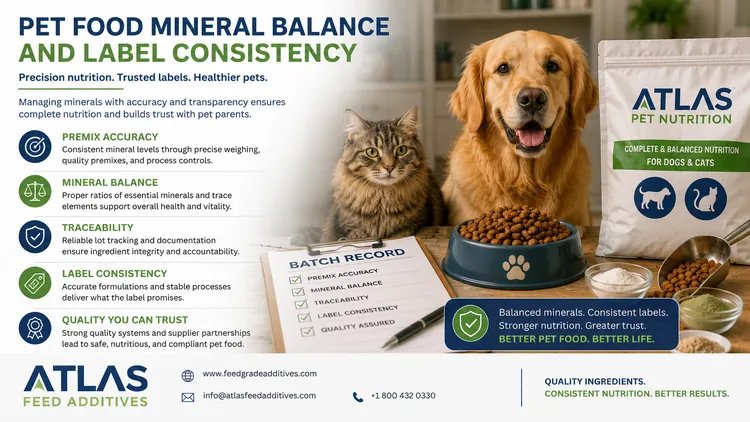
Feed additive decisions are strongest when they begin with a clear production objective. Pet Food Mineral Balance and Label Consistency is not a single-product decision; it is a practical process of matching animal needs, product format, raw material variation, premix accuracy, processing conditions, quality control, and the commercial target.
Why this topic matters
Minerals are included at relatively small levels, but they can have a major impact on nutritional positioning, label declarations, product consistency, and customer trust. In companion animal diets, mineral balance must be managed carefully because the finished product is expected to match the intended formula across many batches, not only during one production run.
Managing premix accuracy and traceability in companion animal diets requires attention to ingredient quality, weighing precision, mixing uniformity, carryover control, storage, documentation, and finished product testing. In real operations, results depend on raw material variability, product format, processing method, packaging, shelf-life, and how consistently the premix is applied.
Practical approach
- Review mineral balance, label consistency, oxidation control, palatability, and digestive support together rather than as separate issues.
- Use mineral sources and premix formats suitable for the finished product format, including kibble, wet food, treats, or specialty diets.
- Check weighing accuracy, mixer performance, premix homogeneity, carryover risk, and traceability before scaling to commercial production.
- Track shelf-life, aroma, stool quality, customer feedback, label compliance, retained samples, and batch-to-batch analytical results.
Mineral source and premix considerations
Trace minerals and specialty minerals may differ in concentration, particle size, carrier system, solubility, reactivity, and handling behavior. These details can affect how easily the mineral source is incorporated into a premix and how consistently it appears in finished product analysis.
Buyers should review whether the mineral source is appropriate for the target species, product type, and processing conditions. For example, a dry kibble application may place more emphasis on premix flowability and heat exposure, while a wet product or treat may require closer attention to moisture, ingredient interactions, and finished product stability.
Label consistency and traceability
Label consistency depends on more than the declared mineral values in the formula. It also depends on raw material contribution, premix accuracy, production records, analytical variation, and the quality system used to connect supplier documents with finished batches. A strong documentation process helps teams respond faster when there are questions from customers, distributors, or regulatory reviewers.
Traceability should connect each mineral or premix lot to the production batch, retained sample, certificate of analysis, and destination-market documentation. This becomes especially important for export programs, private-label production, and premium pet food lines where label claims and batch reliability are closely reviewed.
Product groups to review
Depending on the challenge, the following product group may be worth reviewing with your nutrition, technical, quality, or procurement team:
Buyer checklist
Before ordering, request the product specification, certificate of analysis, shelf-life, storage conditions, recommended inclusion range, packaging details, and destination-market documents. For mineral products, also review mineral concentration, source type, particle size, carrier, flowability, heavy metal limits where relevant, country-specific documentation, and compatibility with the finished recipe.
For commercial trials, define the baseline, control group, production batches, performance indicators, and review period before the additive is introduced. Useful indicators may include finished product mineral analysis, premix uniformity checks, retained sample review, batch record accuracy, label verification, shelf-life observations, customer feedback, and comparison between pilot and commercial production.
How Atlas Feed Additives can support
Atlas Feed Additives can help buyers compare feed-grade additive options, coordinate supplier documentation, and structure inquiries for international shipments. We can support discussions around mineral source selection, premix documentation, packaging preference, label consistency, product format, and destination-market requirements.
Send the target species, product format, current challenge, mineral group, expected quantity, destination country, label requirements, and required documents so we can review the request efficiently.