Organic acids and acidifiers

Tributyrin

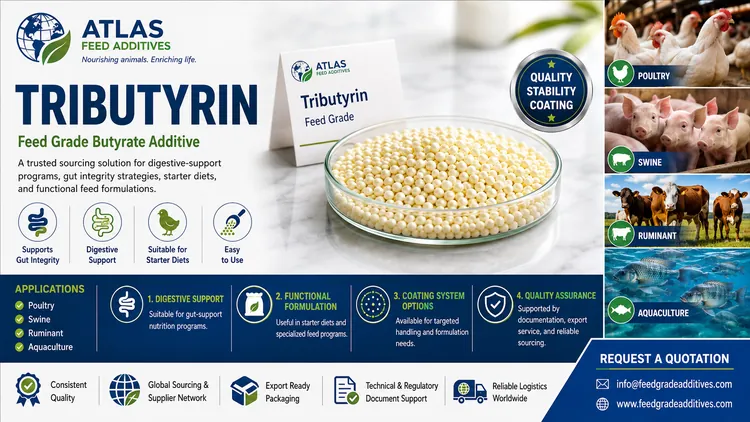
Tributyrin is a feed-grade butyrate additive used in digestive-support, gut integrity, starter diet, and functional nutrition programs. Atlas Feed Additives helps buyers compare Tributyrin specifications, active content, coating systems, carrier options, documentation, packaging, and export-ready supply routes before quotation.

Tributyrin feed additive visual

Product role

Where Tributyrin fits in feed formulation

Tributyrin, also known as glycerol tributyrate, is a triglyceride form of butyric acid used in animal nutrition where formulators want a butyrate source with different handling and release characteristics than free butyric acid or butyrate salts. It is commonly evaluated within organic acid, acidifier, gut-support, postbiotic-support, young animal nutrition, and antibiotic-reduction strategy programs.

In feed procurement, the name “Tributyrin” alone is not sufficient for technical approval. Buyers should verify the declared Tributyrin content, butyric acid equivalent, carrier or matrix, coating or encapsulation system, free-flowing properties, odor profile, thermal stability, shelf-life, particle size, release target, and compatibility with the intended species and production process.

Atlas Feed Additives can coordinate international supplier options for feed mills, premix producers, distributors, integrators, and trading companies that need feed-grade material supported by clear commercial and technical documentation.

Identity and composition

What buyers normally verify

Commercial Tributyrin products may differ significantly by purity, concentration, carrier, coating system, manufacturing route, odor management, and release profile. Some offers are high-concentration Tributyrin materials, while others are diluted or protected blends designed for easier handling, targeted release, or improved mixing in premix and complete feed.

  • Declared Tributyrin percentage or active content
  • Butyric acid equivalent or calculated butyrate contribution
  • Carrier type, matrix type, coating material, or encapsulation technology
  • Physical form, particle-size range, bulk density, and flowability
  • Odor profile and handling precautions during batching or premix production
  • Moisture, ash, fat, impurities, and microbiological data where required
  • Heat stability and pelleting compatibility data if the product will be pelleted
  • Shelf-life, storage conditions, batch number, production date, and expiry date

Procurement relevance

Why specification alignment matters

Tributyrin pricing can look very different depending on whether the offer is based on pure Tributyrin, a protected blend, a coated powder, a liquid product, or a lower-concentration carrier-based formulation. A meaningful comparison should be made on active content, release characteristics, inclusion cost, and suitability for the final feed process.

  • Confirm whether the offered product is suitable for feed use in the destination country.
  • Ask whether the COA reports Tributyrin content, butyric acid equivalent, or both.
  • Review carrier and coating information because it affects active concentration and release behavior.
  • Check whether the product can tolerate pelleting, extrusion, storage, or liquid application if relevant.
  • Compare cost per kilogram of active Tributyrin, not only price per metric ton.
  • Verify whether supplier documents match your importer, customs, registration, and quality-control requirements.

Typical applications

Use areas in animal nutrition and feed manufacturing

Tributyrin may be evaluated for animal nutrition programs where butyrate delivery, digestive support, intestinal integrity, feed efficiency strategy, young animal resilience, and functional additive planning are important. Final inclusion should always be determined by a qualified nutritionist or formulation team according to species, life stage, diet composition, regulatory status, product concentration, and processing conditions.

Poultry feed

Tributyrin may be used in broiler, layer, breeder, turkey, and other poultry programs where the formulation objective includes gut-support strategies, starter performance, intestinal integrity, litter-management support through better nutrition planning, and acidifier or butyrate-source comparison.

Swine feed

It is often evaluated in piglet, nursery, grower, finisher, sow, and transition programs where nutritionists are reviewing digestive support, post-weaning challenges, palatability considerations, feed hygiene strategy, and alternatives to standard acidifier systems.

Ruminant feed

Buyers may review Tributyrin for calves, dairy cattle, beef cattle, sheep, and goats when functional additive programs require careful comparison of digestive-support ingredients, protected forms, rumen considerations, and downstream intestinal delivery.

Aquaculture feed

Tributyrin can be considered in fish and shrimp feed where nutrition teams evaluate gut-support additives, feed conversion strategy, stress-related feeding programs, water-stable pellets, extrusion compatibility, and controlled release in the digestive tract.

Pet food and specialty feed

In pet food and specialty diets, Tributyrin may be reviewed for digestive-support formulas, functional claims that are permitted in the target market, odor-controlled handling, palatability, and compatibility with extrusion or coating systems.

Premix production

Premix manufacturers usually evaluate bulk density, dust level, odor, carrier compatibility, vitamin and enzyme compatibility, flowability, segregation risk, and packaging before approving Tributyrin for regular premix inclusion.

Technical buying guide

Common specification points to request

Exact values should be taken from the supplier's current specification and certificate of analysis. The table below is a practical buyer checklist for comparing Tributyrin offers before price negotiation, sample approval, shipment booking, or contract confirmation.

Tributyrin procurement checklist
Parameter Why it matters What to request
Tributyrin content Confirms the active ingredient level and helps compare concentrated products with diluted blends. Declared minimum or typical Tributyrin percentage, test method, and COA value.
Butyric acid equivalent Helps nutritionists compare different butyrate sources on a functional basis. Calculated butyric acid equivalent or supplier explanation of the conversion basis.
Carrier or matrix Affects active concentration, flowability, blending, release behavior, and labeling. Carrier name, carrier percentage where available, and declaration status for the target market.
Coating or encapsulation Influences odor control, handling, pelleting stability, and release location. Coating type, protected percentage, release profile, and processing recommendations.
Physical form Determines whether the product suits premix, mash feed, pellets, liquid feed, or top-dressing. Powder, granule, coated granule, beadlet, liquid, or other commercial form.
Particle size Affects mixing uniformity, segregation risk, dust, and dosing accuracy. Sieve analysis, particle-size distribution, bulk density, and flowability data.
Odor control Butyrate products can be odor-sensitive, which affects handling and operator acceptance. Odor-management information, coating details, and storage/handling precautions.
Heat stability Important for pelleting, extrusion, and feed processing environments. Recommended processing temperature, retention data if available, and pelleting guidance.
Moisture Impacts shelf-life, caking risk, flowability, and storage stability. Moisture or loss-on-drying value and maximum specification limit.
Microbiological profile May be required by quality teams or certain destination markets. Total plate count, yeast and mold, salmonella status, or other buyer-specific tests if required.
Contaminants Supports feed-grade approval, importer review, and risk management. Heavy metals, dioxins, PCBs, residual solvents, or other contaminants requested by the buyer.
Origin and manufacturer Supports traceability, supplier approval, and import documentation. Country of origin, production site information, batch number, and traceability data.
Packaging Protects active content and helps prevent odor, moisture, leakage, or contamination issues. Bag type, drum, carton, inner liner, palletization, net weight, and container loading plan.
Shelf-life and storage Helps buyers plan inventory rotation and avoid performance loss during storage. Production date, expiry or retest date, recommended temperature, and storage conditions.
Compliance documents Supports buyer approval, registration, customs, and market access. Specification, COA, SDS, origin statement, feed-grade declaration, and market-specific certificates.

Quality and compliance

Documents to request before confirming an order

Feed-grade Tributyrin should be approved through documented quality, not only by trade name or supplier description. Atlas Feed Additives can help buyers organize document requests so purchasing, nutrition, quality assurance, regulatory, and import teams can review the same information before order confirmation.

  • Product specification sheet with declared active content and physical properties
  • Certificate of analysis for the offered batch or representative production lot
  • Safety Data Sheet with handling, storage, and transport guidance
  • Feed-grade or feed-use declaration when required by the buyer
  • Carrier, coating, encapsulation, or matrix information where applicable
  • Country of origin and manufacturer or production-site information where available
  • Heavy metal, microbiological, residual solvent, dioxin, PCB, or contaminant data when required
  • GMO, allergen, irradiation, animal-origin, or other declarations when relevant
  • Halal, ISO, GMP+, FAMI-QS, HACCP, or other certificates if required by the customer
  • Packing list, commercial invoice, bill of lading, and export documents for shipment

Formulation considerations

Questions for the nutrition team

Tributyrin should be evaluated within the total feed program, not in isolation. The final decision depends on active content, target animal, life stage, feed intake, diet composition, health-management program, processing conditions, and whether the nutrition team wants fast release, delayed release, or protected butyrate delivery.

  • What is the target species, age group, and production stage?
  • Is the formula designed for starter feed, grower feed, breeder feed, lactation feed, or transition feed?
  • Is the objective digestive support, gut integrity, feed efficiency strategy, hygiene support, or stress-period nutrition?
  • Will Tributyrin replace or complement sodium butyrate, calcium butyrate, organic acids, probiotics, enzymes, or phytogenic additives?
  • Does the product need gastric release, intestinal release, or a protected release profile?
  • Will the ingredient be exposed to pelleting, extrusion, steam conditioning, liquid application, or long storage?
  • Does the target market allow the intended label claim and use level?

Manufacturing considerations

Handling in feed mills and premix plants

Physical performance is critical for Tributyrin because different commercial forms can behave differently during dosing, mixing, pelleting, storage, and transport. A suitable product should match the plant's equipment and operator expectations as well as the nutrition program.

  • Check whether the powder, granule, coated beadlet, or liquid format fits the dosing system.
  • Review odor level, dust level, and operator handling requirements.
  • Confirm whether the product will remain free-flowing during storage and batching.
  • Evaluate compatibility with vitamins, enzymes, probiotics, amino acids, minerals, and acidifiers.
  • Check heat stability before using in pelleted or extruded feeds.
  • Store in a cool, dry, covered, well-ventilated area away from moisture and strong odors.
  • Use first-in, first-out inventory rotation according to production date and shelf-life.
  • Keep opened bags, drums, or containers sealed to protect active content and reduce odor escape.

Product forms

Commercial formats buyers may compare

Tributyrin can be supplied in different formats depending on supplier technology and application target. Each form has advantages and trade-offs, so the purchasing team should confirm what the nutritionist and feed plant actually need before requesting a final quote.

High-concentration Tributyrin

Used when the buyer wants a higher active-content product and can manage the handling, dosing, and physical characteristics. Compare assay, purity, odor, packaging, and storage requirements carefully.

Coated or protected Tributyrin

Designed to improve handling, odor control, processing behavior, and targeted release. Buyers should request coating type, active content after coating, release data, and pelleting stability information.

Carrier-based powder

Often used for easier blending in premix or complete feed. The carrier can affect active concentration, dust, flowability, labeling, and cost per active unit.

Granular or beadlet form

May help reduce dust and improve flow in some plants. Buyers should check particle size, segregation risk, bulk density, and dosing compatibility.

Liquid Tributyrin

Where available, liquid forms may be used in specific liquid-feed, top-coating, or blending systems. Buyers should review viscosity, pumpability, packaging, temperature sensitivity, and handling precautions.

Blended gut-support formulas

Some products combine Tributyrin with organic acids, essential oils, phytogenic compounds, probiotics, or carriers. Compare the full formula, active claims, regulatory status, and label requirements.

Packaging and logistics

Export-ready supply planning

Atlas Feed Additives supports buyers that need practical export coordination as well as product sourcing. For Tributyrin, packaging and logistics should be agreed before shipment because odor management, moisture protection, active-content stability, bag strength, pallet use, container loading, and document timing can affect total landed cost and receiving quality.

Common packaging options

Depending on supplier availability, offers may include foil bags, laminated bags, kraft bags with inner liner, cartons, drums, pails, jumbo bags, palletized cargo, or non-palletized container loading. The final option should match the product form and warehouse handling system.

Shipment details to confirm

Confirm net weight per package, gross weight, pallet dimensions, container loading quantity, shipping marks, production batch, shelf-life, country of origin, Incoterms, port of loading, port of discharge, and estimated lead time.

Document timing

Buyers should agree when draft documents will be shared, who approves the certificate format, whether legalization is required, and whether any country-specific registration, health, or feed certificate must be prepared before departure.

Storage protection

Tributyrin products should be protected from moisture, excess heat, direct sunlight, contamination, damaged packaging, and prolonged exposure after opening. Follow the supplier's Safety Data Sheet and shelf-life guidance.

Warehouse handling

Keep products sealed, avoid strong-smelling storage areas, use clean pallets, prevent floor contact, separate damaged packages, and rotate stock on a first-in, first-out basis.

Import review

Importers should confirm product classification, feed-use status, label language, documentation format, and any registration requirement before the shipment is dispatched.

Commercial comparison

Ask for the right specification before comparing prices

Price comparisons are meaningful only when active content, butyric acid equivalent, carrier, coating system, release profile, physical form, packaging, origin, documentation, and freight terms are aligned. A lower price per metric ton may not be economical if the active concentration is lower, release profile is unsuitable, or the product cannot tolerate the buyer's feed processing conditions.

For sensitive or regulated markets, buyers should review shelf-life, odor control, storage conditions, traceability, contaminant data, permitted feed-use status, labeling requirements, and compatibility with pelleting, extrusion, premix blending, or liquid application before confirming regular supply.

Quotation preparation

Information to include in your RFQ

A complete request helps Atlas Feed Additives respond faster and prevents mismatched offers. When requesting Tributyrin, please share the technical, commercial, and logistics details that matter for your species program, processing system, and destination market.

Technical details

  • Required Tributyrin content or butyric acid equivalent
  • Preferred format: pure, coated, protected, carrier-based, granule, powder, or liquid
  • Target species, life stage, and feed application
  • Required release profile or coating technology, if specified by nutrition team
  • Particle size, bulk density, odor-control, and flowability requirements
  • Heat stability requirement for pelleting, extrusion, or steam conditioning
  • Required certificates and declaration formats

Commercial details

  • Target quantity and expected order frequency
  • Trial order, spot order, or annual contract plan
  • Preferred currency and payment term
  • Target price basis, if available
  • Requested Incoterms such as EXW, FOB, CFR, CIF, or DAP
  • Sample requirement, approval procedure, and expected approval timeline

Logistics details

  • Destination country and final delivery point
  • Preferred port of discharge or airport if urgent
  • Bag, drum, carton, pallet, or container loading preference
  • Required shipping marks and labeling language
  • Deadline for shipment, arrival, or customs clearance
  • Any legalization, inspection, or registration document required before shipment

Questions

Useful answers

What is Tributyrin used for in animal nutrition?

Tributyrin is used as a functional feed additive in digestive-support, gut integrity, starter diet, young animal, stress-period, and performance-focused nutrition programs. It should be used according to target species, formulation objective, feed processing conditions, product specification, and applicable market rules.

Can Atlas Feed Additives quote Tributyrin?

Yes. Send your required specification, quantity, destination, packaging preference, target Incoterms, required documents, and intended application so Atlas Feed Additives can review suitable supplier options for Tributyrin.

What quality documents should buyers request for Tributyrin?

Common documents include specification, certificate of analysis, safety data sheet, origin information, batch details, feed-grade declaration, carrier or coating information, shelf-life statement, storage guidance, and any market-specific certificates required by the buyer.

Is Tributyrin the same as sodium butyrate or calcium butyrate?

No. Tributyrin is a glyceride form of butyric acid, while sodium butyrate and calcium butyrate are butyrate salts. They may differ in active content, odor, release behavior, handling, solubility, coating needs, and application cost. A nutritionist should approve any substitution.

Which species can use Tributyrin?

Tributyrin may be evaluated for poultry, swine, ruminants, aquaculture, pets, and other animals depending on the formula, species requirements, local regulations, active concentration, and product specification. Final use should follow the target market's feed rules and nutrition program.

What is the most important factor when comparing Tributyrin offers?

The most important factor is active specification alignment. Buyers should compare Tributyrin content, butyric acid equivalent, carrier, coating system, release profile, particle size, odor control, heat stability, packaging, documents, Incoterms, lead time, and total landed cost before choosing a supplier.

Does Tributyrin need to be coated?

Not always. Some applications may use non-coated material, while others may require coating or encapsulation for odor control, handling, pelleting stability, or targeted release. The right choice depends on the formula, species, processing conditions, and nutrition objective.

Can Tributyrin be used in pelleted feed?

It may be used in pelleted feed when the selected product has suitable heat stability and processing compatibility. Buyers should request supplier data for pelleting conditions, active retention, coating stability, and recommended handling.

How should Tributyrin be stored?

Store in a cool, dry, clean, covered, and well-ventilated warehouse. Keep packaging sealed, protect the product from moisture, heat, direct sunlight, contamination, and strong odors, and follow the supplier's shelf-life and Safety Data Sheet.

Can Atlas Feed Additives help with export documents?

Atlas Feed Additives can coordinate document requests with supplier options and help buyers clarify required commercial, technical, and shipment documents before order confirmation.

Request a quotation

Tell us what you need

Send your product list, target specification, destination country, packaging preference, and required documents. Our team will review your request and respond from orders@feedgradeadditives.com.

For the fastest review, include Tributyrin content, butyric acid equivalent, preferred coating system, target species, feed application, heat-stability needs, target quantity, delivery deadline, port of discharge, Incoterms, and any certificate format required by your market.