Ruminant performance and environmental additives

Nitrate Feed Additive

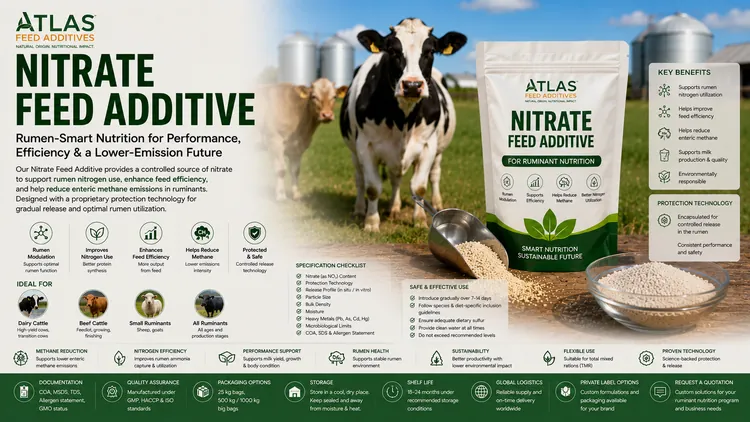
Nitrate Feed Additive is a specialty ruminant additive selected for controlled dairy, beef, feedlot, transition-cow, high-yield, rumen-stability, and emissions-focused nutrition programs where active concentration, delivery technology, adaptation, safety guidance, and market authorization must be reviewed carefully.

Nitrate Feed Additive visual

Product role

Where Nitrate Feed Additive fits

Nitrate Feed Additive is part of the ruminant performance and environmental additives group. In ruminant nutrition, nitrate products may be evaluated as specialty nitrogen-containing ingredients in carefully controlled programs where rumen fermentation, environmental positioning, and performance objectives are managed by qualified nutritionists.

Commercial nitrate feed additives may be supplied as feed-grade nitrate salts, calcium nitrate preparations, nitrate-mineral blends, encapsulated nitrate, protected nitrate, controlled-release granules, or premix-ready formulations. The correct product depends on the animal species, diet design, active nitrate concentration, release profile, adaptation protocol, safety margin, feeding system, and destination-market authorization.

Because nitrate metabolism in ruminants can involve nitrite as an intermediate, this product category requires careful specification, controlled inclusion, gradual adaptation, uniform mixing, and professional review. Atlas Feed Additives can coordinate international supplier options for feed mills, premix producers, dairy and beef integrators, environmental-feed programs, distributors, and private-label ruminant additive brands that require documented feed-grade material.

Ruminant nutrition role

Why nitrate additives are evaluated in ruminant programs

Nitrate feed additives are mainly evaluated in ruminant systems because rumen microbes can use alternative hydrogen sinks during fermentation. In some nutrition strategies, nitrate is assessed as part of methane-reduction or rumen-modulation programs, but it must be used with careful attention to conversion pathways, nitrite risk, dietary balance, animal adaptation, and local authorization.

In practical feed manufacturing, nitrate products are not evaluated only by product name. Buyers need to know the nitrate source, active level, nitrogen equivalent, release technology, carrier, particle size, mixing behavior, target species, inclusion guidance, safety documents, and whether the product is intended for dairy cows, beef cattle, feedlot finishing, or another ruminant application.

Practical value

Procurement-focused benefits

  • Supports specialized ruminant nutrition programs where nitrate use is authorized and professionally managed.
  • Can be evaluated in methane-reduction or environmental-positioning programs where local regulations allow suitable claims.
  • May be used in controlled dairy, beef, feedlot, transition, or high-yield programs when the diet and adaptation plan are appropriate.
  • Can be requested with protected, encapsulated, or controlled-release technology to support safer handling and targeted rumen delivery.
  • Allows buyers to compare suppliers by active concentration, release profile, particle size, carrier, stability, safety guidance, and documentation.
  • Can be sourced with COA, SDS, technical sheet, origin information, batch traceability, and market-specific regulatory documents.

Typical applications

Species, feed types, and controlled use situations

Nitrate Feed Additive should be considered only in professionally formulated ruminant programs where the product is authorized, dose guidance is clear, and adaptation is managed. Final suitability depends on species, ration composition, nitrogen balance, sulfur status, forage nitrate load, feeding system, animal health, and supplier instructions.

  • Dairy cow programs where environmental nutrition, high-yield performance, or controlled rumen fermentation is part of the formulation objective.
  • Transition-cow and early-lactation programs only where the supplier and nutritionist confirm suitability and safety margins.
  • Beef cattle and feedlot finishing rations where nitrate use is authorized and gradually adapted.
  • Rumen-modulation programs where hydrogen balance and methane-emissions positioning are evaluated under professional supervision.
  • Mineral premixes, concentrates, or complete feeds that require uniform distribution and strict inclusion control.
  • Research, pilot, or sustainability-focused feed programs where methane reduction claims must be supported by approved local rules.
  • Custom ruminant additive blends using nitrate together with buffers, yeast products, organic acids, protected nutrients, or other specialty ingredients where compatibility is confirmed.

Safety and adaptation

Controlled use is essential for nitrate feed additives

Nitrate products require more careful management than many routine feed additives. In ruminants, nitrate can be reduced to nitrite in the rumen before further reduction. If nitrite formation exceeds the animal's ability to convert it safely, nitrite accumulation can create serious animal-health risk. For this reason, nitrate feed additives must never be handled as ordinary mineral fillers or simple nitrogen sources without clear supplier guidance.

Key safety control points

  • Use only products intended and authorized for feed use in the destination market.
  • Follow the supplier's maximum inclusion rate and step-up adaptation protocol.
  • Introduce gradually and avoid sudden ration changes that increase nitrate exposure.
  • Calculate total nitrate exposure from additive, forage, water, byproducts, and other ration components.
  • Ensure uniform mixing to prevent pockets of high nitrate concentration.
  • Use appropriate carrier, coating, or controlled-release technology when required by the program.
  • Do not use in unadapted animals without a professional adaptation plan.
  • Review animal health status, feed intake consistency, and risk factors before inclusion.
  • Confirm veterinary or nutritionist oversight for commercial use.
  • Maintain emergency response guidance and batch traceability.

Buyer quality checklist

What to confirm before comparing Nitrate Feed Additive offers

Nitrate products should not be compared by price per kilogram alone. Two offers can differ significantly in active nitrate level, nitrate nitrogen contribution, source material, coating or encapsulation, release profile, carrier, particle size, dust level, uniformity, safety guidance, adaptation protocol, and regulatory status.

Technical specification points

  • Declared product type: nitrate feed additive, calcium nitrate preparation, protected nitrate, encapsulated nitrate, controlled-release nitrate, or nitrate-containing ruminant blend.
  • Nitrate source and chemical identity.
  • Active nitrate concentration and analytical method.
  • Nitrate nitrogen equivalent and contribution to total dietary nitrogen.
  • Calcium, sodium, potassium, or other mineral contribution depending on nitrate source.
  • Protection technology, coating system, encapsulation, or controlled-release method, if used.
  • Release profile and rumen delivery information where available.
  • Carrier material and feed-grade suitability.
  • Physical form: powder, granule, pellet, coated particle, beadlet, premix, or mineral blend.
  • Particle size, bulk density, flowability, dusting tendency, and segregation risk.
  • Mixing uniformity guidance and minimum inclusion accuracy.
  • Recommended inclusion rate, maximum inclusion level, and step-up adaptation protocol.
  • Species and production-stage authorization.
  • Compatibility with minerals, buffers, urea, protein meals, protected nutrients, yeast products, ionophores where permitted, and other additives.
  • Stability during storage, pelleting, extrusion, mineral block production, or liquid application when relevant.
  • Moisture sensitivity, hygroscopicity, caking risk, and warehouse handling requirements.
  • Safety information, hazard classification, and worker-handling precautions.
  • Contaminant controls and undesirable substance limits required by the destination market.
  • Packaging size, liner type, moisture barrier, pallet configuration, and batch traceability.

Formulation design

How buyers define the right nitrate specification

The best Nitrate Feed Additive specification depends on the target ruminant species, total mixed ration design, forage nitrate level, protein system, energy level, sulfur supply, adaptation capacity, feeding frequency, and methane-reduction or performance objective. A dairy TMR, beef finishing ration, transition-cow ration, and environmental pilot program may require different source forms and safety controls.

  • Define the target species and production stage before requesting a quote.
  • Specify whether the product must be protected, encapsulated, or controlled-release.
  • Request active nitrate concentration and nitrate nitrogen equivalent.
  • Share the intended feed form: TMR, concentrate, premix, mineral product, pellet, block, tub, or top-dress.
  • Confirm whether the product is for dairy cows, beef cattle, feedlot finishing, or another ruminant group.
  • Review total dietary nitrate from forages, water, and other ingredients.
  • Confirm adaptation period, step-up schedule, and monitoring responsibilities.
  • Check local authorization for nitrate source, target species, dose, and methane-reduction or environmental claims.

Processing notes

Feed manufacturing factors that affect nitrate additive value

Nitrate feed additives require strong attention to mixing, storage, segregation, and worker handling. Uniform distribution is essential because uneven mixing can create localized high-concentration areas. Product selection should consider the feed mill's dosing accuracy, mixer validation, premix sequence, packaging, moisture control, and final feed format.

  • Confirm whether the product is suitable for complete feed, premix, concentrate, mineral blend, pellet, block, tub, or top-dress use.
  • Check flowability and dusting tendency for automated dosing and worker handling.
  • Review particle size and density to reduce segregation risk in premixes and finished feeds.
  • Ask whether the product is compatible with minerals, buffers, urea, molasses, fats, oils, yeast products, protected nutrients, and other additives.
  • Confirm whether moisture sensitivity or caking affects storage and blending.
  • Review heat stability if the product will pass through pelleting, drying, or block manufacturing.
  • Use validated mixing procedures and appropriate sequencing to improve homogeneity.
  • Follow supplier guidance for shelf life, opened-package use, and warehouse storage.

Procurement note

Ask for the right specification before comparing prices.

Price comparisons are meaningful only when nitrate source, active concentration, nitrate nitrogen equivalent, carrier, protection technology, release profile, particle size, packaging, origin, shelf life, storage conditions, adaptation instructions, and documentation are aligned. For sensitive nitrate products, buyers should also review safety instructions, species authorization, dose limits, mixing uniformity, total dietary nitrate exposure, and destination-market regulatory requirements.

For export orders, confirm regulatory status, permitted source names, maximum inclusion levels, species authorization, label wording, import documents, safety statements, and permitted claims before purchase. Atlas Feed Additives can help organize supplier communication so each quotation is evaluated against the same technical, safety, and commercial basis.

Documentation

Documents commonly requested for Nitrate Feed Additive

Document requirements vary by destination country, product form, nitrate source, target species, final label claim, and whether the product is supplied as a simple feed-grade source, protected additive, premix blend, or private-label ruminant product. Buyers should confirm required documents before order confirmation so the supplier can verify availability and lead time.

Quality and technical documents

  • Product specification sheet.
  • Certificate of analysis for the supplied batch.
  • Safety data sheet.
  • Active nitrate concentration declaration.
  • Nitrate nitrogen equivalent and mineral contribution statement.
  • Source identity and feed-grade status declaration.
  • Protection, coating, encapsulation, or release-profile information where applicable.
  • Recommended inclusion rate and maximum inclusion guidance.
  • Adaptation protocol and safe-use instructions.
  • Mixing uniformity and feed manufacturing guidance.
  • Heat-stability, moisture-stability, and storage-stability data where available.
  • Batch number, production date, retest date, and expiry date.
  • Storage and handling instruction sheet.
  • Product label or draft label for approval.
  • Heavy metal, microbiological, dioxin, PCB, residual solvent, or undesirable substance statements when required by the buyer.
  • Emergency handling or veterinary safety guidance where provided by the supplier.

Trade and shipment documents

  • Commercial invoice and packing list.
  • Certificate of origin, if required.
  • Health certificate, free sale certificate, or veterinary-related documents when applicable.
  • Bill of lading, airway bill, or road transport document depending on shipment mode.
  • Insurance certificate when required by Incoterms.
  • Import registration or buyer-specific declaration forms.
  • Private-label artwork approval and label compliance documents.
  • Dangerous goods or transport classification review if required by product form and shipping rules.
  • Halal, kosher, ISO, GMP+, FAMI-QS, HACCP, or other quality certificates when available and required.

Packaging and storage

Handling nitrate feed additives correctly

Because nitrate products require reliable traceability, moisture control, safety labeling, and uniform dosing, packaging and storage conditions are important purchasing details. Buyers should confirm the recommended storage temperature, moisture protection, shelf life, transport classification, and opened-package handling before shipment.

  • Keep the product in unopened packaging until it is ready for use.
  • Protect from moisture, direct sunlight, excessive heat, and repeated temperature cycling.
  • Store separately from incompatible materials when required by the safety data sheet.
  • Follow the supplier's storage temperature and expiry guidance.
  • Reseal opened packs quickly if partial use is allowed by the supplier.
  • Check whether ambient, cool, dry, or controlled storage is recommended.
  • Confirm whether the product is suitable for sea freight, air freight, or road transport.
  • Use appropriate worker-handling precautions, dust control, PPE, and spill procedures.
  • Review warehouse rotation and first-expiry-first-out control for specialty ruminant additives.

Formulation compatibility

Questions for premix and private-label buyers

When Nitrate Feed Additive is used in a premix, mineral product, feedlot concentrate, dairy TMR package, or private-label ruminant additive, buyers should confirm compatibility with all ingredients and processing conditions. Safety and uniformity are the main priorities.

  • Is the nitrate additive compatible with the planned carrier and premix base?
  • Can it be blended with buffers, macro minerals, trace minerals, protected choline, protected amino acids, yeast products, organic acids, enzymes, or other additives?
  • Will the product remain stable and uniform for the required shelf life?
  • Does the product tolerate the expected feed mill temperature and processing conditions?
  • Is the powder, granule, coated particle, or premix form suitable for the buyer's dosing system?
  • Are label claims and nitrate declarations approved for the destination market?
  • Does the product need additional safety labeling, separate storage, or special transport review?

Quotation request guide

Information to send for a faster Nitrate Feed Additive offer

Atlas Feed Additives can review supplier options more efficiently when the request includes both technical and commercial details. If you do not yet have a final specification, send the target species, feed type, nitrate source preference, active level, processing conditions, and destination country so the team can help identify the missing parameters.

Technical details

  • Required product name: Nitrate Feed Additive.
  • Target product form: feed-grade nitrate salt, calcium nitrate preparation, protected nitrate, encapsulated nitrate, controlled-release granule, premix, or custom blend.
  • Target species: dairy cows, beef cattle, feedlot cattle, calves, sheep, goats, or other ruminants where authorized.
  • Target feed type: TMR, concentrate, mineral premix, pellet, block, tub, top-dress, or complete feed.
  • Required active nitrate concentration and nitrate nitrogen equivalent.
  • Required protection or controlled-release technology.
  • Main objective: methane-reduction program, environmental feed positioning, rumen modulation, controlled nitrogen supply, high-yield dairy support, feedlot finishing program, or custom ruminant package.
  • Existing nitrate exposure from forage, water, or other ingredients if available.
  • Expected inclusion rate, adaptation protocol, or request for supplier recommendation.
  • Feed manufacturing process and mixing system.
  • Required documents and certificates.
  • Destination-market regulatory, safety, label, and claim requirements.

Commercial details

  • Required order quantity or annual forecast.
  • Destination country and delivery address or port.
  • Preferred Incoterms and shipment method.
  • Packaging preference and pallet requirements.
  • Target delivery date or seasonal demand window.
  • Private-label, neutral-label, or Atlas-coordinated supplier-label requirement.
  • Buyer company details for proforma invoice preparation.
  • Sample request details, including sample quantity, target formula, and testing timeline.

Technical buying notes

Important points for feed additive distributors and ruminant buyers

Active nitrate level matters

Nitrate feed additives should be compared by active nitrate concentration, nitrate nitrogen contribution, and recommended dose. A low-cost product may not be suitable if the active level, release profile, or safety guidance is not aligned with the target program.

Release technology matters

Unprotected nitrate, protected nitrate, encapsulated nitrate, and controlled-release nitrate products can behave differently in the rumen and feed manufacturing process. Buyers should confirm the delivery technology and release-profile information before purchase.

Adaptation matters

Animals should not be exposed to sudden nitrate increases without a professional plan. Gradual adaptation, total nitrate calculation, feed intake monitoring, and ration consistency are central to responsible nitrate use.

Regulatory wording matters

Nitrate source names, species authorization, maximum levels, environmental claims, methane-reduction claims, and safety statements vary by country. Buyers should confirm whether the final label can use the intended product name and claims in the destination market.

Questions

Useful answers

What is Nitrate Feed Additive used for in animal nutrition?

Nitrate Feed Additive is selected for controlled ruminant nutrition programs such as dairy, beef, feedlot, rumen-modulation, and emissions-focused programs where nitrate use is authorized and professionally formulated. It should be used according to the target species, supplier instructions, adaptation guidance, and applicable market rules.

Why does nitrate require careful adaptation?

Nitrate can be reduced to nitrite in the rumen. If nitrite accumulates faster than it is safely converted, animal-health risk can occur. Gradual adaptation, uniform mixing, total nitrate calculation, and professional supervision are essential.

Can Nitrate Feed Additive be used in dairy cows?

It may be evaluated in dairy cow programs where the product is authorized, the ration is professionally formulated, and adaptation is controlled. Buyers should confirm suitability for transition cows, high-yield cows, or lactating cows before use.

Can Nitrate Feed Additive be used in beef cattle or feedlot rations?

It may be considered in beef and feedlot programs when the source, dose, adaptation schedule, total dietary nitrate, and local authorization are properly reviewed by a qualified nutritionist or veterinarian.

Is protected or encapsulated nitrate better than unprotected nitrate?

The best form depends on the feeding system and supplier data. Protected or encapsulated forms may help manage release profile and handling, but buyers should compare active concentration, release data, stability, safety instructions, and cost-in-use before deciding.

What specification should buyers request?

Buyers should request nitrate source, active nitrate concentration, nitrate nitrogen equivalent, mineral contribution, carrier, protection technology, release profile, inclusion guidance, adaptation protocol, maximum dose, mixing instructions, shelf life, storage conditions, and required documents.

What quality documents should buyers request for Nitrate Feed Additive?

Common documents include a specification sheet, certificate of analysis, safety data sheet, active nitrate declaration, source declaration, release-profile information where applicable, batch number, manufacturing date, expiry date, storage instructions, origin information, safety guidance, and any market-specific certificates required by the buyer.

Can Atlas Feed Additives quote Nitrate Feed Additive?

Yes. Send your target species, feed type, required active concentration, source preference, protection technology, required quantity, destination country, packaging preference, shipment terms, and documents so Atlas Feed Additives can review suitable supplier options.

What should I include in the message when requesting a price?

Please include target species, ration type, nitrate source preference, active nitrate requirement, protection technology, order quantity, destination country, packaging preference, required documents, and whether the product is for resale, premix production, private label, or direct feed mill use.

Can Nitrate Feed Additive be supplied under private label?

Private-label availability depends on supplier capability, order quantity, product form, packaging format, label wording, safety statements, active declaration, artwork approval, and destination-market rules. Atlas Feed Additives can review private-label options when the buyer provides the required label and regulatory details.

Can nitrate be combined with other ruminant additives?

Nitrate may be used in broader ruminant programs with protected nutrients, buffers, yeast products, minerals, or other additives when compatibility, safety, and regulatory requirements are confirmed. The total ration must be reviewed before use.

Request a quotation

Tell us what you need

Send your product list, target specification, nitrate source preference, active concentration requirement, protection technology, species, feed type, destination country, packaging preference, expected order quantity, Incoterms, processing conditions, and required documents. Our team will review your request and respond from orders@feedgradeadditives.com.

Important: Nitrate feed additives require controlled use, professional formulation, gradual adaptation, uniform mixing, and destination-market authorization. Product availability, specification, documents, labels, authorized species, dose range, safety statements, and permitted claims depend on supplier confirmation and applicable rules. Information on this page is for B2B sourcing support and does not replace veterinary, nutritionist, or regulatory review.