Ruminant performance and environmental additives

Live Yeast Rumen Stabilizer

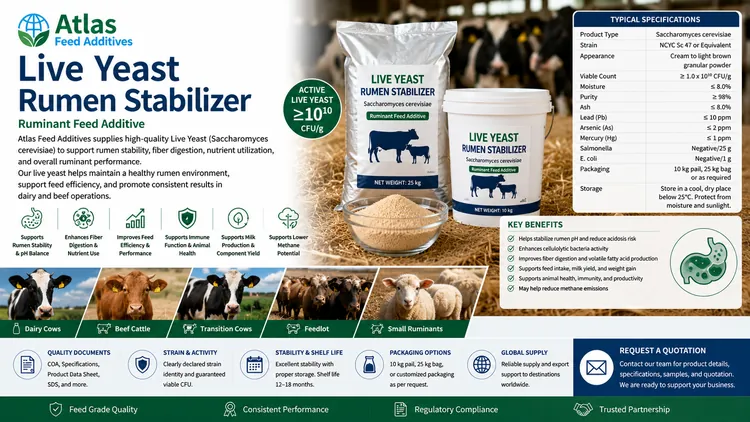
Live Yeast Rumen Stabilizer is selected for dairy, beef, transition-cow, high-yield, feedlot, rumen-stability, and environmental nutrition programs where buyers need consistent viable activity, clear CFU specification, suitable handling, and reliable feed-grade documentation.

Live Yeast Rumen Stabilizer feed additive visual

Product role

Where Live Yeast Rumen Stabilizer fits

Live Yeast Rumen Stabilizer is part of the ruminant performance and environmental additives group. It is commonly evaluated for dairy and beef nutrition programs where rumen stability, feed intake consistency, fermentation support, diet transitions, and high-production feeding systems are important commercial objectives.

Buyers typically evaluate this product by strain identity, viable yeast count, CFU declaration, activity guarantee, carrier, delivery technology, physical form, heat tolerance, moisture level, microbiological profile, intended species, process compatibility, storage conditions, shelf life, and documentation requirements.

Atlas Feed Additives can coordinate international supplier options for feed mills, premix producers, dairy integrators, beef producers, feedlot operations, distributors, and importers that need consistent feed-grade material with export-oriented documentation and clear quotation support.

Technical identity

Key product profile

  • Product group: ruminant performance and environmental additives.
  • Functional role: specialty additive for rumen-stability and performance-oriented nutrition programs.
  • Common organism type: live yeast, often Saccharomyces cerevisiae strain-based, depending on supplier specification.
  • Activity basis: typically expressed as CFU per gram or another viable count declaration.
  • Commercial forms: powder, granule, microgranule, coated product, or carrier-based premix.
  • Use context: dairy, beef, feedlot, calf, small ruminant, transition, high-yield, and rumen-stability programs.
  • Buyer focus: strain identity, viable activity, end-of-shelf-life guarantee, stability, mixing behavior, and storage recommendations.
  • Process relevance: compatibility with premixing, complete-feed manufacturing, mineral blocks, top-dressing, TMR addition, or pelleted feed should be confirmed.

Commercial positioning

Why specifications matter

Live yeast products are not interchangeable by name alone. Two offers may both be described as live yeast but differ in strain, viable count, CFU guarantee, carrier, heat tolerance, moisture, shelf life, storage requirements, recommended inclusion level, regulatory status, and supporting technical data.

For a meaningful comparison, buyers should align the target species, diet type, production stage, CFU basis, activity guarantee, application method, processing conditions, packaging, storage expectations, and destination-market documents before comparing price per kilogram.

Applications

Typical use areas in ruminant nutrition

Dairy transition cow programs

Transition-cow diets are designed around a sensitive period before and after calving. Live Yeast Rumen Stabilizer may be evaluated in programs focused on consistent feed intake, rumen adaptation, ration transitions, early-lactation support, and overall herd performance objectives.

  • Close-up and fresh cow programs
  • Ration-change support strategies
  • Early-lactation feeding programs
  • TMR and premix applications
  • Herds with intensive production management

High-yield dairy cow diets

High-yield dairy cows often consume energy-dense rations where rumen stability and feed efficiency are important. Buyers may evaluate live yeast products as part of a broader nutrition program that includes fiber quality, starch management, buffers, minerals, protein balance, and feeding consistency.

  • Peak-lactation diets
  • High-concentrate rations
  • Rumen-stability programs
  • Milk production and feed-efficiency strategies
  • Programs designed by qualified dairy nutritionists

Beef cattle and feedlot rations

In beef and feedlot systems, live yeast products may be reviewed for ration adaptation, high-energy finishing diets, feed intake consistency, and rumen fermentation support strategies. Final use should be aligned with the feeding system and nutritionist recommendations.

  • Feedlot adaptation periods
  • Finishing rations
  • High-grain diet management
  • Feed intake consistency programs
  • Beef integrator and commercial feed applications

Calf and youngstock programs

Young ruminant programs may evaluate live yeast products where gut development, early feed transition, starter intake, and rumen development objectives are part of the formulation strategy. Buyers should confirm product suitability for the age group and local feed rules.

  • Calf starter feeds
  • Youngstock mineral and supplement programs
  • Rumen development strategies
  • Weaning transition support
  • Specialty young-animal feeds

Small ruminants

Sheep and goat programs may consider Live Yeast Rumen Stabilizer for dairy, meat, and breeding animals where rumen stability, diet adaptation, fiber utilization strategies, and feed consistency are relevant. Local authorization and formulation suitability should be confirmed.

  • Dairy goat and dairy sheep programs
  • Meat lamb and goat feed systems
  • High-concentrate rations
  • Mineral and supplement blends
  • Farm-specific nutrition strategies

Environmental and efficiency programs

Some ruminant programs evaluate additives in the context of feed efficiency, nutrient utilization, manure characteristics, or emissions-focused objectives where authorized and supported by technical data. Claims and use must follow market-specific regulations and supplier documentation.

  • Feed-efficiency programs
  • Rumen-modulation strategies
  • Environmental nutrition projects
  • Programs requiring validated technical support
  • Use only where claims are authorized and documented

Specification control

Common specification points to request

  • Yeast species and strain identification
  • Viable cell count or CFU per gram
  • Whether CFU is guaranteed at production, delivery, or end of shelf life
  • Recommended inclusion level or application basis
  • Carrier type and carrier declaration
  • Product form: powder, granule, microgranule, coated product, or premix
  • Particle size distribution
  • Bulk density and flowability
  • Moisture content and water activity where available
  • Microbiological profile and pathogen controls
  • Heavy metals and contaminant controls where required
  • Heat stability or pelleting tolerance data where available
  • Compatibility with minerals, buffers, acids, liquids, or other additives
  • Shelf life and recommended storage conditions
  • Packaging type and oxygen or moisture protection

Quality documents

Buyer quality checklist

  • Product specification sheet
  • Certificate of Analysis
  • Safety Data Sheet
  • Technical data sheet or product brochure
  • Strain or active declaration
  • CFU guarantee or viable count statement
  • Batch number and manufacturing date
  • Country of origin statement
  • Shelf-life or retest-date statement
  • Storage and handling guidance
  • Feed-grade or feed-use suitability declaration
  • GMO, allergen, BSE/TSE, halal, kosher, or other declarations if requested
  • Market-specific import and compliance documents
  • Technical support data or trial references where available

Procurement note

Ask for the right specification before comparing prices.

Price comparisons are meaningful only when strain identity, viable count, CFU guarantee basis, carrier, particle size, packaging, origin, shelf life, storage requirements, and documentation are aligned. A product with a lower price per kilogram may not be more economical if it has lower viable activity, weaker heat tolerance, shorter shelf life, limited documentation, or unsuitable packaging.

For live microbial products, buyers should compare cost according to viable activity, guaranteed CFU level, recommended inclusion, stability during shipment and storage, and compatibility with the intended feed process. Storage temperature, moisture control, and application point are especially important for maintaining product quality.

Formulation and manufacturing

Processing considerations for live yeast products

Viability and activity

Live yeast products depend on viable activity. Buyers should clarify whether the declared CFU count is measured at manufacture, after packaging, at delivery, or at the end of shelf life. This distinction is important when comparing suppliers and determining practical value.

Pelleting and heat exposure

Steam conditioning, pelleting, extrusion, and high processing temperatures can reduce live yeast viability. Buyers should request heat-tolerance information and confirm whether the product should be added before pelleting, after pelleting, through top-dressing, or through a premix route.

Premix compatibility

Compatibility should be reviewed when live yeast is blended with minerals, buffers, organic acids, trace minerals, vitamins, enzymes, mycotoxin binders, fat powders, or liquid ingredients. Moisture, pH, salt concentration, and storage time can influence stability.

Mixing uniformity

Uniform distribution is important when live yeast is included at low or moderate levels in premixes and complete feeds. Particle size, carrier, density, flowability, addition sequence, and mixing time can influence final distribution.

Storage and logistics

Live microbial products require good storage discipline. Heat, humidity, long transit time, damaged packaging, and open bags can reduce viable activity. Buyers should review export route, warehouse conditions, shelf life, and first-in, first-out stock rotation.

Program design

Live Yeast Rumen Stabilizer should be used as part of a professionally designed ruminant nutrition program. Diet fermentability, forage quality, starch level, effective fiber, feeding frequency, buffers, minerals, water quality, and herd management all influence final outcomes.

Packaging

Common packaging options

Packaging availability depends on supplier capability, product form, activity level, order quantity, and destination-market requirements. Atlas Feed Additives can review available packaging options during quotation.

  • 1 kg, 5 kg, 10 kg, 20 kg, or 25 kg bags depending on supplier format
  • Foil-lined or moisture-protected bags where available
  • Multi-layer paper or plastic-laminated bags
  • Cartons, drums, or composite packaging for sensitive products
  • Vacuum, oxygen-barrier, or humidity-resistant packaging where offered
  • Palletized shipment for export handling
  • Batch number, net weight, product name, storage information, and shelf-life marking
  • Private-label or buyer-specific marking where available

Storage and handling

Practical handling guidance

  • Store in a clean, dry, cool, covered, and well-ventilated area.
  • Protect from high heat, direct sunlight, humidity, condensation, and contamination.
  • Keep packaging tightly closed after opening.
  • Follow the supplier’s recommended storage temperature and shelf-life guidance.
  • Use first-in, first-out stock rotation.
  • Avoid prolonged exposure to open air during weighing and mixing.
  • Do not store near strong odors, chemicals, pesticides, or incompatible feed materials.
  • Follow the Safety Data Sheet and local occupational safety rules.

Quotation preparation

Information to send for a faster Live Yeast Rumen Stabilizer quotation

Technical details

  • Required yeast strain or accepted strain options
  • Target CFU per gram or viable count
  • Whether CFU must be guaranteed at production, delivery, or end of shelf life
  • Preferred product form: powder, granule, coated product, or premix
  • Carrier preference, if any
  • Heat stability or pelleting tolerance requirement
  • Target inclusion rate or supplier recommendation basis

Application details

  • Target species: dairy cow, beef cattle, calf, sheep, goat, or other ruminant
  • Production stage: transition, peak lactation, finishing, starter, or maintenance
  • Complete feed, premix, mineral blend, TMR, top-dress, or block application
  • Pelleted, mash, liquid, or dry feed system
  • Expected storage time before use
  • Processing temperature exposure
  • Any previous supplier specification used as reference

Commercial details

  • Required quantity
  • Trial order or annual volume estimate
  • Preferred packaging
  • Destination country and delivery address or port
  • Preferred Incoterms
  • Target shipment period
  • Payment and documentation expectations

Documentation details

  • COA format requirements
  • SDS language requirements
  • Strain declaration requirement
  • CFU or viable count statement requirement
  • Origin documentation
  • Feed-grade declaration
  • GMO, allergen, BSE/TSE, halal, kosher, or other declarations
  • Import permit, registration, or authorization needs

Buyer comparison

How to compare Live Yeast Rumen Stabilizer offers

When several suppliers quote live yeast products, buyers should compare each offer against the same activity, stability, application, and logistics baseline.

  • Strain identity: confirm species and strain information where available.
  • Activity basis: compare CFU per gram and whether it is guaranteed through shelf life.
  • Recommended inclusion: compare practical cost at the suggested feeding level.
  • Heat tolerance: review suitability for pelleting, extrusion, premixing, or post-pellet application.
  • Storage stability: check shelf life, temperature limits, moisture protection, and packaging barrier.
  • Process fit: confirm compatibility with mixer, premix, TMR, mineral blend, or top-dress use.
  • Documents: confirm COA, SDS, specification, origin, CFU guarantee, and market declarations.
  • Total landed cost: compare product price with freight, duties, local handling, shelf-life risk, and cost per viable activity unit.

Risk control

Questions to ask before placing an order

  • What yeast strain is used?
  • What is the declared CFU per gram?
  • Is the viable count guaranteed at production, delivery, or end of shelf life?
  • Is the product suitable for pelleting or should it be added after heat processing?
  • What storage temperature is recommended?
  • How long is the shelf life under recommended conditions?
  • Is the product compatible with minerals, acids, buffers, or other additives in the intended premix?
  • Is the product authorized for the target species and destination market?
  • Are all feed-use, import, and market-specific documents available before shipment?

Atlas support

Export-focused sourcing for ruminant performance additives

Atlas Feed Additives supports buyers by reviewing technical requirements, supplier availability, viable activity, strain information, product form, packaging options, storage requirements, quality documentation, destination logistics, and quotation details. For Live Yeast Rumen Stabilizer, this can include comparing CFU levels, storage conditions, heat tolerance, carrier systems, and documentation packages.

Atlas can help feed mills, premix producers, dairy integrators, beef producers, feedlot operations, distributors, and importers source feed-grade ruminant additives that match their commercial, technical, and regulatory requirements.

Best-fit buyer profile

  • Dairy feed producers supporting transition and high-yield herds
  • Feedlot and beef integrators managing high-energy rations
  • Premix producers handling specialty ruminant additives
  • Mineral and supplement manufacturers
  • Distributors building ruminant performance portfolios
  • Importers requiring export-ready documentation and supplier coordination
  • Nutrition companies designing rumen-stability programs

Questions

Useful answers about Live Yeast Rumen Stabilizer

What is Live Yeast Rumen Stabilizer used for in animal nutrition?

Live Yeast Rumen Stabilizer is selected for transition-cow, high-yield dairy, beef, feedlot, rumen-stability, feed-efficiency, or environmental nutrition programs. It should be used according to the target species, diet design, supplier guidance, and applicable market rules.

Can Atlas Feed Additives quote Live Yeast Rumen Stabilizer?

Yes. Send your required specification, strain or activity target, CFU level, quantity, destination, packaging preference, application method, and required documents so Atlas Feed Additives can review suitable supplier options for Live Yeast Rumen Stabilizer.

What quality documents should buyers request for Live Yeast Rumen Stabilizer?

Common documents include specification, Certificate of Analysis, Safety Data Sheet, strain or active declaration, viable count or CFU statement, origin information, batch details, shelf-life statement, storage guidance, microbiological profile, and any market-specific certificates required by the buyer.

Why is CFU count important?

CFU count indicates viable activity. Buyers should confirm whether the declared CFU is guaranteed at production, at delivery, or through the end of shelf life, because this affects technical comparison and practical value.

Is Live Yeast Rumen Stabilizer suitable for pelleted feed?

Suitability depends on the specific product, strain, protection technology, temperature exposure, steam conditioning, and pelleting conditions. Buyers should request heat-stability information and confirm the recommended application point before purchasing.

Can it be used in mineral premixes?

It may be used in mineral premixes when the product is compatible with the premix matrix and storage conditions. Buyers should evaluate moisture, trace mineral levels, salt level, acids, buffers, storage time, and supplier guidance before blending.

What affects live yeast stability?

Stability can be affected by heat, humidity, oxygen exposure, storage time, packaging quality, processing temperature, moisture level, and compatibility with other ingredients. Proper storage and handling are important for maintaining viable activity.

Does Atlas provide dosage recommendations?

Atlas Feed Additives supports sourcing, documentation, and quotation coordination. Inclusion rates and nutrition program decisions should be made by qualified nutrition professionals according to species, ration design, product specification, supplier recommendation, and local regulations.

What information should I include in my quotation request?

Please include required strain or CFU specification, target species, application method, product form, quantity, destination, packaging preference, storage or heat-stability needs, Incoterms, and required documents. A previous specification sheet or COA is helpful when available.

Request a quotation

Tell us what you need

Send your product list, target specification, strain or CFU requirement, destination country, packaging preference, order quantity, delivery terms, target species, application method, storage requirements, and required documents. Our team will review your request and respond from orders@feedgradeadditives.com.