| Product identity |
Trade name, technical name, active ingredient, feed-grade status, intended species, production class, and functional category. |
Confirms that the offered material matches the buyer’s ruminant methane or environmental additive program and legal classification. |
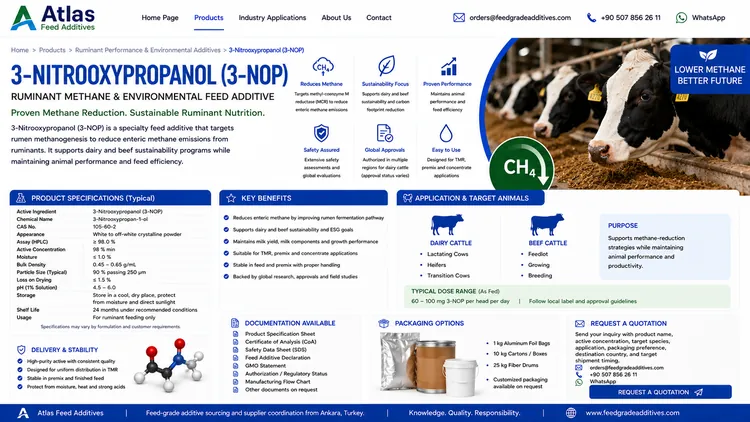
| Active concentration |
Declared 3-Nitrooxypropanol content, assay method, minimum guaranteed active level, active level at expiry where available, and acceptable range. |
Cost-in-use and dose accuracy depend on active concentration, not only the product name or price per kilogram. |
| Assay method |
Analytical method, sample preparation, unit expression, acceptable range, batch-to-batch tolerance, and COA release method. |
Allows buyers to compare specifications and verify active content through COA and quality-control programs. |
| Carrier and excipients |
Carrier identity, diluent, stabilizer, coating material, flow agent, anticaking system, and any excipients relevant to feed labeling. |
Carriers affect active dilution, handling, stability, premix compatibility, dust level, and destination-market acceptance. |
| Delivery or protection technology |
Protected form, granulation, coating, release behavior, stability technology, and intended application point. |
Delivery technology influences rumen availability, mixing uniformity, handling safety, and practical program results. |
| Approved use |
Authorized species, animal class, production stage, dose range, feeding system, label wording, market-specific claim limits, and user restrictions. |
3-Nitrooxypropanol is market-specific; buyers must not assume that one country’s authorization applies elsewhere. |
| Dose guidance |
Recommended inclusion rate, active dose per animal or per unit of feed, TMR guidance, premix dilution, maximum use level where applicable, and practical feeding range. |
Correct dose depends on active level, feeding system, daily intake, ration composition, and authorization terms. |
| Ration compatibility |
Compatibility with forage level, concentrate level, fats, buffers, minerals, protected nutrients, yeasts, enzymes, acids, and medications where permitted. |
Diet composition and additive interactions can influence intake, distribution, stability, and program outcomes. |
| Physical form |
Powder, granule, microgranule, coated particle, carrier premix, particle size, bulk density, dust level, flowability, and color. |
Affects dosing accuracy, mixing uniformity, operator handling, segregation, bag emptying, and premix stability. |
| Homogeneity |
Mixing uniformity data, minimum dilution, premix inclusion instructions, coefficient of variation target, sampling method, and recommended batch size. |
Uniform daily intake is important for consistent additive delivery and program documentation. |
| Processing stability |
Pelleting, steam conditioning, TMR mixing, storage in mineral premix, heat exposure, moisture exposure, feed-out stability, and retention data. |
Processing and storage can influence active recovery and practical performance if not validated. |
| Handling safety |
SDS guidance, PPE, ventilation, dust control, skin and eye precautions, spill response, transport classification, and operator training requirements. |
Specialty additives require safe storage, dosing, and handling procedures before plant approval. |
| Monitoring plan |
Recommended farm records, ration records, methane calculation method, animal group definition, intake monitoring, verification requirements, and reporting templates. |
Environmental programs often require documentation beyond ordinary feed additive use. |
| Contaminants |
Heavy metals, dioxins or PCBs where relevant, residual solvents where relevant, microbiology, unwanted impurities, and customer-specific limits. |
Supports feed safety, import control, customer approval, and internal quality programs. |
| Stability |
Shelf-life, expiry date, retest date, storage temperature, humidity limits, light protection, sealed-pack stability, and opened-pack handling. |
Helps buyers protect active concentration and flowability during shipping, warehousing, and feed production. |
| Packaging |
Net weight, bag, drum, carton, foil liner, pallet configuration, container loading estimate, label language, batch coding, and private-label needs. |
Affects logistics, warehouse control, moisture protection, handling safety, traceability, and label compliance. |
| Documents |
Technical data sheet, product specification, COA, SDS, origin statement, batch details, authorization documents, stability data, and market-specific certificates. |
Allows buyers to confirm quality and compliance before purchase, shipment, customs clearance, and production use. |