
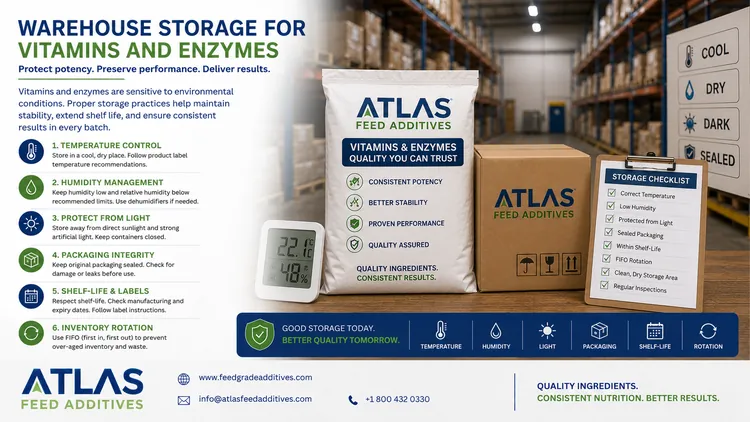
Feed additive decisions are strongest when they begin with a clear production objective. Warehouse Storage for Vitamins and Enzymes is not only a logistics topic; it is a practical quality-control process that connects product stability, packaging, warehouse conditions, inventory rotation, feed manufacturing needs, and the commercial target.
Why this topic matters
Vitamins and enzymes can be sensitive to storage conditions. Heat, humidity, light exposure, damaged packaging, long storage time, and poor stock rotation can reduce product quality before the additive reaches the mixer or premix line. Good warehouse practice helps protect value that has already been paid for.
Temperature, humidity, light, and inventory rotation practices should be reviewed as part of the purchasing and quality program. In real operations, the result depends on product form, supplier packaging, warehouse discipline, climate, transport route, shelf-life, storage layout, and how consistently the additive is handled after delivery.
Practical approach
- Define the practical storage challenge first, including heat exposure, humidity, light, damaged bags, slow-moving stock, or repeated opening of containers.
- Choose additives and packaging formats that match the species, feed process, warehouse conditions, and expected stock turnover.
- Track measurable outcomes such as arrival condition, remaining shelf-life, lot traceability, retained samples, inventory age, and complaints from production.
- Review supplier documents, storage guidance, packaging details, and shelf-life statements before confirming large or long-transit orders.
Temperature, humidity, and light control
Warehouse conditions can vary widely between seasons and regions. Vitamins may be affected by heat, oxygen, moisture, and light depending on their form and coating. Enzymes may also require careful protection from moisture and excessive temperature so that declared activity is preserved as much as possible until use.
Buyers should review the recommended storage temperature, humidity sensitivity, and light-protection needs on the product label or supplier documentation. In hot or humid locations, warehouse ventilation, pallet spacing, wall clearance, roof condition, and moisture control become important parts of the quality program.
Packaging integrity and lot control
Packaging is the first protection layer for vitamins and enzymes. Bags, drums, cartons, liners, and sealed containers should be inspected at arrival for damage, moisture marks, broken seals, unreadable labels, or pallet instability. Any issue should be recorded before the product enters normal stock.
Lot control is equally important. Each product should remain linked to its batch number, certificate of analysis, production date, expiry date, and receiving record. When partial bags or containers are opened, they should be resealed properly and used promptly according to site procedures and supplier guidance.
Inventory rotation and warehouse layout
First-expired, first-out inventory rotation is especially important for products with sensitive active ingredients. Slow-moving stock should be reviewed before new orders are placed, and products with shorter remaining shelf-life should be identified clearly so they are not left behind newer deliveries.
Warehouse layout should keep vitamins and enzymes away from direct sunlight, wet floors, strong odors, incompatible chemicals, pests, and excessive dust. Pallets should be stored off the floor where practical, with enough space for inspection, cleaning, and air movement. Clear labeling reduces the risk of selecting the wrong product during production.
Production and quality coordination
Storage decisions should be connected to production planning. If a product is used in small quantities but ordered in large lots, the remaining shelf-life and storage risk may become more important than the unit price. For sensitive additives, ordering frequency, pack size, and warehouse capacity should be reviewed together.
Quality teams can support the process by maintaining receiving records, storage logs, retained samples, nonconformance notes, and corrective actions. When product performance questions arise, these records help separate supplier issues from storage, handling, mixing, or application problems.
Product groups to review
Depending on the challenge, the following product groups may be worth reviewing with your nutrition, technical, quality, or procurement team:
Buyer checklist
Before ordering, request the product specification, certificate of analysis, shelf-life, recommended storage conditions, packaging details, recommended inclusion range, and destination-market documents. For vitamins and enzymes, also review heat sensitivity, humidity sensitivity, light protection, enzyme activity declaration where relevant, coating or stabilization system, and remaining shelf-life at shipment.
For commercial trials or new supplier approvals, define the baseline, product lots, feed batches, storage conditions, performance indicators, and review period before the additive is introduced. Useful indicators may include arrival condition, retained sample condition, stock rotation accuracy, dosing behavior, premix uniformity, enzyme activity checks where available, vitamin assay results where relevant, and production feedback.
How Atlas Feed Additives can support
Atlas Feed Additives can help buyers compare feed-grade additive options, coordinate supplier documentation, and structure inquiries for international shipments. We can support discussions around vitamin and enzyme sourcing, packaging preference, shelf-life expectations, supplier documentation, storage guidance, and destination-market requirements.
Send the target species, product group, expected quantity, destination country, warehouse conditions, preferred packaging, shipment timing, and required documents so we can review the request efficiently.