
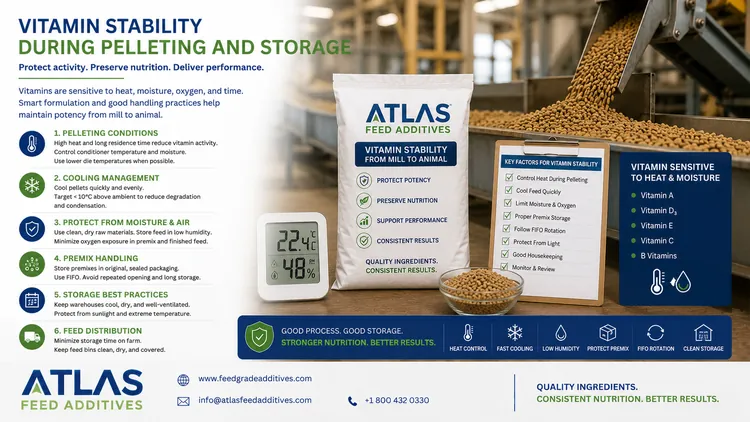
Feed additive decisions are strongest when they begin with a clear production objective. Vitamin Stability During Pelleting and Storage is not a single-product decision; it is a practical process of matching animal needs, raw material risk, feed manufacturing conditions, and the commercial target.
Why this topic matters
Vitamins are included in feed at relatively small quantities, yet they support many essential functions linked to growth, reproduction, immunity, metabolism, bone development, and general animal performance. When vitamin activity is reduced during manufacturing or storage, the finished feed may still look normal, but the nutritional value delivered to the animal can be lower than expected.
The main pressure points are heat, moisture, oxygen exposure, contact with reactive minerals, long storage periods, and repeated handling. Pelleting can improve feed hygiene, density, and intake consistency, but the same process can expose sensitive nutrients to steam, friction, and conditioning temperatures. A good program therefore considers both formulation and processing.
Where vitamin losses can occur
Vitamin stability risk does not begin only at the pellet mill. It can start during premix production, continue during transport, increase during feed manufacturing, and continue again in storage. Each step should be reviewed as part of the same quality chain.
- Premix stage: contact with trace minerals, choline chloride, moisture, or unsuitable carriers can increase degradation risk.
- Conditioning stage: steam, temperature, moisture, and retention time can place extra stress on sensitive vitamins.
- Pelleting stage: friction and die pressure may increase heat exposure beyond the conditioner setting.
- Cooling stage: insufficient cooling can leave warm feed in bags or silos, increasing condensation and storage risk.
- Storage stage: humidity, warehouse temperature, damaged packaging, and long shelf-life can reduce nutrient reliability.
Practical approach
A practical vitamin stability program should combine product selection, process control, storage discipline, and documentation review. The objective is not only to buy a vitamin product, but to protect its declared activity until the feed is consumed.
- Define the practical challenge first: pelleting temperature, storage duration, species, feed form, and target production phase.
- Choose vitamin sources and premix formats that match the species, manufacturing process, and expected shelf-life.
- Review whether coated, stabilized, or protected forms are suitable for sensitive applications.
- Control moisture and cooling so finished feed does not enter bags, bins, or bulk trucks while still warm.
- Track measurable outcomes such as feed intake, performance, analytical recovery, complaint rate, and batch consistency.
Pelleting considerations
Pelleting conditions should be reviewed with the feed mill team, because small changes in temperature, steam quality, die specification, and throughput can change nutrient exposure. Higher conditioning temperatures and longer retention times may be useful for some production goals, but they can also increase the need for a more robust vitamin program.
When vitamin stability is a concern, buyers and technical teams should ask for practical information such as heat stability data, recommended handling conditions, expected activity after processing, and whether the supplier recommends an overage strategy. Final decisions should be based on formulation targets, production reality, professional advice, and local rules.
Premix and storage management
Good warehouse practice is a simple but important part of vitamin protection. Premixes and finished feeds should be stored in dry, clean, well-ventilated areas, away from direct sunlight, water exposure, pests, and strong odors. Bags should be kept closed when not in use, and damaged packaging should be isolated and checked before use.
Stock rotation is also important. A first-in, first-out system helps prevent old premix or finished feed from staying in the warehouse longer than planned. For export shipments or long-distance transport, packaging strength, pallet protection, container conditions, and destination climate should be considered before dispatch.
Product groups to review
Depending on the challenge, the following product groups may be worth reviewing with your nutrition, technical, or procurement team:
Buyer checklist
Before ordering, request the product specification, certificate of analysis, shelf-life, storage conditions, recommended inclusion range, packaging details, and destination-market documents. For commercial trials, define the baseline, control group, feed batches, performance indicators, and review period before the additive is introduced.
For vitamin programs specifically, it is also useful to ask how the product should be stored after opening, whether it is suitable for pelleted feed, what analytical method is used for quality control, and how long the supplier expects the declared activity to remain reliable under recommended storage conditions.
How Atlas Feed Additives can support
Atlas Feed Additives can help buyers compare feed-grade additive options, coordinate supplier documentation, and structure inquiries for international shipments. Send the target application, current challenge, species, production phase, expected pelleting conditions, monthly quantity, destination country, and required documents so we can review the request efficiently.