Feed additive decisions are strongest when they begin with a clear production objective. Swine Feed Hygiene with Organic Acids is not a single-product decision; it is a practical process of matching animal needs, raw material risk, feeding system design, farm hygiene, and the commercial target.
Why this topic matters
Preservation and hygiene concepts are important in both liquid and dry swine feeding systems because feed quality can change during storage, handling, mixing, and delivery. Organic acids and acidifier blends are often reviewed when producers want to support feed hygiene, manage preservation risk, and improve consistency across different production phases.
In real operations, the result depends on feed quality, farm management, genetics, health status, water quality, storage time, equipment cleanliness, and how consistently the additive is applied. A strong program should therefore combine product selection with good hygiene, clear phase objectives, and measurable farm records.
Where hygiene challenges can appear
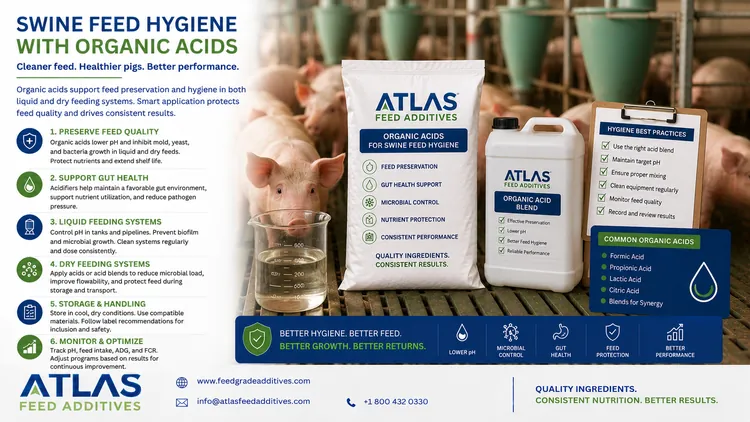
Swine feed hygiene should be reviewed from raw material intake to the feeder. Problems can develop in bins, silos, augers, liquid tanks, pipelines, mixers, and farm storage areas. Warm conditions, moisture, residues, poor cleanout, and long holding time can all increase hygiene risk.
- Dry feed systems: bins, conveyors, and feeders should be checked for moisture entry, bridging, residues, and old feed buildup.
- Liquid feeding systems: tanks, pipelines, valves, and mixing equipment require routine cleaning and monitoring.
- Raw materials: cereals, by-products, protein meals, and liquid ingredients can vary in quality and storage behavior.
- Water quality: water used in liquid feeding or drinking systems can influence hygiene, palatability, and additive performance.
- Farm handling: feed delivery frequency, storage duration, and feeder management affect the practical outcome of any acidifier program.
Practical approach
A practical acidifier program starts by defining the main objective: feed preservation, liquid feed hygiene, nursery transition support, intake consistency, or risk management during warm weather and long storage periods. Once the objective is clear, product choice and evaluation become more focused.
- Separate nursery, grower, finisher, and breeder objectives because each phase has different intake, gut, and performance priorities.
- Review whether the product is designed for dry feed, liquid feed, water application, or a specific farm system.
- Use palatability, acids, fibers, enzymes, and micronutrients as a coordinated program rather than isolated decisions.
- Check corrosion risk, handling safety, equipment compatibility, and storage requirements before use.
- Measure intake, daily gain, feed conversion, medication records, manure consistency, and system cleanliness during evaluation.
Liquid and dry system considerations
Liquid feeding programs require close attention to pH, mixing order, holding time, residue buildup, and cleaning routines. Acidifier selection should be matched with the farm's equipment, ingredient profile, and application target. Staff should also understand safe handling procedures and the importance of consistent dosing.
Dry feed systems have different priorities. Product flowability, mixing uniformity, pellet or mash compatibility, storage stability, and palatability are important. If feed intake drops after a product change, the full program should be reviewed, including inclusion level, diet composition, feed form, water access, and animal health status.
Product groups to review
Depending on the challenge, the following product group may be worth reviewing with your nutrition, technical, or procurement team:
Buyer checklist
Before ordering, request the product specification, certificate of analysis, shelf-life, storage conditions, recommended inclusion range, packaging details, handling guidance, and destination-market documents. For commercial trials, define the baseline, control group, feed batches, performance indicators, and review period before the additive is introduced.
For swine feed hygiene programs, it is also useful to share the production phase, feeding system type, feed form, water quality concerns, storage duration, farm hygiene challenge, current diet type, and whether the product will be used in feed, water, or liquid feeding equipment. This helps suppliers and technical teams recommend options that match the actual farm setting.
How Atlas Feed Additives can support
Atlas Feed Additives can help buyers compare feed-grade acidifier and additive options, coordinate supplier documentation, and structure inquiries for international shipments. Send the target application, current challenge, species, production phase, feeding system, expected quantity, destination country, and required documents so we can review the request efficiently.