
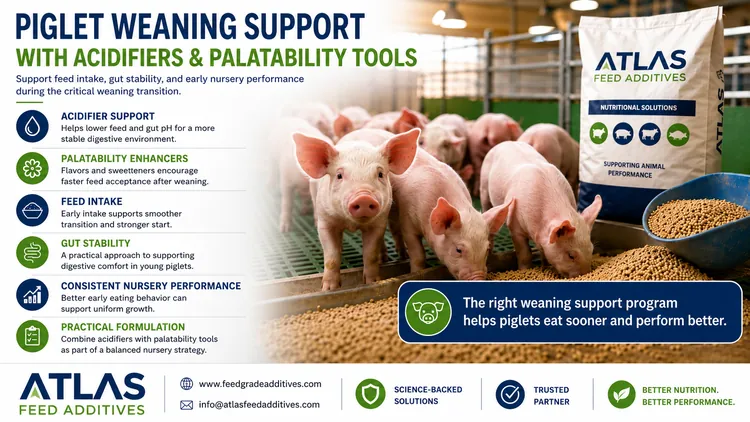
Feed additive decisions are strongest when they begin with a clear production objective. Piglet Weaning Support with Acidifiers and Palatability Tools is not a single-product decision; it is a practical process of matching animal needs, raw material risk, feed manufacturing conditions, farm management, and the commercial target.
Why this topic matters
Weaning is one of the most sensitive transition periods in pig production. Piglets move from sow milk to dry feed while also adapting to new housing, new pen mates, handling, and changes in digestive function. Even a short delay in feed intake can affect growth consistency, gut comfort, and the overall start of the nursery phase.
Acidifiers and palatability tools are commonly reviewed because they can help make starter diets easier to accept and support a more stable feeding pattern. In real operations, the final result depends on feed quality, farm management, genetics, health status, water quality, hygiene, storage, and how consistently the additive is applied.
Practical approach
- Separate nursery, grower, finisher, and breeder objectives instead of using one general swine additive strategy.
- Use palatability, acids, fibers, enzymes, and micronutrients as a coordinated program rather than isolated additions.
- Review feed form, pellet quality, ingredient digestibility, water access, and feeder space together with additive selection.
- Measure intake, daily gain, feed conversion, medication records, manure consistency, and uniformity between pens.
How acidifiers fit into weaning programs
Organic acids and acidifier blends are usually considered when the goal is to support feed hygiene, digestive comfort, and a smoother transition to starter diets. The best fit depends on the acid profile, buffering capacity of the diet, inclusion level, feed form, and whether the product is protected, blended, liquid, or dry.
When reviewing acidifiers, buyers should ask for the active composition, carrier information, handling precautions, recommended use range, compatibility notes, and any available stability data. Acidifier programs should also be evaluated alongside protein quality, mineral level, fiber source, and the farm’s broader gut health strategy.
How palatability tools support intake
Flavors, sweeteners, and palatability enhancers can help encourage earlier and more consistent feed intake, especially when piglets are adapting to a new diet. They are most useful when the base feed is already well formulated and the goal is to improve acceptance, reduce hesitation, or support consistency between batches.
Palatability tools should be selected with the target age, feed ingredients, regional preference, processing temperature, and inclusion level in mind. A product that performs well in one starter formulation may need adjustment when raw materials, fat source, protein source, or pellet quality changes.
Product groups to review
Depending on the challenge, the following product groups may be worth reviewing with your nutrition, technical, or procurement team:
Buyer checklist
Before ordering, request the product specification, certificate of analysis, shelf-life, storage conditions, recommended inclusion range, packaging details, and destination-market documents. For acidifiers, also review active acid composition, carrier type, corrosiveness or handling guidance, and compatibility with premix components.
For commercial trials, define the baseline, control group, feed batches, performance indicators, and review period before the additive is introduced. Useful indicators may include first-week feed intake, average daily gain, feed conversion, mortality, medication records, manure consistency, and variation between pens or rooms.
How Atlas Feed Additives can support
Atlas Feed Additives can help buyers compare feed-grade additive options, coordinate supplier documentation, and structure inquiries for international shipments. Send the target application, piglet age or weight range, current challenge, product group, expected quantity, and destination country so we can review the request efficiently.