
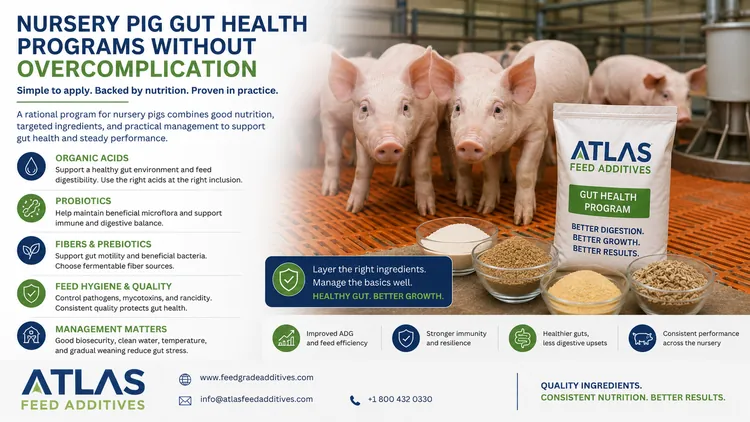
Feed additive decisions are strongest when they begin with a clear production objective. Nursery Pig Gut Health Programs Without Overcomplication is not a single-product decision; it is a practical process of matching piglet needs, raw material risk, feed manufacturing conditions, farm hygiene, health status, and the commercial target.
Why this topic matters
The nursery phase is a sensitive period because piglets are adapting after weaning, learning to consume dry feed consistently, and responding to new housing and social pressure. A gut health program should help support intake, digestive comfort, manure consistency, and growth stability without adding unnecessary complexity to the formula.
Layering acids, probiotics, fibers, and hygiene in a rational program means each tool should have a clear purpose. In real operations, the result depends on feed quality, creep feed experience, weaning age and weight, water quality, stocking density, room temperature, health status, medication history, and how consistently the additive is applied.
Practical approach
- Separate creep feed, nursery, grower, finisher, and breeder objectives instead of using one general swine additive strategy.
- Use palatability, organic acids, probiotics, fibers, enzymes, minerals, and vitamins as a coordinated program rather than isolated additions.
- Start with the main challenge: low intake, loose manure, poor uniformity, high medication use, weak feed conversion, or inconsistent transition after weaning.
- Measure intake, daily gain, feed conversion, medication records, mortality, manure consistency, room variation, and water consumption where possible.
Building a rational gut health program
A practical nursery program should begin with feed and farm basics. Diet digestibility, protein quality, fiber strategy, pellet or crumble quality, feeder access, water availability, hygiene, and temperature control can influence results as much as the additive package itself.
Organic acids may be reviewed for feed hygiene and digestive support objectives. Probiotics and fermentation products may be considered when the goal is microbial balance and transition support. Fiber sources can help shape gut function and manure consistency, but they should be selected carefully so that the formula remains digestible for young pigs.
Avoiding overcomplication
Overcomplication often happens when several additives are added without a clear reason for each one. This can increase cost, make results harder to interpret, and create compatibility questions in the premix or finished feed. A better approach is to define the target, select a limited number of complementary tools, and monitor results over a realistic review period.
Each additive should have a role, such as improving feed acceptance, supporting feed hygiene, helping digestive transition, supporting nutrient release, or improving manure consistency. If two products are intended to solve the same problem, the technical team should decide whether both are needed or whether one stronger option is more practical.
Product groups to review
Depending on the challenge, the following product groups may be worth reviewing with your nutrition, technical, veterinary, or procurement team:
Buyer checklist
Before ordering, request the product specification, certificate of analysis, shelf-life, storage conditions, recommended inclusion range, packaging details, and destination-market documents. For nursery gut health programs, also review active composition, carrier type, heat stability, compatibility with premixes, application point, and whether the product is intended for feed, water, or both.
For commercial trials, define the baseline, control group, feed batches, performance indicators, and review period before the additive is introduced. Useful indicators may include first-week feed intake, average daily gain, feed conversion, medication records, manure score, mortality, culls, uniformity, water intake, and room-by-room comparison.
How Atlas Feed Additives can support
Atlas Feed Additives can help buyers compare feed-grade additive options, coordinate supplier documentation, and structure inquiries for international shipments. We can support discussions around acidifier type, probiotic or fermentation product options, palatability support, packaging preference, product documentation, and destination-market requirements.
Send the target species, piglet age or weight range, production phase, current challenge, product group, expected quantity, destination country, and required documents so we can review the request efficiently.