Feed additive decisions are strongest when they begin with a clear production objective. Non-GMO and Origin Declarations in Feed Additives is not a single-product decision; it is a practical process of matching customer requirements, raw material background, supplier documentation, destination-market rules, shipment planning, and the commercial target.
Why this topic matters
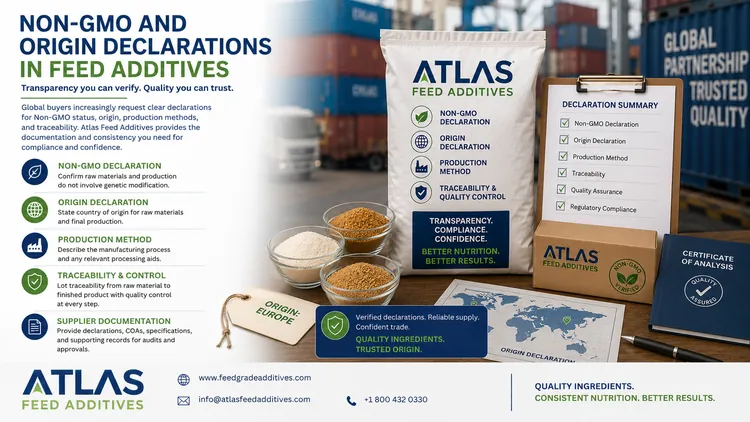
Non-GMO and origin declarations are often requested when buyers need more transparency around how a feed additive is produced, where it is manufactured, and whether the supplied material matches customer or destination-market expectations. These documents can support procurement files, audit programs, import reviews, private-label projects, and customer-facing quality systems.
When buyers request origin and production-method transparency, the final documentation package should be checked before shipment. In real operations, the result depends on supplier traceability, batch records, raw material controls, packaging labels, certificate wording, destination-country rules, and how clearly the buyer defines the required declaration in advance.
Practical approach
- Plan documentation, packaging, labeling, and destination requirements before shipment rather than after goods are already loaded.
- Clarify whether the buyer needs a Non-GMO statement, country of origin, manufacturer declaration, certificate of origin, production-method declaration, or customer-specific form.
- Long transit can expose additives to heat and humidity, so documentation planning should be paired with suitable packaging and shelf-life review.
- Agree on inspection, loading photos, batch documents, label details, and document wording in advance to reduce delays at import or customer approval stage.
Understanding declaration types
Origin documentation can refer to the country of manufacture, country of final processing, exporter country, raw material origin, or formal certificate of origin depending on the buyer’s request. These terms should not be assumed to mean the same thing. A clear purchase inquiry should specify exactly which origin statement is needed and for which product lot.
Non-GMO declarations can also vary in wording. Some buyers request a supplier declaration, while others may require additional supporting documents, raw material statements, or third-party verification depending on their internal policy or market requirements. The correct document should be confirmed before the order is finalized.
Traceability and supplier review
Strong traceability connects the product name, batch number, manufacturing site, production date, expiry date, packaging label, certificate of analysis, and shipment documents. When a declaration is issued, it should match the product being shipped and avoid broad claims that are not supported by the supplier’s records.
Buyers should also review whether the supplier can provide consistent documentation across repeat shipments. A one-time document may solve an urgent order, but long-term procurement programs need repeatable wording, stable product specifications, and a clear process for handling document updates or customer questions.
Product groups to review
Depending on the challenge, the following product groups may be worth reviewing with your nutrition, technical, quality, or procurement team:
Buyer checklist
Before ordering, request the product specification, certificate of analysis, shelf-life, storage conditions, recommended inclusion range, packaging details, destination-market documents, and any required Non-GMO or origin statement. If the declaration must follow a specific template, send that template to the supplier before confirming the order.
For first shipments or supplier qualification, define the document package, product labels, batch references, inspection points, and review period before the additive is introduced. Useful checks may include certificate wording, lot traceability, packaging label match, loading photos, retained samples, customer approval status, and any destination-country import feedback.
How Atlas Feed Additives can support
Atlas Feed Additives can help buyers compare feed-grade additive options, coordinate supplier documentation, and structure inquiries for international shipments. We can support discussions around Non-GMO declarations, origin statements, certificate wording, packaging labels, batch traceability, supplier comparison, and destination-market requirements.
Send the target additive group, product specification, expected quantity, destination country, required declaration type, customer template if available, shipment timing, and required documents so we can review the request efficiently.