
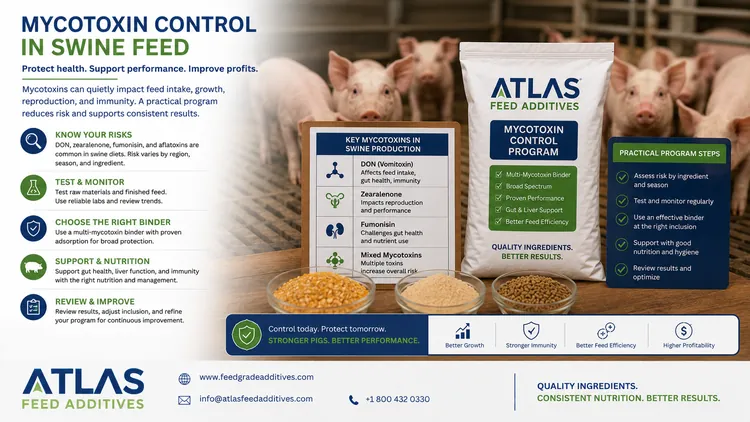
Feed additive decisions are strongest when they begin with a clear production objective. Mycotoxin Control in Swine Feed is not a single-product decision; it is a practical process of matching swine production phase, raw material risk, feed manufacturing conditions, health status, farm management, and the commercial target.
Why this topic matters
Swine can be sensitive to several mycotoxin challenges, including DON, zearalenone, fumonisin, and mixed contamination patterns. The impact may appear as reduced feed intake, weaker growth, reproductive concerns, inconsistent manure, immune pressure, or unexplained performance variation depending on the animal group and exposure level.
A practical approach to DON, zearalenone, fumonisin, and mixed challenges should combine raw material monitoring, feed testing, storage control, binder selection, and farm performance review. In real operations, the result depends on feed quality, ingredient origin, crop season, storage conditions, genetics, health status, production phase, and how consistently the additive is applied.
Practical approach
- Separate nursery, grower, finisher, gilt, sow, and boar objectives because mycotoxin risk can affect each group differently.
- Use mycotoxin testing, raw material risk mapping, feed hygiene, binders, detox support, and micronutrients as a coordinated program.
- Measure intake, daily gain, feed conversion, medication records, manure consistency, reproductive performance, and culling reasons where relevant.
- Review supplier quality, sampling method, storage time, moisture control, silo hygiene, and batch traceability before judging additive performance.
Risk mapping and testing
Mycotoxin risk often changes by season, supplier, grain origin, harvest condition, drying method, and warehouse control. Corn, wheat, barley, soybean meal, by-products, and other ingredients may each contribute different risks. A basic risk map helps the feed mill decide which raw materials need closer inspection or more frequent testing.
Sampling quality is important because contamination may be uneven across a truckload, silo, or finished feed batch. Buyers should define where samples are taken, how often testing is done, which mycotoxins are included, and how results are linked to purchasing decisions, formula changes, or additive strategy.
Binder and detox support considerations
Mycotoxin binders and detox support products can vary in composition, target profile, carrier, particle size, inclusion range, and supporting documentation. Some products are based on clay minerals, yeast cell wall components, enzymes, plant extracts, or multi-component systems. The best choice depends on the expected mycotoxin challenge and the swine category being fed.
For DON and zearalenone challenges, buyers should avoid assuming that every binder has the same profile. Ask suppliers for relevant data, recommended inclusion rates, target mycotoxin information, species suitability, and compatibility with the complete feed formula. Binder use should support a risk-control program rather than replace raw material selection and storage discipline.
Program design for swine farms
Nursery pigs may show risk through intake depression, manure inconsistency, poor uniformity, or weak transition after weaning. Grower and finisher pigs may show performance losses, feed conversion changes, or health pressure. Breeding herds may require closer attention to zearalenone-related reproductive indicators, gilt development, sow performance, boar condition, and culling reasons.
A practical control program should connect feed mill data with farm observations. When performance problems appear, the technical team should review feed batches, testing results, ingredient changes, medication history, water quality, housing conditions, and health records before assigning the issue to one cause.
Product groups to review
Depending on the challenge, the following product group may be worth reviewing with your nutrition, technical, veterinary, quality, or procurement team:
Buyer checklist
Before ordering, request the product specification, certificate of analysis, shelf-life, storage conditions, recommended inclusion range, packaging details, and destination-market documents. For mycotoxin control products, also review active composition, target mycotoxin profile, carrier type, particle size, heat stability, compatibility with premixes, and supporting technical data.
For commercial trials, define the baseline, control group, feed batches, testing plan, performance indicators, and review period before the additive is introduced. Useful indicators may include mycotoxin analysis, raw material risk score, feed intake, average daily gain, feed conversion, manure score, mortality, medication records, reproductive performance, return-to-service interval, litter data, and retained sample results.
How Atlas Feed Additives can support
Atlas Feed Additives can help buyers compare feed-grade additive options, coordinate supplier documentation, and structure inquiries for international shipments. We can support discussions around binder type, detox support options, target swine phase, raw material risk, packaging preference, and destination-market requirements.
Send the target species, production phase, raw materials used, current challenge, testing data if available, product group, expected quantity, destination country, and required documents so we can review the request efficiently.