
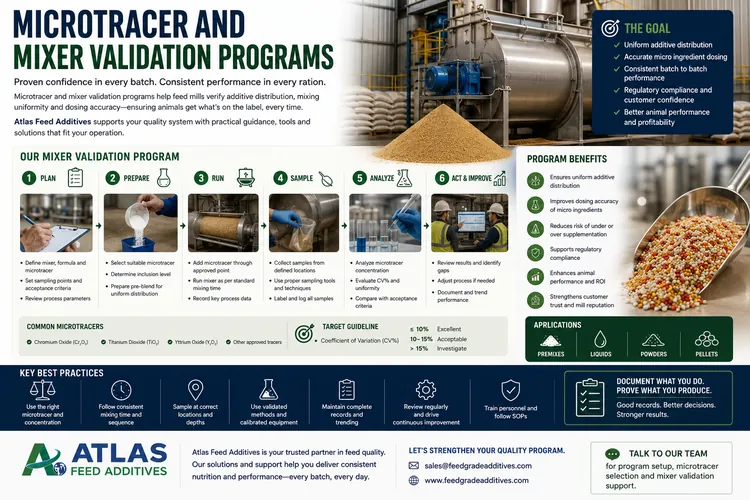
Feed additive decisions are strongest when they begin with a clear production objective. Microtracer and Mixer Validation Programs are not only laboratory exercises; they are practical quality-control tools for confirming that micro-ingredients, premixes, and feed additives are distributed evenly through the intended batch.
Why this topic matters
How routine checks protect additive distribution matters because even a well-selected additive cannot perform as expected if it is not dosed, mixed, and delivered consistently. Small inclusion products such as vitamins, trace minerals, enzymes, medications, pigments, acidifiers, or specialty additives are especially dependent on accurate dosing and proper mixing.
In real operations, the result depends on ingredient flow, mixer design, batch size, fill level, mixing time, sequencing, carrier choice, equipment wear, operator discipline, and how consistently production records are maintained. Mixer validation gives the feed mill a practical way to detect uneven mixing, dosing errors, or carryover risks before they become field problems.
Practical approach
- Good manufacturing practice determines whether additives are delivered evenly across the full batch.
- Review dosing equipment, scale calibration, mixing time, fill level, ingredient sequencing, and discharge procedure.
- Use microtracer or other validation methods to check whether the mixer produces a consistent distribution pattern.
- Control carryover risk through batch sequencing, flushing, cleanout procedures, and clear production planning.
- Maintain sampling records, test results, corrective actions, operator notes, and recheck dates for audit readiness.
Validation program design
A practical validation program should define the mixer being tested, batch size, mixing time, tracer addition point, number of samples, sample locations, acceptance criteria, and reporting format. The test should reflect normal production conditions as closely as possible so the result is useful for daily manufacturing decisions.
For feed mills using multiple mixers, premix lines, or different batch sizes, one validation result may not represent every process. It may be necessary to check separate lines, different formulas, low-inclusion additives, or high-risk products that require tighter control. Changes in equipment, repair work, operator practice, or formula type can also justify a new validation check.
Sampling and interpretation
Sampling quality has a major effect on the usefulness of the result. Samples should be taken according to a defined plan, handled carefully, labeled clearly, and linked to the correct batch record. If samples are taken from only one convenient point, the result may not reflect the true distribution inside the mixer or finished feed flow.
Results are often reviewed through distribution patterns, recovery, or variation between samples. When variation is high, the team should review mixing time, ingredient order, mixer loading, worn paddles or ribbons, dead zones, discharge timing, and whether the tracer or additive was added at the correct stage. The goal is not only to pass a test, but to understand and improve the process.
Product groups to review
Depending on the challenge, the following product groups may be worth reviewing with your nutrition, technical, quality, or procurement team. Products used at low inclusion rates or with high performance impact should receive special attention because uneven distribution can quickly affect animal results or customer confidence.
Buyer checklist
Before ordering additives for feed mill use, request the product specification, certificate of analysis, shelf-life, storage conditions, recommended inclusion range, packaging details, bulk density, flowability guidance, safety data sheet, batch traceability, and destination-market documents. These details help production teams prepare accurate dosing, storage, and handling plans.
For commercial trials or validation work, define the baseline, target formula, mixer line, batch size, additive inclusion point, sample plan, performance indicators, and review period before the additive is introduced. A clear protocol makes it easier to compare results and document whether process changes improved additive distribution.
Corrective actions and records
If validation results are outside the expected range, the feed mill should document the issue and take practical corrective action. This may include adjusting mixing time, recalibrating scales, changing ingredient sequencing, repairing mixer parts, modifying batch size, improving carrier selection, or retraining operators.
Records should be simple but complete. Useful documents include test dates, formulas tested, batch numbers, sample locations, equipment settings, laboratory or internal test results, corrective actions, and approval notes. These records support customer confidence, internal audits, and continuous improvement in feed manufacturing.
How Atlas Feed Additives can support
Atlas Feed Additives can help buyers compare feed-grade additive options, coordinate supplier documentation, and structure inquiries for international shipments. Send the target application, additive group, feed mill process, current challenge, order volume, destination country, and required documents so we can review the request efficiently.