
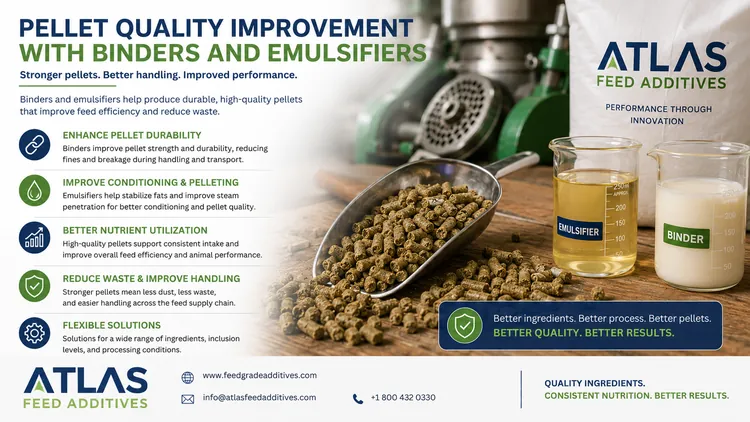
Feed additive decisions are strongest when they begin with a clear production objective. Pellet Quality Improvement with Binders and Emulsifiers is not a single-product decision; it is a practical process of matching animal needs, raw material risk, feed manufacturing conditions, equipment capability, and the commercial target.
Why this topic matters
Pellet quality affects feed handling, dust level, transport losses, feeder performance, animal intake, and the consistency of nutrient delivery. A durable pellet can reduce fines and improve presentation, but the goal should not be hardness alone. Feed mills need pellets that hold together while still supporting intake, digestibility, and overall production performance.
Improving durability without sacrificing nutritional performance requires attention to grinding, mixing, conditioning, die configuration, fat addition, cooling, storage, and additive selection. In real operations, results depend on feed formula, raw material quality, moisture, starch level, fiber level, fat source, species target, and how consistently the binder or emulsifier program is applied.
Practical approach
- Good manufacturing practice determines whether additives are delivered evenly and whether pellet quality gains are repeatable.
- Review dosing equipment, mixing time, conditioning temperature, steam quality, sequencing, and carryover controls before judging additive performance.
- Check pellet durability index, fines percentage, moisture, temperature after cooling, throughput, energy use, and customer complaints.
- Maintain sampling records, retained samples, corrective actions, and batch notes so quality changes can be linked to production conditions.
Where binders may help
Binders are commonly reviewed when pellets break during cooling, conveying, bagging, bulk loading, or farm delivery. The right binder can help improve cohesion, reduce fines, and support more consistent pellet appearance. However, binder performance depends heavily on formula composition, particle size, moisture, conditioning, die pressure, and the point of addition.
Buyers should review binder type, recommended inclusion range, carrier, flowability, moisture contribution, heat stability, and compatibility with other ingredients. A binder should support the feed manufacturing process, not hide deeper problems such as poor grinding control, inadequate conditioning, worn dies, weak cooling, or excessive post-pellet handling damage.
Where emulsifiers may fit
Emulsifiers are often considered when the formula contains added fats or oils and the goal is to support fat utilization, mixing behavior, or feed processing consistency. In some programs, emulsifiers may be reviewed together with binders because fat level and fat addition point can influence pellet quality, pellet durability, and fines formation.
When evaluating emulsifiers, buyers should consider target species, fat source, dosage, application point, processing temperature, compatibility with the premix, and whether the product is intended mainly for nutritional support, processing support, or both. The best decision usually comes from comparing production data with animal performance indicators rather than looking at pellet durability alone.
Product groups to review
Depending on the challenge, the following product group may be worth reviewing with your nutrition, technical, quality, or procurement team:
Buyer checklist
Before ordering, request the product specification, certificate of analysis, shelf-life, storage conditions, recommended inclusion range, packaging details, and destination-market documents. For pellet quality programs, also review binder or emulsifier format, carrier type, flowability, application point, heat stability, moisture impact, and compatibility with the existing formula.
For commercial trials, define the baseline, control group, feed batches, performance indicators, and review period before the additive is introduced. Useful indicators may include pellet durability index, fines at mill dispatch, fines at farm delivery, moisture, throughput, energy use, die performance, animal intake, feed conversion, and customer feedback.
How Atlas Feed Additives can support
Atlas Feed Additives can help buyers compare feed-grade additive options, coordinate supplier documentation, and structure inquiries for international shipments. We can support discussions around binder selection, emulsifier review, target feed type, production challenge, packaging preference, and destination-market requirements.
Send the target species, feed format, current pellet quality issue, production conditions, product group, expected quantity, destination country, and required documents so we can review the request efficiently.