
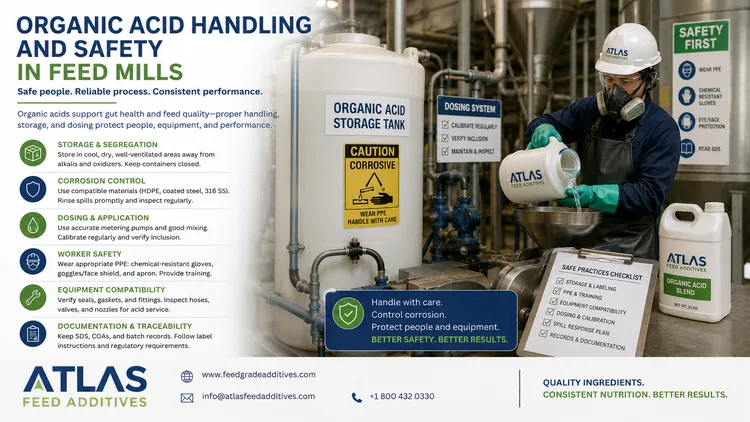
Feed additive decisions are strongest when they begin with a clear production objective. Organic Acid Handling and Safety in Feed Mills is not a single-product decision; it is a practical process of matching animal needs, acidifier format, raw material risk, feed manufacturing conditions, operator safety, equipment compatibility, and the commercial target.
Why this topic matters
Organic acids and acidifier blends can support feed hygiene, preservation goals, gut health programs, and feed quality strategies, but they also require careful handling. Depending on the product format, concentration, carrier, and application method, buyers may need to consider odor, corrosion, dust, liquid dosing accuracy, storage temperature, and worker protection.
Practical storage, corrosion, dosing, and worker-safety planning help prevent avoidable quality problems and production interruptions. In real operations, results depend on feed quality, product form, equipment design, storage discipline, operator training, destination climate, and how consistently the additive is applied.
Practical approach
- Good manufacturing practice determines whether organic acids are delivered evenly and safely into premixes or finished feed.
- Review dosing equipment, mixing time, sequencing, liquid application points, dry carrier behavior, and carryover controls before routine use.
- Check safety data sheets, personal protective equipment, ventilation, spill response, eyewash access, and operator training requirements.
- Maintain sampling records, retained samples, maintenance notes, corrosion observations, and corrective actions for traceability.
Storage and packaging considerations
Organic acids may be supplied as liquids, coated products, salts, blends, or dry carrier-based formulations. Each format has different storage and handling requirements. Liquid products may need compatible tanks, pumps, seals, pipes, and dosing lines, while dry blends may require moisture control, dust control, and attention to flowability.
Buyers should confirm whether the packaging is suitable for the destination climate and expected storage time. Drums, IBCs, lined bags, sealed pails, or moisture-resistant bags may be used depending on the product. Labels should remain readable, lot numbers should be traceable, and containers should be stored away from incompatible materials according to supplier guidance.
Corrosion and equipment compatibility
Corrosion risk depends on acid type, concentration, water content, contact time, temperature, and equipment material. Feed mills should review whether tanks, pumps, dosing lines, nozzles, conveyors, mixers, and contact surfaces are compatible with the selected product.
Before scaling up, it is useful to inspect seals, fittings, valves, and dosing points after initial use. A small leak or unsuitable material can create safety, odor, maintenance, and production problems. Compatibility checks should be included in the purchasing discussion rather than left only to the production team after delivery.
Dosing and production control
Accurate dosing is important because organic acids are often used for a defined technical purpose. Overdosing may increase cost, odor, palatability concerns, or handling risk, while underdosing may fail to deliver the intended benefit. Dosing equipment should be calibrated, and operators should record actual usage against batch targets.
For liquid acidifiers, review pump accuracy, line flushing, nozzle placement, and distribution across the feed stream. For dry products, review premix uniformity, particle size, carrier quality, and mixing sequence. When product format changes, the feed mill should recheck handling behavior instead of assuming the same procedure will work.
Product groups to review
Depending on the challenge, the following product group may be worth reviewing with your nutrition, technical, quality, safety, or procurement team:
Buyer checklist
Before ordering, request the product specification, certificate of analysis, safety data sheet, shelf-life, storage conditions, recommended inclusion range, packaging details, and destination-market documents. For organic acids, also review active composition, concentration, pH where relevant, corrosiveness, carrier type, application point, handling precautions, and equipment compatibility notes.
For commercial trials, define the baseline, control group, feed batches, quality indicators, safety checks, and review period before the additive is introduced. Useful indicators may include dosing accuracy, odor observations, equipment condition, feed uniformity, production interruptions, worker feedback, retained sample condition, feed intake, feed conversion, and customer complaints depending on the application.
How Atlas Feed Additives can support
Atlas Feed Additives can help buyers compare feed-grade additive options, coordinate supplier documentation, and structure inquiries for international shipments. We can support discussions around liquid or dry acidifier format, packaging preference, safety documentation, equipment questions, supplier comparison, and destination-market requirements.
Send the target species, feed format, current challenge, acidifier type if known, expected quantity, destination country, storage conditions, dosing system, and required documents so we can review the request efficiently.