
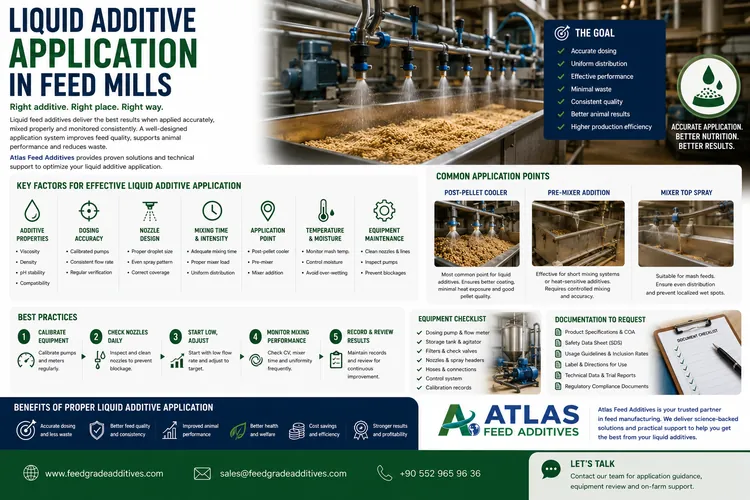
Feed additive decisions are strongest when they begin with a clear production objective. Liquid Additive Application in Feed Mills is not a single-product decision; it is a practical process of matching additive properties, dosing equipment, application point, mixing conditions, feed type, and the commercial target.
Why this topic matters
Liquid additives can support feed quality, nutrient delivery, pellet performance, hygiene programs, palatability, or antioxidant protection, depending on the product and application. However, even a well-selected product can underperform if it is sprayed unevenly, added at the wrong point, stored incorrectly, or applied without proper equipment calibration.
Nozzle design, mixing time, and application-point considerations are central to consistent performance. In real operations, the result depends on product viscosity, pump accuracy, spray pattern, line pressure, mixer loading, feed particle size, batch size, equipment cleanliness, and how consistently the additive is applied across production shifts.
Practical approach
- Confirm that the dosing system, pump, meter, tank, pipework, and nozzles are suitable for the liquid product being used.
- Review product viscosity, storage temperature, agitation requirements, solubility, and whether the product separates during storage.
- Check nozzle position, spray angle, droplet size, pressure, flow rate, and coverage across the mixer or coating point.
- Review dosing equipment, mixing time, sequencing, flush procedures, and carryover controls before routine production begins.
- Maintain calibration records, batch records, sampling results, cleaning logs, and corrective actions for quality-control review.
Application points to review
Liquid additives may be applied in the mixer, on finished feed, before pelleting, after pelleting, or at a dedicated coating point. The correct location depends on the product objective and its sensitivity to heat, pressure, moisture, or processing conditions. Some liquids are intended for uniform distribution inside the batch, while others are better suited to post-pellet application where heat exposure is lower.
The application point should be reviewed together with the feed form. Mash feed, pellets, crumbles, and coated products may each require different spray coverage, retention time, and mixing behavior. A practical review should also consider whether the liquid affects flowability, dust, pellet durability, moisture, or the risk of material build-up inside equipment.
Product groups to review
Depending on the challenge, the following product groups may be worth reviewing with your nutrition, technical, quality, or procurement team. Vitamins and vitamin-like nutrients may need careful protection if they are sensitive to heat, oxidation, or long storage. Trace minerals and specialty minerals should be reviewed for compatibility when included in liquid or semi-liquid systems. Antioxidants may help protect oils, fats, vitamins, pigments, or other oxidation-sensitive ingredients.
When comparing liquid additives, buyers should check active concentration, carrier system, viscosity, density, pH, storage conditions, shelf-life, packaging format, application method, and compatibility with existing mill equipment. The product should be selected not only for its function, but also for whether the feed mill can dose and distribute it accurately.
Equipment and quality-control points
Good manufacturing practice determines whether additives are delivered evenly. Pump calibration, tank scale accuracy, nozzle condition, line flushing, and mixer performance should be checked regularly. Blocked nozzles, worn pumps, air pockets, temperature changes, or incorrect pressure can all create under-dosing, over-dosing, or poor distribution.
Sampling should be planned before a new liquid application program starts. Retention samples, batch records, flow checks, and occasional distribution tests help confirm that the system is working as expected. If the product is used at low inclusion rates, dosing accuracy and uniformity become even more important.
Trial and production review
For commercial trials, define the baseline, product objective, inclusion rate, application point, batch size, mixing time, feed type, sampling method, and review period before the additive is introduced. Practical indicators may include dosing accuracy, mixer uniformity, pellet quality, product build-up, feed moisture, dust level, flow behavior, animal performance, and customer feedback.
Results should be interpreted carefully because problems may come from equipment, formulation, product properties, or operating conditions. A structured trial helps separate product performance from mechanical issues and supports better decisions before the application is expanded across more formulas or production lines.
Buyer checklist
Before ordering, request the product specification, certificate of analysis, active concentration, shelf-life, storage conditions, recommended inclusion range, packaging details, safety data sheet, and destination-market documents. For liquid application, also ask for viscosity, density, pH, recommended storage temperature, mixing or agitation guidance, equipment compatibility, and cleaning instructions.
For international shipments, confirm label requirements, customs documentation, product classification, batch traceability, palletization, leakage protection, and whether the product is accepted in the destination market. These details help procurement, production, and quality-control teams evaluate the product before it enters routine feed manufacturing.
How Atlas Feed Additives can support
Atlas Feed Additives can help buyers compare feed-grade additive options, coordinate supplier documentation, and structure inquiries for international shipments. Our team can support the early review stage by clarifying the product group, target species, production phase, application point, packaging format, destination country, and document expectations.
Send the target application, current manufacturing challenge, product group, estimated quantity, and destination country so we can review the request efficiently and help identify suitable feed additive options for your feed mill program.