
Silage and forage additives

Sodium Benzoate Silage Additive

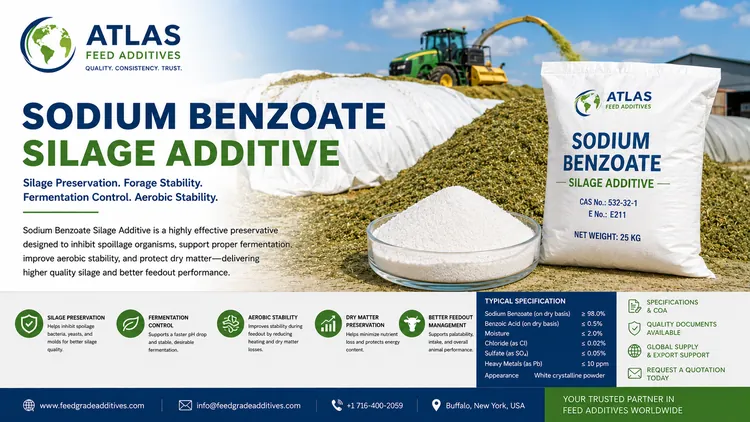
Sodium Benzoate Silage Additive is a forage preservation product used in silage programs where fermentation control, dry-matter preservation, aerobic stability, feedout quality, yeast and mold pressure management, and consistent feed-grade documentation are important.

Sodium Benzoate Silage Additive feed additive visual

Product role

Where Sodium Benzoate Silage Additive fits

Sodium Benzoate Silage Additive is part of the silage and forage additives group. It is typically evaluated as a preservative-style forage additive for silage programs that require support for fermentation quality, dry-matter retention, aerobic stability, feedout performance, and protection against quality losses during storage and bunker-face exposure.

Forage quality can be affected by crop maturity, dry matter level, packing density, oxygen exclusion, chop length, harvest hygiene, inoculation strategy, storage time, sealing quality, feedout rate, and weather conditions. Sodium Benzoate Silage Additive should therefore be reviewed as part of a full forage management program rather than as an isolated ingredient.

Buyers may consider this product for corn silage, grass silage, alfalfa haylage, whole-crop silage, high-moisture grain, and other forage systems where permitted. It may be especially relevant when the buyer is concerned about warm-weather feedout, slow face removal, bunker-face heating, yeast and mold pressure, or dry-matter losses during storage.

Buyers usually evaluate Sodium Benzoate Silage Additive by reviewing assay, active ingredient concentration, solubility, physical form, application rate, carrier system, applicator compatibility, storage stability, packaging, shelf life, origin, and the quality of documents such as a certificate of analysis and safety data sheet.

Atlas Feed Additives can coordinate international supplier options for forage additive distributors, dairy farms, beef operations, feed mills, premix producers, contractors, integrators, and importers that need consistent material, technically comparable offers, export-ready documents, and practical sourcing support.

Typical applications

  • Corn silage programs where aerobic stability and feedout quality are important
  • Grass silage and haylage systems exposed to variable dry matter and weather conditions
  • High-moisture grain and whole-crop silage where storage stability is a key concern
  • Dairy and beef forage programs requiring consistent feed hygiene and dry-matter preservation
  • Warm-weather feedout, bunker-face management, and slow face-removal situations
  • Silage programs where yeast, mold, heating, or spoilage pressure is a repeated challenge
  • Distributor and contractor programs requiring water-soluble or applicator-compatible additive options

Buyer quality checklist

  • Declared Sodium Benzoate assay and active ingredient concentration
  • Application rate guidance by forage type, dry matter, and storage challenge
  • Water solubility, mixing behavior, and applicator compatibility
  • Physical form, carrier system, dust level, and flowability
  • Packaging protection, shelf life, and storage temperature guidance
  • Batch traceability, production date, and expiration date
  • Certificate of analysis, safety data sheet, origin information, and technical data sheet
  • Market-specific documents required for import, registration, labeling, or distributor approval

Technical overview

Key points for forage programs and sourcing

Sodium Benzoate Silage Additive is selected for preservation and stability support in forage systems, but commercial products can differ by concentration, solubility, physical form, carrier system, application rate, and documentation. Buyers should request a complete technical specification before comparing offers, especially when the product will be used with farm applicators, contractor equipment, or distributor programs.

Silage performance depends on the full harvesting and storage process. Crop dry matter, sugar content, buffering capacity, chop length, compaction, sealing, oxygen exclusion, storage time, feedout rate, and face management all affect the final result. A silage additive can support a program, but it cannot replace good ensiling practice, proper packing, clean equipment, and effective storage management.

Sodium Benzoate products used for silage may be supplied as powder, granule, crystalline material, or a formulated blend. Water solubility and applicator compatibility are especially important if the product will be mixed into a tank solution and applied through a forage harvester, baler, wagon, or stationary applicator.

Use should be determined by qualified nutrition, forage, and quality teams. Sodium Benzoate Silage Additive should be selected according to forage type, dry matter level, target application rate, storage system, feedout challenge, climate, supplier guidance, customer requirements, and applicable market rules.

Specification guidance

Common specification areas buyers review

Assay and active ingredient declaration

Buyers should confirm the declared Sodium Benzoate assay and active ingredient basis used in supplier documentation. This helps technical teams compare offers, calculate cost per treated ton of forage, and confirm whether the product matches the intended application program.

Application rate and treated-ton cost

For silage additives, the most meaningful comparison is often cost per treated ton, not only price per kilogram. Buyers should compare active concentration, application rate, packaging size, preparation method, and labor or applicator requirements.

Water solubility and tank mixing

If the product will be applied in liquid form, water solubility and tank-mixing behavior are critical. Buyers should confirm mixing order, water quality guidance, agitation requirements, solution stability, and whether the product is compatible with the intended applicator system.

Physical form and handling

Powder, crystalline, granular, or carrier-based forms can influence dust, flowability, measuring accuracy, dissolving speed, and warehouse handling. The best format depends on whether the buyer uses manual dosing, farm applicators, contractor systems, or premix-style preparation.

Forage type and dry matter range

Buyers should match the product to the forage type and dry matter range. Corn silage, grass silage, haylage, whole-crop silage, and high-moisture grain can have different fermentation profiles and different stability challenges.

Aerobic stability and feedout context

Aerobic stability becomes especially important during feedout, when oxygen reaches the silage face and exposed forage can heat. Buyers should consider face removal rate, climate, bunker management, feedout duration, and whether the product is intended to support stability during this stage.

Packaging and storage protection

Packaging should protect the product from moisture, contamination, caking, and damage during transport. Buyers should confirm bag type, net weight, palletization, labeling, shelf life, storage guidance, and container loading details before shipment.

Documentation and compliance

A complete document set helps buyers manage supplier approval, customs clearance, distributor registration, customer audits, and regulatory review. Required documents should be confirmed before purchase because acceptance requirements can vary by country and application category.

Procurement note

Ask for the right specification before comparing prices.

Price comparisons are meaningful only when assay, active ingredient concentration, application rate, physical form, solubility, packaging, origin, shelf life, storage requirements, and documentation are aligned. A lower unit price may not represent better value if the product has weaker solubility, incomplete application guidance, unsuitable packaging, or a higher cost per treated ton.

For silage additives, buyers should also review forage type, dry matter range, harvest conditions, feedout challenge, applicator equipment, label instructions, batch traceability, and local market rules. Documents should be checked before shipment to reduce customs, quality approval, distributor registration, and receiving delays.

Forage industry relevance

Why buyers evaluate silage additives carefully

Silage additives are used to support forage quality, but their value depends heavily on practical field conditions. Harvest timing, crop dry matter, chopping, packing, sealing, and feedout management can all influence whether the additive program delivers the expected result.

For dairy and beef producers, forage quality directly affects ration consistency, intake, production planning, and feed cost. A supplier that can provide consistent active content, reliable certificates of analysis, clear application guidance, durable packaging, and predictable lead times may offer stronger value than a supplier selected only by the lowest price.

Buyers should also evaluate total landed cost, freight, customs clearance, documentation charges, packaging durability, farm storage conditions, distributor support, and the cost per treated ton of forage.

Handling and storage

Practical storage considerations

  • Store in a clean, dry, and well-ventilated area according to the supplier’s safety data sheet.
  • Keep packaging closed when not in use to help prevent moisture exposure and contamination.
  • Protect from water, high humidity, damaged packaging, excessive heat, and direct sunlight.
  • Use appropriate personal protective equipment according to workplace rules and the safety data sheet.
  • Maintain first-in, first-out inventory rotation according to production date and expiration date.
  • Prepare tank solutions only according to supplier guidance and use them within recommended time limits.
  • Store separately from incompatible materials and check damaged packages before use.
  • Follow applicable feed, workplace safety, transport, import, and labeling regulations.

Commercial support

How Atlas Feed Additives supports Sodium Benzoate Silage Additive buyers

Atlas Feed Additives supports customers that need practical sourcing coordination for feed-grade additives, including Sodium Benzoate Silage Additive. The objective is to help buyers receive technically comparable offers supported by clear specifications, realistic lead times, suitable documentation, and export-focused communication.

  • Review of buyer specification, target forage application, and required active concentration
  • Supplier option coordination based on quantity, destination, and documentation needs
  • Commercial comparison between available sodium benzoate silage additive offers
  • Packaging, palletization, and container loading coordination
  • Document collection for quality approval, customs, distributor registration, and import preparation
  • Support for repeat-order planning when buyers need seasonal or annual supply
  • Communication support for buyers comparing preservative-style additives and microbial silage inoculants

Buyer comparison

What to compare in supplier offers

Sodium Benzoate Silage Additive offers can look similar at first glance, but important differences may appear in active content, solubility, application rate, carrier system, physical form, packaging, documentation, and lead time. A complete offer should make the technical and commercial conditions clear before the buyer commits to an order.

  • Product grade and intended silage-use category
  • Declared assay and supporting certificate of analysis
  • Active ingredient concentration and cost per treated ton
  • Recommended application rate and forage-type guidance
  • Water solubility, tank-mixing behavior, and applicator compatibility
  • Physical form, dust level, flowability, and handling profile
  • Moisture, insoluble matter, appearance, and impurity limits
  • Storage temperature, shelf life, production date, and expiration date
  • Bag size, pallet configuration, and container loading estimate
  • Production origin and shipment origin
  • Lead time, minimum order quantity, and seasonal supply capability
  • Document availability before shipment

Application context

How Sodium Benzoate Silage Additive is evaluated in forage programs

Sodium Benzoate Silage Additive is typically evaluated within the complete forage preservation plan. Forage teams may consider crop type, dry matter, sugar level, buffering capacity, chop length, packing density, oxygen exclusion, storage structure, climate, feedout rate, and bunker-face management before selecting the most appropriate additive strategy.

The product may also be compared with bacterial silage inoculants such as Lactobacillus plantarum, Lactobacillus buchneri, Pediococcus pentosaceus, and Enterococcus faecium. Inoculants and preservative-style additives can have different objectives, so the best choice depends on whether the buyer is prioritizing fermentation speed, lactic acid production, aerobic stability, yeast control, or feedout stability.

Because silage additive programs are seasonal and time-sensitive, buyers should plan procurement early. Supplier consistency, document readiness, shipping reliability, correct storage, and clear application guidance can be just as important as the initial product price.

Documentation workflow

Recommended approval steps before shipment

A structured document review helps buyers avoid delays during seasonal purchasing, customs clearance, distributor approval, farm delivery, and customer audits. Sodium Benzoate Silage Additive should be approved by both the technical team and the purchasing team before shipment is confirmed.

  • Confirm product name, grade, active concentration, and intended silage-use category.
  • Review specification and certificate of analysis against the buyer’s internal limits.
  • Check safety data sheet, handling instructions, storage requirements, and shelf life.
  • Confirm application rate, treated-ton calculation, and applicator compatibility.
  • Confirm packaging size, palletization, container loading, and label information.
  • Verify country of origin, batch traceability, production date, and expiration date.
  • Confirm destination-market documents before loading.
  • Retain approved documents for customer audits and repeat-order comparison.

Questions

Useful answers

What is Sodium Benzoate Silage Additive used for in animal nutrition?

Sodium Benzoate Silage Additive is used in silage and forage programs where buyers want support for fermentation control, dry-matter preservation, aerobic stability, feedout management, and forage quality protection. It may be considered for corn silage, grass silage, haylage, high-moisture grain, and other forage applications depending on crop type, dry matter, application objective, and applicable market rules.

Can Atlas Feed Additives quote Sodium Benzoate Silage Additive?

Yes. Send your required specification, active concentration, quantity, destination, packaging preference, preferred Incoterms, and required documents. Atlas Feed Additives can review suitable supplier options and provide quotation support for Sodium Benzoate Silage Additive.

What quality documents should buyers request for Sodium Benzoate Silage Additive?

Common documents include product specification, certificate of analysis, safety data sheet, country of origin information, batch details, shelf-life statement, packaging information, storage instructions, application guidance, and any certificates required by the destination market or buyer’s internal approval process.

Is Sodium Benzoate Silage Additive suitable for every forage program?

No single silage additive is suitable for every situation. Suitability depends on forage type, dry matter, harvest conditions, storage structure, packing density, sealing quality, feedout rate, climate, application method, local regulations, and the buyer’s forage-quality objective.

Is Sodium Benzoate Silage Additive the same as a bacterial inoculant?

No. Sodium Benzoate Silage Additive is a preservative-style additive, while bacterial inoculants are based on selected microbial strains. Buyers should compare the options according to fermentation objective, aerobic stability target, crop type, feedout conditions, and supplier guidance.

Why is applicator compatibility important?

Many silage additives are applied through forage harvesters, balers, wagons, or stationary applicators. Buyers should confirm water solubility, tank mixing, solution stability, recommended dilution, and equipment compatibility before use.

What makes Sodium Benzoate Silage Additive offers difficult to compare?

Offers may differ by assay, active concentration, application rate, solubility, physical form, carrier system, packaging, shelf life, origin, lead time, document quality, shipment terms, and treated-ton cost. Buyers should compare the complete technical and commercial offer, not only the price per kilogram.

What details should be included in a quotation request?

A complete request should include product name, target active concentration, intended forage type, expected treated tonnage, quantity, destination, preferred Incoterms, packaging preference, application method, required documents, target shipment date, and any registration, labeling, import, or customer-specific requirements.

How should Sodium Benzoate Silage Additive be stored?

Sodium Benzoate Silage Additive should be stored according to the supplier’s safety data sheet and label instructions. In general, buyers should keep the product in clean, dry, well-ventilated storage, protect it from moisture and heat, keep packaging closed, and rotate stock according to production date and shelf life.

Request a quotation

Tell us what you need

Send your product list, target specification, active concentration, destination country, packaging preference, quantity, preferred Incoterms, intended forage application, required documents, and target delivery date. Our team will review your request and respond from orders@feedgradeadditives.com.