Phytogenics and botanical extracts

Quillaja Saponins

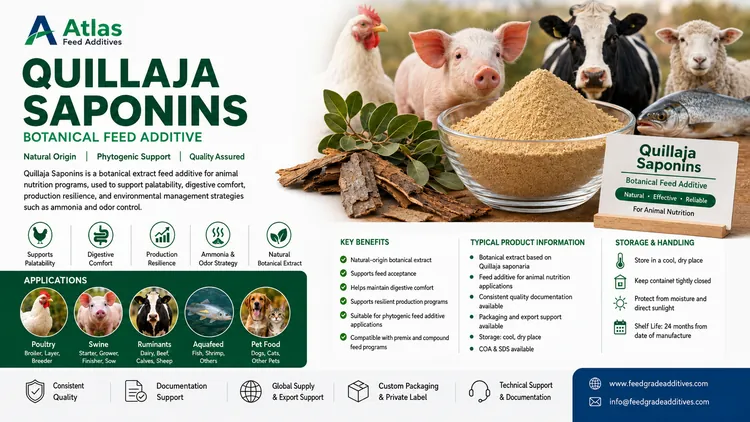
Quillaja Saponins are botanical-origin feed additive ingredients used in phytogenic programs focused on palatability, digestive comfort, production resilience, natural-origin positioning, and selected feed management strategies.

Quillaja Saponins feed additive visual

Product role

Where Quillaja Saponins fit

Quillaja Saponins are part of the phytogenics and botanical extracts group. They are commonly evaluated by feed mills, premix producers, additive manufacturers, distributors, aquaculture companies, poultry and swine integrators, ruminant nutrition suppliers, and pet food manufacturers that require natural-origin ingredients for targeted feed additive programs.

In animal nutrition, botanical extracts should be evaluated by the exact technical specification rather than by the plant name alone. Quillaja-based products can differ in saponin content, extraction method, botanical raw material, carrier, physical form, solubility, particle size, odor, taste impact, heat stability, moisture sensitivity, contaminant profile, and documentation.

Atlas Feed Additives can coordinate international supplier options for feed-grade Quillaja Saponins based on marker compound level, standardization method, carrier system, physical form, application area, packaging, origin, destination-market requirements, and shipment documentation.

Typical applications

  • Poultry, swine, ruminant, aquaculture, and pet food programs using phytogenic or botanical-origin feed additives.
  • Natural-origin feeding programs focused on digestive comfort, palatability, resilience, and performance-oriented formulation strategies.
  • Botanical premixes that combine saponins with essential oils, organic acids, yeast products, probiotics, minerals, enzymes, or plant extracts.
  • Antibiotic-reduction, wellness-oriented, and productivity-support programs where allowed by local rules and customer policy.
  • Odor and ammonia-management strategies where the specific product, formulation, and claim are suitable for the target market.
  • Aquafeed applications where botanical ingredients are evaluated for feed intake, gut support, and water-stable feed systems.
  • Specialty feed additive blends requiring standardized botanical marker compounds and consistent documentation.

Buyer quality checklist

  • Saponin concentration and analytical method.
  • Standardization approach and batch-to-batch consistency.
  • Botanical source, extraction method, and country of origin.
  • Physical form, carrier, solubility, dispersibility, and particle size.
  • Heat stability, shelf life, moisture sensitivity, and storage guidance.
  • Odor, taste, color, and potential sensory impact in the finished feed.
  • Contaminant controls including heavy metals, microbiology, pesticide residues, and mycotoxins where required.
  • Market-specific authorization, claim support, customer approval, and documentation availability.

Technical overview

Why botanical extract specification matters

Quillaja Saponins are not all the same. Two offers may both be described as quillaja extract, but they can differ greatly in total saponin content, carrier, extraction process, solubility, concentration, odor profile, taste impact, color, moisture level, heat stability, and cost-in-use.

For botanical feed additives, standardization is especially important. Buyers should understand whether the product is standardized to total saponins, a supplier-specific marker, a dry matter basis, or a formulation basis. The method used for measuring active content affects formulation calculations, supplier comparison, and final product positioning.

Atlas Feed Additives helps buyers clarify these technical and documentation variables before comparing quotations, reducing the risk of mismatched grades, incomplete certificates, unclear claims, or products that do not fit the buyer's production process.

Specification guidance

Common Quillaja Saponins specification items

Final parameters depend on supplier, botanical raw material, extraction route, active marker method, carrier, and buyer application. Buyers should request a current product specification sheet and certificate of analysis for the exact grade being offered.

Identity and standardization

  • Product name and commercial grade name.
  • Botanical source and plant part where declared.
  • Active marker declaration, such as total saponins or supplier-defined marker.
  • Saponin concentration and analytical method.
  • Standardization basis, such as dry basis, as-is basis, or formulation basis.
  • Batch number, origin information, and traceability details.

Physical and formulation parameters

  • Appearance, color, odor, and physical form.
  • Powder, liquid, extract, carrier-based blend, or water-dispersible format.
  • Carrier or diluent declaration where applicable.
  • Particle size distribution or mesh size for dry grades.
  • Bulk density, flowability, and dusting behavior where required.
  • Solubility or dispersibility in water, oil, premix, or target feed matrix.

Quality and safety parameters

  • Certificate of analysis showing active marker result.
  • Moisture, loss on drying, ash, or dry matter where specified.
  • Heavy metals according to buyer or market requirements.
  • Microbiological profile where relevant.
  • Pesticide residue, mycotoxin, and undesirable substance information where requested.
  • Residual solvent declaration where applicable to the extraction process.

Commercial and logistics data

  • Packaging type and net weight per bag, drum, carton, or pallet unit.
  • Minimum order quantity and production lead time.
  • Shelf life and recommended storage conditions.
  • Pallet configuration and container loading estimate.
  • Incoterms, destination port, and shipment documentation.
  • Document availability before shipment for customer approval.

Application guidance

How buyers use Quillaja Saponins in animal nutrition

Poultry programs

Quillaja Saponins may be evaluated in poultry feed programs focused on natural-origin additive strategies, digestive comfort, feed efficiency support, litter or ammonia-management positioning where suitable, and performance resilience. Buyers should confirm claim language, market authorization, inclusion level, processing stability, and compatibility with other feed additives.

Swine programs

Swine nutrition programs may use botanical extract blends in starter, grower, finisher, or sow feed depending on formulation goals. Quillaja Saponins should be reviewed for palatability impact, carrier compatibility, premix uniformity, moisture sensitivity, and interaction with acids, minerals, enzymes, probiotics, or flavor systems.

Ruminant programs

In ruminant nutrition, quillaja-based ingredients may be considered as part of natural-origin additive systems, specialty premixes, or production-support formulations. Buyers should evaluate target claim, rumen compatibility, application form, feed processing, local rules, and customer expectations before purchase.

Aquafeed and pet food

Aquafeed and pet food applications often require strong attention to palatability, odor, color, extrusion stability, water stability, and label positioning. Quillaja Saponins may be evaluated as part of botanical feed additive blends, but the selected grade must fit the target formulation and processing route.

Formulation note

Match the extract grade to the claim and production process

Quillaja Saponins can be used in different product formats, including dry premixes, liquid additives, soluble formulations, and multi-component botanical blends. The best grade depends on the formulation objective, target species, inclusion level, feed processing method, storage conditions, and label or technical claim.

Buyers should avoid assuming that a concentrated extract, a carrier-based powder, and a liquid formulation are interchangeable. Each format may behave differently during mixing, pelleting, extrusion, storage, and final feed application.

Compatibility checks

Review before full-scale use

  • Compatibility with acids, essential oils, enzymes, probiotics, yeasts, minerals, and vitamins.
  • Effect on feed odor, color, taste, and palatability.
  • Heat stability during pelleting, conditioning, extrusion, or drying.
  • Solubility or dispersibility in the intended application medium.
  • Uniform distribution in premixes and finished feed.
  • Dusting, caking, hygroscopicity, and flow behavior.
  • Stability after transport and storage.
  • Suitability for the destination market and customer claim language.

Processing note

Botanical extracts need practical production trials

Botanical extracts can be sensitive to heat, moisture, oxidation, light, and interactions with other feed ingredients. When introducing Quillaja Saponins into a new formula, buyers should test the exact product under their own production conditions rather than relying only on general product descriptions.

Useful checks may include mixing uniformity, active marker retention, pellet or extrusion stability, premix shelf-life testing, sensory evaluation, flowability testing, and compatibility checks with other actives. These trials are especially important when the product is used in high-value premixes, aquafeed, pet food, or export-oriented formulations.

Trial checklist

  • Confirm the active marker before and after processing.
  • Check odor and taste impact in the finished feed.
  • Review flowability after storage.
  • Check compatibility with the premix carrier.
  • Evaluate heat stability where pelleting or extrusion is used.
  • Confirm label and claim language with regulatory teams.

Quality documents

Documents to request before purchase

Documentation requirements vary by country, customer, species, certification program, and final product positioning. Atlas Feed Additives can help buyers organize supplier documentation for commercial and technical review before shipment.

Core documents

  • Product specification sheet.
  • Certificate of analysis for the offered batch or representative batch.
  • Safety data sheet.
  • Technical data sheet.
  • Batch number, production date, expiry date, and shelf-life statement.
  • Botanical origin and extraction process information where available.

Analytical and quality documents

  • Saponin content or active marker result.
  • Analytical method or standardization explanation where available.
  • Moisture, ash, or dry matter information where relevant.
  • Particle size or bulk density information for powder grades.
  • Heavy metal, microbiological, pesticide, mycotoxin, and contaminant results where required.
  • Residual solvent statement where applicable.

Compliance and customer documents

  • GMO, allergen, BSE/TSE, irradiation, and residual solvent statements where requested.
  • Feed-grade suitability declaration where applicable.
  • Halal, kosher, ISO, HACCP, GMP+, FAMI-QS, organic-related, or other certificates when available.
  • Country of origin certificate when required.
  • Market-specific feed additive documentation where applicable.
  • Supplier questionnaire or vendor approval documents when requested by the buyer.

Shipment documents

  • Commercial invoice and packing list.
  • Bill of lading, airway bill, or transport document.
  • Pallet configuration and container loading details.
  • Packaging specification and label copy where required.
  • Phytosanitary, plant-origin, or import documents where applicable.
  • Pre-shipment document review for import and customer approval.

Storage and handling

Protect active content, sensory quality, and flowability

Quillaja Saponins should be stored according to supplier instructions. In general, botanical extracts should be protected from moisture, excessive heat, direct sunlight, open air exposure, strong odors, and contamination. Packaging should remain sealed until use.

Because botanical ingredients may have sensory characteristics, warehouse teams should store them away from strong-smelling materials and maintain clean handling procedures. For powder grades, review caking, dusting, and flowability. For liquids, review viscosity, separation, pourability, and container integrity before use.

Warehouse checklist

  • Store in a clean, dry, ventilated area.
  • Keep containers sealed until use.
  • Protect from heat, direct sunlight, and humidity.
  • Separate from strong odors and incompatible materials.
  • Inspect packaging before acceptance and before use.
  • Record batch number, receiving date, and expiry date.
  • Use first-expiry, first-out stock rotation.
  • Follow the safety data sheet for handling precautions.

Procurement note

Ask for the right specification before comparing prices

Price comparisons are meaningful only when saponin concentration, active marker method, carrier, physical form, particle size, solubility, packaging, origin, shelf life, and documentation are aligned. A lower kilogram price may not be competitive if the active level is lower, the grade is less stable, or the documentation does not support the buyer's target market.

For botanical extracts, cost-in-use should consider active concentration, inclusion level, formulation compatibility, stability, customer acceptance, claim language, batch consistency, and supplier reliability. Buyers should request the specification and certificate of analysis before making purchasing decisions.

Quotation preparation

Information to send for a faster quote

  • Required product name: Quillaja Saponins or Quillaja Extract.
  • Target saponin concentration or active marker requirement.
  • Powder, liquid, water-dispersible, or carrier-based grade preference.
  • Application area such as poultry, swine, ruminant, aquafeed, pet food, or premix blend.
  • Expected first-order quantity and annual demand.
  • Destination country, destination port, or delivery location.
  • Required packaging size and pallet preference.
  • Required documents, certificates, and customer approval requirements.

Comparison guide

Quillaja Saponins compared with related phytogenic ingredients

Phytogenic feed additive sourcing should be based on active markers, botanical source, formulation purpose, stability, sensory impact, and market requirements. Quillaja Saponins are often evaluated alongside essential oils and other plant-derived actives in natural-origin feed programs.

Quillaja Saponins

Typically evaluated for standardized saponin content, botanical-origin positioning, digestive comfort strategies, palatability considerations, and selected odor or ammonia-management programs where suitable.

Oregano Oil

Often selected for essential-oil-based phytogenic blends. Buyers usually compare carvacrol and thymol levels, carrier system, encapsulation, odor profile, and heat stability.

Thyme Oil

Used in botanical and aromatic feed additive systems. Key checks include active marker content, sensory strength, formulation compatibility, stability, and regulatory positioning.

Cinnamaldehyde and Carvacrol

Concentrated plant-derived actives may be selected for specific phytogenic programs. Buyers should compare purity, carrier, encapsulation, volatility, odor impact, and compatibility with the target feed process.

Related products

Other phytogenics and botanical extracts

Atlas Feed Additives can support sourcing requests for Quillaja Saponins and other botanical feed ingredients used in natural-origin feed additive programs, digestive-support formulations, premixes, aquafeed, pet food, and specialty animal nutrition products.

Questions

Useful answers

What are Quillaja Saponins used for in animal nutrition?

Quillaja Saponins are used in natural-origin and phytogenic feeding programs where formulators are focused on palatability, digestive comfort, production resilience, feed additive blends, and selected odor or ammonia-management strategies. They should be used according to the target species, formulation objective, product specification, and applicable market rules.

Can Atlas Feed Additives quote Quillaja Saponins?

Yes. Send your required saponin content, specification, quantity, destination country, packaging preference, application area, and required documents so Atlas Feed Additives can review suitable supplier options for Quillaja Saponins.

What quality documents should buyers request for Quillaja Saponins?

Common documents include product specification, certificate of analysis, safety data sheet, technical data sheet, botanical origin information, batch details, standardization method, contaminant declarations, shelf-life statement, and market-specific certificates required by the buyer.

Why is saponin standardization important?

Saponin standardization helps buyers compare products on a consistent active basis. It affects formulation, dosage calculation, cost-in-use, batch consistency, technical positioning, and quality approval.

Are Quillaja Saponins suitable for all species?

Suitability depends on product grade, target species, inclusion level, formulation objective, technical guidance, customer requirements, and local market rules. Buyers should not assume universal suitability without reviewing the supplier specification and applicable regulations.

Can Quillaja Saponins be used in pelleted or extruded feed?

Some grades may be suitable for pelleting or extrusion, but heat stability depends on the exact product, carrier, processing temperature, residence time, moisture, and formulation. Buyers should run processing trials and review supplier stability data before full-scale use.

What should buyers compare between suppliers?

Buyers should compare saponin level, analytical method, botanical origin, carrier, physical form, solubility, particle size, stability, sensory impact, contaminant controls, documentation, packaging, shelf life, and cost-in-use.

How should Quillaja Saponins be stored?

Store according to supplier instructions, usually in sealed packaging, protected from moisture, excessive heat, direct sunlight, contamination, and strong odors. Maintain batch traceability and use first-expiry, first-out stock rotation.

Request a quotation

Tell us what you need

Send your product list, target saponin content, specification, destination country, packaging preference, application area, expected quantity, and required documents. Our team will review your request and respond from orders@feedgradeadditives.com.