Silage and forage additives

Potassium Sorbate Silage Additive

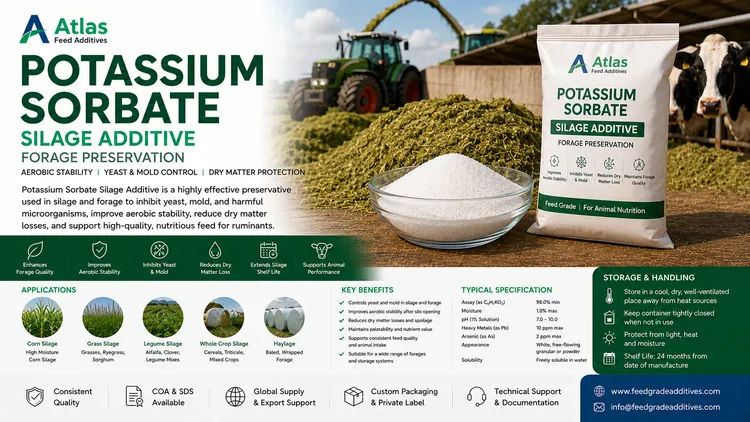
Potassium Sorbate Silage Additive is selected for forage programs where fermentation control, dry-matter preservation, yeast and mold management, aerobic stability, bunker-face quality, and warm-weather feedout performance are important technical objectives.

Potassium Sorbate Silage Additive feed additive visual

Product role

Where Potassium Sorbate Silage Additive fits

Potassium Sorbate Silage Additive is part of the silage and forage additives group. It is used in programs designed to support the stability of ensiled feeds, particularly where yeasts, molds, oxygen exposure, warm feedout conditions, bunker-face heating, or dry-matter losses can reduce forage value and animal intake.

In practical forage management, the additive may be used as a water-soluble powder, granule, liquid-compatible preparation, premix blend, or formulated silage additive. Buyers should compare offers by assay, sorbic acid equivalent, solubility, application rate, applicator compatibility, crop target, packaging, shelf life, storage needs, and regulatory status.

Atlas Feed Additives can coordinate international supplier options for forage additive distributors, dairy and beef nutrition companies, feed mills, premix producers, silage-service providers, integrators, importers, and farms that need feed-grade Potassium Sorbate Silage Additive supported by technical documents, batch-level certificates, and export-focused service.

What the product is designed to support

Silage quality depends on crop quality, chop length, dry matter, packing density, oxygen exclusion, sealing, fermentation speed, storage time, and feedout discipline. Potassium Sorbate Silage Additive is positioned for situations where yeast and mold activity, aerobic spoilage, and feedout heating are key risks.

  • supports aerobic stability during feedout and bunker-face exposure
  • helps manage yeast and mold pressure in suitable forage applications
  • supports dry-matter preservation when used as part of a complete silage program
  • helps reduce quality losses linked to oxygen exposure and warm feedout conditions
  • supports forage freshness and palatability management at the feed bunk
  • may be used with inoculants, acids, or preservative systems where compatible and authorized
  • supports dairy and beef forage programs where silage quality consistency is a priority

Typical applications

  • corn silage and maize silage programs
  • grass silage, haylage, and pasture-based forage systems
  • alfalfa silage and legume forage programs
  • whole-crop cereal silage
  • high-moisture corn and high-moisture grain
  • dairy and beef forage preservation programs
  • warm-weather feedout and bunker-face management
  • total mixed ration stabilization where suitable and authorized
  • silage additives paired with Lactobacillus buchneri or Lactobacillus plantarum where compatible
  • forage systems exposed to long storage, slow feedout, or high oxygen exposure

Technical identity

Key specification points for silage-additive buyers

Potassium Sorbate Silage Additive buyer reference table
Item Typical buyer reference Why it matters
Product group Silage and forage additive / technological additive Confirms the product category for purchasing, formulation, regulatory, and forage-program records.
Active component Potassium Sorbate, sorbate-based preparation, or formulated preservative blend Defines the active preservation system and distinguishes it from lactic acid bacteria inoculants.
Assay Supplier-declared Potassium Sorbate content or purity Supports active-basis comparison and correct application-rate calculation.
Sorbic acid equivalent Declared or calculated active sorbate contribution where required Useful when comparing potassium sorbate, sorbic acid, and formulated preservative blends.
Physical form Powder, granule, soluble powder, liquid-compatible preparation, or premix blend Affects mixing, dissolution, applicator compatibility, storage, and field use.
Water solubility Supplier guidance for solution preparation and applicator use Important for liquid application systems used during harvest or feedout treatment.
Application rate Recommended dose by crop type, dry matter, moisture, and feedout risk Forage conditions strongly influence the required preservation strategy.
Applicator compatibility Suitable for low-volume, high-volume, tank-mix, spray, or mixer application where specified Ensures the product can be delivered uniformly through the buyer’s equipment.
Storage stability Shelf life, moisture sensitivity, packaging protection, and solution stability where relevant Prevents caking, loss of quality, handling problems, or dosing errors.
Documentation Specification, COA, SDS, application guidance, origin, batch details, shelf life, authorization status Supports supplier approval, customs clearance, audits, traceability, and safe use.

Forage preservation context

Why aerobic stability matters

Aerobic instability occurs when silage is exposed to oxygen during feedout, bunker-face management, bag opening, transport, or mixing into a total mixed ration. Yeasts can use fermentation acids and create heat, which may lead to dry-matter loss, visible spoilage, mold growth, reduced palatability, and lower bunk stability.

Potassium Sorbate Silage Additive is used to help manage these risks in suitable applications. It is not a replacement for good ensiling management. Harvest timing, dry matter, chop length, packing density, rapid sealing, oxygen-barrier film, face management, removal rate, and clean feeding practices remain essential for successful forage preservation.

  • target high-risk crops, warm-weather feedout, or slow feedout situations
  • match application rate to dry matter, crop type, storage time, and aerobic spoilage risk
  • ensure uniform distribution through water application, mixer application, or approved equipment
  • monitor silage temperature, odor, mold, visible spoilage, and bunk refusals during feedout
  • combine additive use with tight packing, good sealing, and disciplined bunker-face management

Buyer quality checklist

What to verify before approval

Potassium Sorbate Silage Additive should be compared by active content, sorbic acid equivalent, solubility, crop target, application rate, field-use practicality, storage stability, and documentation. Buyers should avoid comparing only price per kilogram without considering active contribution and cost per treated ton of forage.

  • declared Potassium Sorbate assay or active level
  • sorbic acid equivalent or active contribution where required
  • product form: powder, granule, soluble powder, blend, or liquid-compatible product
  • water solubility and tank-mix behavior
  • recommended dose by crop type, dry matter, and feedout risk
  • applicator compatibility and solution preparation instructions
  • carrier type, particle size, dust level, and flowability
  • moisture content, caking tendency, and packaging protection
  • solution stability after mixing where relevant
  • compatibility with silage inoculants, enzymes, acids, and other preservatives
  • shelf life and storage temperature guidance
  • certificate of analysis for each batch or lot
  • market-specific authorization status for forage and feed use

Documents

Recommended document package

Atlas Feed Additives can help buyers request and organize the technical, safety, and commercial documents commonly required for supplier approval, import control, distributor registration, farm-use programs, customer audits, and export shipments.

  • product specification sheet
  • certificate of analysis by batch or lot
  • safety data sheet
  • technical data sheet
  • assay or active content declaration
  • sorbic acid equivalent declaration where required
  • application-rate guidance by crop or forage condition
  • water solubility and applicator-use instructions
  • country-of-origin statement
  • feed-grade or intended-use declaration where available
  • storage and handling guidance
  • GMO, allergen, BSE/TSE, contaminant, or microbiological statements where required
  • Halal, Kosher, ISO, FAMI-QS, GMP+, or other certificates if available and required
  • packing list, commercial invoice, and certificate of origin for export shipments

Application and handling

Practical notes for forage programs

Crop and dry-matter matching

Crop type, maturity, dry matter, sugar level, chop length, and packing density affect preservation needs. Application guidance should be matched to corn silage, grass silage, haylage, alfalfa, or high-moisture grain conditions.

Water application systems

When used through liquid applicators, the product should dissolve properly, remain compatible with tank conditions, and pass through pumps, lines, nozzles, and filters without blocking or settling.

Uniform coverage

Uniform application is essential. Uneven treatment can leave pockets of forage exposed to yeast, mold, heating, and dry-matter loss. Equipment calibration should be part of the program.

Feedout management

Aerobic stability is strongly affected by face management, daily removal rate, exposed surface area, weather, and TMR holding time. Additives work best when feedout practices are disciplined.

Compatibility review

Compatibility should be checked when Potassium Sorbate is used with lactic acid bacteria inoculants, enzymes, acids, propionates, benzoates, sugars, buffers, or mineral carriers.

Storage protection

Potassium Sorbate preparations should be protected from moisture and heat. Poor storage can cause caking, flow problems, dissolution issues, or reduced usability during the harvest season.

Application areas

Where Potassium Sorbate Silage Additive may be used

Typical forage and silage application areas
Application area Main objective Buyer considerations
Corn silage Support aerobic stability and feedout quality Review dry matter, packing density, feedout rate, yeast pressure, and application method.
Grass silage and haylage Support preservation in variable moisture and sugar conditions Check crop maturity, wilting quality, moisture, chopping consistency, and storage system.
Alfalfa silage Support quality preservation where buffering capacity and moisture create challenges Review dry matter, inoculant pairing, packing, sealing, and risk of heating during feedout.
High-moisture grain Help manage yeast and mold pressure during storage and feeding Confirm moisture level, processing method, storage duration, and application uniformity.
Total mixed ration Support bunk stability where TMR heating is a recurring issue Check authorized use, dose, mixing uniformity, feedout time, ambient temperature, and bunk management.
Warm-weather feedout Reduce quality losses linked to oxygen exposure and heat Review daily removal rate, exposed face size, silage density, and weather conditions.
Silage-service programs Offer targeted additive solutions for farms and forage contractors Confirm field applicator compatibility, pack size, dilution instructions, and operator training.

Procurement note

Ask for the right specification before comparing prices.

Price comparisons are meaningful only when assay, sorbic acid equivalent, product form, solubility, recommended application rate, target crop, packaging, shelf life, origin, authorization status, and documentation are aligned. A lower price per kilogram may not be economical if the product requires a higher dose, dissolves poorly, cakes during storage, or lacks field-use guidance.

For silage additives, the key commercial question is often not only “What is the price per kilogram?” but “What is the cost per treated ton of forage under my crop, dry matter, storage, feedout, and climate conditions?” Atlas Feed Additives helps buyers structure quotation requests so offers can be compared more accurately.

Quote request details to send

  • product name and required active specification
  • required assay or sorbic acid equivalent
  • target crop: corn silage, grass silage, haylage, alfalfa, high-moisture grain, or TMR
  • expected dry matter, moisture, or feedout challenge if available
  • preferred product form: soluble powder, granule, liquid-compatible product, or premix blend
  • target application rate or treated forage volume
  • required quantity and order frequency
  • destination country, port, or delivery address
  • preferred Incoterm
  • packaging requirement
  • required certificates and declarations
  • target shipment date and harvest-season timing

Commercial comparison

How to compare silage additive offers

Commercial and technical comparison points
Comparison point Ask the supplier Reason for review
Active content What is the guaranteed Potassium Sorbate content? Allows active-basis comparison and application-rate calculation.
Sorbic acid equivalent What active sorbate contribution should be used for formulation? Useful when comparing sorbate products, sorbic acid, or formulated silage blends.
Application rate What dose is recommended per ton of forage or per liter of solution? Determines true cost per treated ton rather than price per kilogram alone.
Solubility Does the product dissolve easily in water under field conditions? Prevents applicator plugging, poor coverage, and operator delays during harvest.
Applicator compatibility Can it be used with the buyer’s low-volume or high-volume applicator system? Ensures practical use during fast-moving harvest operations.
Blend compatibility Can it be used with inoculants, enzymes, acids, or preservatives? Prevents reduced activity, handling problems, or poor field performance.
Documents Which technical, quality, safety, and export documents are available? Reduces delays during supplier approval, customs clearance, and customer audits.
Packaging What bag, sachet, drum, carton, or pallet format is offered? Affects moisture protection, harvest-season handling, and distribution convenience.
Shelf life What is the remaining shelf life at shipment? Important for seasonal inventory planning and harvest timing.
Total treated cost What is the cost per treated ton at the recommended dose? Provides a more useful comparison than product price alone.

Packaging and logistics

Storage and shipment considerations

Potassium Sorbate Silage Additive should be protected from moisture, contamination, direct sunlight, excessive heat, strong odors, incompatible materials, and damaged packaging. Harvest-season products should be ordered early enough to avoid customs delays and to allow field teams to prepare applicators before crop arrival.

  • sealed bags, sachets, cartons, drums, or lined packaging suitable for moisture-sensitive products
  • moisture-resistant packaging where required
  • clear product, batch, net weight, manufacturing date, and expiry labeling
  • pack sizes suitable for farm, contractor, distributor, or forage-service use
  • palletized export packaging for international shipments
  • cool, dry, well-ventilated warehouse storage
  • first-expired, first-out inventory rotation
  • lot traceability from receipt to field application
  • storage away from strong odors, chemicals, moisture, and damaged packaging
  • harvest-season logistics planning to avoid late arrival during forage cutting windows

Who buys this product?

Suitable buyer profiles

  • dairy farm supply companies
  • beef and ruminant feed suppliers
  • silage additive distributors
  • forage contractors and silage-service providers
  • feed mills serving dairy and beef customers
  • premix and specialty additive manufacturers
  • large dairy farms and farm groups
  • importers building silage additive portfolios
  • nutrition companies managing forage quality programs
  • technical buyers comparing aerobic-stability solutions

Program positioning

Where Potassium Sorbate Silage Additive may add value

Aerobic stability

Potassium Sorbate Silage Additive may be selected where yeast growth, heating, and oxygen exposure reduce silage quality after opening. It is most useful when paired with good feedout discipline.

Warm-weather feedout

Hot weather can accelerate heating and spoilage. Sorbate-based forage additives may support stability in summer feeding programs and warm-climate dairy or beef operations.

Bunker-face management

Poor face management increases oxygen penetration and spoilage risk. Additives can help, but daily face removal, clean cutting, and tight face control remain essential.

High-moisture grain

High-moisture grain can face yeast and mold pressure during storage and feedout. Product suitability should be confirmed against moisture, processing method, and storage structure.

TMR stability

Some feeding systems require longer bunk exposure. Where authorized and technically suitable, sorbate-based systems may be evaluated for total mixed ration stability.

Distributor forage portfolios

Distributors can position this product alongside Lactobacillus buchneri, Lactobacillus plantarum, Pediococcus pentosaceus, Enterococcus faecium, enzyme blends, and preservative additives.

Why Atlas Feed Additives?

Support beyond a price quote

Atlas Feed Additives helps buyers approach silage-additive sourcing with a technical and commercial checklist. This is especially important because forage products vary by active concentration, solubility, application rate, crop suitability, field-use convenience, storage stability, packaging, and document availability.

  • supplier option review based on target specification
  • quotation coordination for seasonal or recurring demand
  • support for active-content and cost-per-treated-ton comparison
  • packaging, lead time, and logistics coordination
  • support for distributors, forage-service providers, nutrition companies, farms, and importers
  • export-focused communication from Ankara, Turkey
  • clear communication in English and Turkish

Important disclaimer

Use according to local rules and forage-management guidance

Potassium Sorbate Silage Additive should be used according to crop type, dry matter, product specification, supplier instructions, safety data sheet, qualified forage-management guidance, customer quality standards, and applicable market rules. Atlas Feed Additives does not replace veterinary, regulatory, agronomic, or nutritionist advice.

Silage additive authorization, allowed applications, maximum use levels, labeling requirements, import rules, and claims can vary by country. Buyers should confirm compliance before ordering, importing, labeling, selling, or using the product in forage programs.

Questions

Useful answers about Potassium Sorbate Silage Additive

What is Potassium Sorbate Silage Additive used for?

It is used in forage programs to support fermentation control, dry-matter preservation, yeast and mold management, aerobic stability, feedout quality, and forage freshness where the product is authorized and technically suitable.

Why is aerobic stability important in silage?

Aerobic instability can cause heating, yeast growth, mold development, dry-matter loss, reduced palatability, and lower feed value when silage is exposed to oxygen during feedout or bunker-face management.

Is Potassium Sorbate Silage Additive the same as a bacterial inoculant?

No. Potassium Sorbate is a preservative-type additive, while bacterial inoculants contain selected live lactic acid bacteria. They may be used in different roles or together where compatible, authorized, and technically justified.

Can it be used with Lactobacillus buchneri or Lactobacillus plantarum?

It may be used in certain additive systems where compatibility is confirmed. Buyers should ask the supplier whether the sorbate level, application timing, water solution, and storage conditions are compatible with live inoculant strains.

Can it be used for corn silage?

Yes, it may be considered for corn silage where aerobic stability, yeast pressure, warm-weather feedout, or bunker-face heating are concerns. Application rate should match dry matter, storage conditions, and supplier guidance.

Can it be used in high-moisture grain?

It may be used in high-moisture grain programs where authorized and suitable. Buyers should confirm moisture level, storage type, application method, dose, and local regulatory status.

What specification points should buyers compare?

Buyers should compare assay, sorbic acid equivalent, product form, water solubility, application rate, crop suitability, applicator compatibility, carrier, particle size, shelf life, packaging, origin, authorization status, and documentation.

What documents should buyers request?

Common documents include product specification, certificate of analysis, safety data sheet, technical data sheet, assay declaration, sorbic acid equivalent where relevant, application guidance, shelf-life declaration, storage guidance, origin statement, and market-specific certificates.

How should Potassium Sorbate Silage Additive be stored?

Store it in sealed original packaging in a cool, dry, well-ventilated area. Protect from moisture, heat, direct sunlight, contamination, strong odors, and damaged packaging. Follow the supplier’s SDS and storage instructions.

What field-use details should be checked before harvest?

Confirm application rate, dilution instructions, applicator type, nozzle compatibility, tank-mix behavior, water quality, treated-ton capacity, packaging size, operator instructions, and whether the product can be applied uniformly under harvest conditions.

Can Atlas Feed Additives quote Potassium Sorbate Silage Additive?

Yes. Send your required specification, crop target, treated-ton target, assay, application method, quantity, destination, packaging preference, required documents, preferred Incoterm, and shipment timing so Atlas Feed Additives can review suitable supplier options.

Can Atlas quote related silage additives?

Yes. Atlas Feed Additives can review requests for related products such as Lactobacillus plantarum silage inoculant, Lactobacillus buchneri silage inoculant, Pediococcus pentosaceus silage inoculant, Enterococcus faecium silage inoculant, silage enzyme blends, organic acid blends, and preservative additives depending on availability and target specification.

Request a quotation

Tell us what you need

Send your product list, required assay, crop target, treated-ton requirement, application method, destination country, packaging preference, annual or seasonal quantity, delivery term, required documents, and target shipment date. Our team will review your request and respond from orders@feedgradeadditives.com.