Silage and forage additives

Buffered Silage Acid Blend

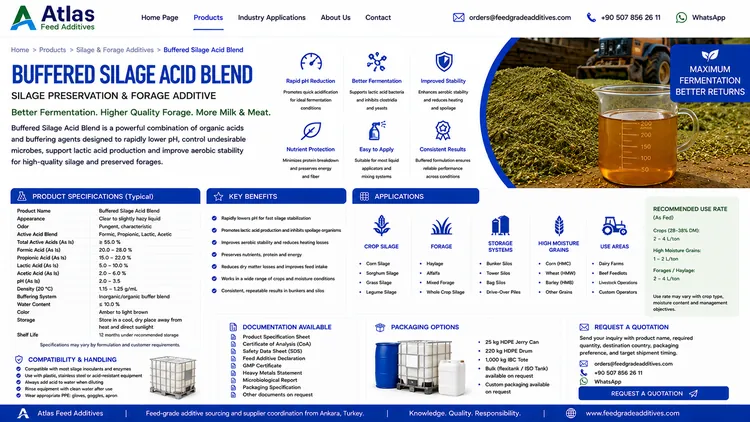
Buffered Silage Acid Blend is a silage and forage additive used to support fermentation control, dry-matter preservation, forage hygiene, aerobic stability, and feedout quality in corn silage, grass silage, haylage, high-moisture grain, and warm-weather forage programs.

Buffered Silage Acid Blend feed additive visual
  • Buffered acid system for forage preservation programs
  • Used in silage, haylage, high-moisture grain, and feedout management
  • Specification-driven sourcing and documentation review

Product role

Where Buffered Silage Acid Blend fits

Buffered Silage Acid Blend is part of the silage and forage additives group. It is commonly evaluated by dairy farms, beef operations, forage contractors, feed mills, premix companies, distributors, and integrators that need support for silage fermentation, dry-matter retention, aerobic stability, bunker-face quality, and forage hygiene.

Buffered acid blends are typically designed to provide organic acid activity while improving handling characteristics compared with some unbuffered liquid acids. Depending on supplier technology, the blend may include organic acids, organic acid salts, buffering agents, carriers, surfactants, stabilizers, or water-soluble components. Buyers should confirm the exact active profile and application guidance before comparing offers.

In forage preservation, product performance depends on many non-product factors: crop type, dry matter, sugar level, buffering capacity of the forage, chop length, packing density, oxygen exclusion, silo sealing, storage time, feedout speed, weather, water quality, applicator calibration, and farm-level management. A Buffered Silage Acid Blend should be used as part of a complete forage preservation plan, not as a substitute for proper harvest and storage practice.

Atlas Feed Additives can coordinate international supplier options for buyers that need consistent feed-grade Buffered Silage Acid Blend with export-focused documentation, specification review, packaging coordination, and quotation support.

Forage preservation concept

Why silage acid blends are used

Silage quality depends on rapid oxygen removal, favorable fermentation, good sealing, appropriate dry matter, controlled contamination, and stable feedout. When forage is harvested under difficult conditions, exposed to air, stored too wet or too dry, packed poorly, or fed out slowly in warm weather, the risk of nutrient loss and spoilage can increase.

Buffered Silage Acid Blend can be evaluated as a tool to support fermentation control, reduce storage losses, manage undesirable microbial pressure, and improve aerobic stability at feedout. The product must be matched to the forage type, harvest conditions, dry matter, application system, and intended outcome.

Commercial purpose

Why buyers request Buffered Silage Acid Blend

  • Support fermentation control in silage and forage programs
  • Help preserve dry matter and feed value during storage
  • Support aerobic stability during warm-weather feedout
  • Provide a buffered acid option with improved handling characteristics
  • Support bunker-face management and reduced spoilage pressure
  • Help manage variable harvest conditions, moisture, and crop quality
  • Support dairy and beef forage programs where forage consistency is important
  • Provide a technical alternative or complement to microbial silage inoculants
  • Improve purchasing consistency through specification-based sourcing
  • Support export projects requiring documentation, label clarity, and stable packaging

Application areas

Typical applications in forage and silage programs

Corn silage

Corn silage programs may use Buffered Silage Acid Blend where the goal is to support fermentation control, reduce spoilage pressure, and improve aerobic stability during feedout. Application should consider plant maturity, kernel processing, dry matter, chop length, packing density, bunker management, sealing, and feedout speed.

  • Relevant for bunker silos, piles, bags, and tower systems
  • Useful where warm-weather feedout and face heating are key risks
  • Should be evaluated with dry matter, starch maturity, packing density, and oxygen exclusion
  • Requires calibrated application equipment and even distribution

Grass silage and haylage

Grass silage and haylage can vary widely in dry matter, sugar content, buffering capacity, field wilting conditions, ash contamination, and packing behavior. Buffered acid blends may be considered where fermentation control, clostridial risk, dry-matter preservation, or aerobic stability are key concerns.

  • Relevant for grass, ryegrass, mixed forage, and haylage systems
  • Requires attention to wilting time, weather exposure, and soil contamination
  • Should be matched to crop dry matter and sugar level
  • Can be reviewed alongside microbial inoculants and forage-management practices

Alfalfa and legume silage

Alfalfa and legume crops often have higher buffering capacity than some grass or corn silages, which can make fermentation management more challenging. Buffered Silage Acid Blend may be evaluated where rapid acidification support and storage quality are commercial priorities.

  • Useful where legume buffering capacity makes pH management more difficult
  • Requires attention to dry matter, chop length, packing, and sealing
  • Should be reviewed with forage analysis and target animal program
  • Application rate should follow supplier guidance and local authorization

High-moisture grain

High-moisture corn and other high-moisture grains can be vulnerable to mold, yeast activity, heating, and storage losses if oxygen exclusion, moisture control, and treatment uniformity are weak. Buffered acid blends may be considered for preservation support in suitable systems.

  • Relevant for high-moisture corn and grain preservation programs
  • Requires uniform application and careful moisture management
  • Should be matched to storage structure and expected storage duration
  • Works best alongside good packing, sealing, and feedout discipline

Bunker-face and feedout management

Even well-fermented silage can deteriorate when exposed to oxygen during feedout. Buffered Silage Acid Blend may be evaluated where farms face heating, visible spoilage, slow feedout, loose face management, warm temperatures, or long total mixed ration exposure times.

  • Useful in warm-weather feeding programs and slow feedout situations
  • Should be combined with proper face shaving, rapid feedout, and clean delivery
  • Can support stability when forage is exposed to air after opening
  • Requires correct dilution, application, and safety procedures

Dairy and beef forage programs

Dairy and beef operations rely on consistent forage quality for ration stability, intake, milk production, growth, and feed efficiency. Buffered acid blends can be part of a forage-risk management strategy when the operation wants to protect feed value from harvest through feedout.

  • Relevant for dairy herds, beef feedlots, calf programs, and replacement heifer rations
  • Supports forage consistency in high-volume feeding systems
  • Should be reviewed with nutritionist, forage contractor, and farm management team
  • Best results require good harvest timing, packing, sealing, and feedout discipline

Specification guide

Specification points to define before comparing offers

Buffered Silage Acid Blend should not be purchased only by product name. Products may differ by active acid profile, buffering system, concentration, liquid or dry form, pH, density, corrosivity, recommended dose, dilution requirements, crop target, packaging, handling precautions, shelf life, and documentation. Buyers should request a complete technical specification before comparing prices.

Specification area What to request Why it matters
Product identity Exact product name, grade, form, and feed or forage-use declaration Confirms that the product matches the intended silage or forage application and not an unrelated industrial acid product.
Active acid profile Declared organic acids and salts, such as formic, propionic, acetic, lactic, sorbic, benzoic, or other components where applicable Different acid profiles support different preservation, fermentation, and aerobic-stability objectives.
Total active concentration Total acid or active ingredient concentration with analytical method Allows meaningful comparison of product strength and cost-in-use.
Buffering system Buffered salts, neutralizing agents, carrier system, or pH-management technology Influences handling, corrosivity, pH, application equipment compatibility, and worker safety.
Physical form Liquid, dry powder, soluble powder, granule, concentrate, or ready-to-use form Physical form affects dosing, storage, applicator choice, dilution, transport, and farm use.
pH Product pH, pH in dilution, and measurement conditions Supports evaluation of safety, compatibility, and acidification behavior.
Density Liquid density or bulk density for dry products Important for dosing calibration, storage volume, freight planning, and applicator setup.
Corrosivity profile Compatibility with stainless steel, plastic, rubber seals, nozzles, pumps, tanks, and applicator materials Helps buyers prevent equipment damage and select appropriate application systems.
Recommended application rate Dose by crop, dry matter, moisture challenge, treatment objective, and tonne of forage Cost-in-use and expected outcome depend on the correct application rate.
Dilution guidance Water dilution rate, mixing order, water quality tolerance, and working-solution stability Important for applicator performance, farm practicality, and uniform application.
Applicator compatibility Suitable pump type, nozzle type, flow rate, pressure range, tank material, and calibration guidance Uneven application can reduce practical effectiveness and increase cost.
Crop target Corn silage, grass silage, alfalfa haylage, whole-crop silage, high-moisture grain, TMR, or other target use Different crops have different moisture, sugar, buffering, and spoilage profiles.
Storage conditions Temperature range, freeze protection, ventilation, moisture protection, and sunlight exposure guidance Storage conditions affect product stability, safety, and usability.
Shelf life Declared shelf life under recommended storage conditions Important for import planning, seasonal forage treatment, and distributor stock rotation.
Safety data Safety data sheet, PPE guidance, spill response, transport classification, and handling precautions Acid blends require careful handling, worker training, and compliant transport.
Packaging Drum, IBC, canister, pail, bag, soluble sachet, pallet quantity, venting needs, and label information Packaging affects storage, handling, freight, farm use, and safety planning.
Certification ISO, HACCP, GMP+, FAMI-QS, feed-grade declaration, Halal, Kosher, or other certificates where required Some buyers and destination markets require supplier quality-system documents before approval.
Regulatory status Destination-market authorization, label rules, feed or forage additive status, and import documentation Use and import must comply with the rules of the destination country.

Quality control

Buyer quality checklist

  • Full product specification with guaranteed and typical values
  • Active acid profile and concentration declaration
  • Buffered salt or buffering system description
  • Certificate of analysis for each batch or shipment
  • Safety data sheet in the required language where possible
  • Feed or forage-use declaration and origin information
  • Batch number, production date, expiry date, and shelf-life declaration
  • pH, density, dry matter, concentration, and appearance information
  • Corrosivity and applicator compatibility guidance
  • Dilution, application rate, and mixing instructions
  • Storage temperature, freeze protection, and ventilation guidance
  • Heavy metal, contaminant, or undesirable-substance data if required
  • Microbiological statement or preservative efficacy data if required by buyer
  • GMP+, FAMI-QS, ISO, HACCP, Halal, Kosher, or other certification when applicable
  • Packaging specification, label details, and pallet configuration
  • Transport classification, dangerous goods status, or non-dangerous statement where applicable
  • Import documents required by the destination country
  • Supplier traceability and complaint-handling process

Incoming inspection

Practical checks at delivery

  • Confirm product name, grade, batch number, net weight or volume, and label details
  • Check that active concentration and product form match the purchase contract
  • Inspect drums, IBCs, canisters, bags, caps, seals, pallets, and shrink wrap
  • Look for leakage, swelling, crystallization, sediment, damaged packaging, or unusual odor
  • Verify production date, expiry date, and remaining shelf life
  • Compare certificate of analysis values with the agreed specification
  • Check storage and handling instructions before warehouse placement
  • Confirm whether the product requires freeze protection or ventilation
  • Retain a representative sample according to internal quality procedures when appropriate
  • Store away from incompatible materials, direct sunlight, heat, water-sensitive materials, and damaged packaging
  • Apply first-expiry-first-out warehouse rotation
  • Record any deviation before releasing the product for farm, contractor, or feed program use

Application guidance

Technical considerations before use

Final application should be determined by the forage specialist, nutritionist, farm manager, silage contractor, or technical supplier. Correct use depends on crop type, harvest timing, dry matter, chop length, packing density, storage structure, expected storage duration, feedout rate, ambient temperature, water quality, applicator calibration, worker safety, and local authorization.

Crop dry matter

Dry matter strongly influences fermentation risk and application strategy. Very wet forage, very dry forage, high buffering capacity crops, and variable field conditions may require different product selection or application rates.

Uniform application

Silage additives must be distributed evenly. Poor nozzle placement, incorrect pump calibration, clogged lines, weak water mixing, or inconsistent harvest flow can reduce practical effectiveness.

Oxygen exclusion

No additive can fully compensate for poor packing, delayed sealing, damaged plastic, loose bunker faces, or slow feedout. Buffered Silage Acid Blend should be used together with good oxygen-management practices.

Feedout speed

Aerobic spoilage often becomes visible after opening the silo. Feedout rate, face management, temperature, exposed surface area, and daily removal depth should be considered when selecting a silage additive strategy.

Equipment compatibility

Even buffered acid blends can require careful equipment selection. Buyers should confirm pump, hose, nozzle, tank, seal, and metal compatibility before use, especially for liquid acid concentrates.

Regulatory compliance

Use must comply with destination-country feed and forage additive regulations, worker-safety rules, label requirements, storage rules, transport classification, and any required import or registration procedures.

Procurement note

Ask for the right specification before comparing prices.

Price comparisons are meaningful only when active acid profile, concentration, buffering system, recommended dose, physical form, packaging, origin, documentation, safety data, shelf life, applicator compatibility, and logistics terms are aligned. A lower unit price may not be the best value if the product is more diluted, has a higher required dose, creates equipment compatibility issues, has a weaker document package, or is not suitable for the buyer’s crop and storage system.

For sensitive forage-additive procurement projects, Atlas Feed Additives can help clarify the technical request, collect supplier documents, compare specifications, coordinate quotation details, and support buyers with export-focused communication.

Packaging and logistics

Common shipment details to confirm

Packaging and logistics should be agreed before order confirmation because buffered acid products may have specific requirements for storage, transport, ventilation, spill prevention, freeze protection, temperature exposure, and compatible packaging materials. The correct packaging depends on whether the product is supplied as a liquid concentrate, ready-to-use liquid, dry soluble powder, granule, or other form.

  • Liquid drum, IBC, canister, pail, or tanker availability
  • Dry powder bag, soluble sachet, carton, drum, or big-bag option where applicable
  • Net weight, net volume, and package size
  • Packaging material compatibility with buffered acid formulation
  • Seal, cap, venting, liner, pallet, and shrink-wrap details
  • Dangerous goods classification or non-dangerous transport statement where applicable
  • Storage temperature, freeze protection, and ventilation requirements
  • Container loading photos and pallet photos where required
  • Minimum order quantity and production lead time
  • Incoterms, destination port, and required shipping documents
  • Any registration, legalization, or certificate authentication required by the destination country

Quotation details

Information to send for a faster offer

  • Product name and target specification
  • Required active acid profile or reference product
  • Target application: corn silage, grass silage, haylage, alfalfa, high-moisture grain, or TMR support
  • Physical form preference: liquid concentrate, ready-to-use liquid, soluble powder, granule, or custom form
  • Expected application rate or supplier dose guidance requested
  • Harvest volume, seasonal volume, or annual volume estimate
  • Destination country and delivery port or city
  • Preferred packaging format and pallet requirements
  • Required certificates, safety data, and quality documents
  • Applicator type, water dilution needs, and equipment compatibility concerns
  • Expected order timing, harvest season, and delivery deadline
  • Any special labeling, language, registration, or transport requirement
  • Preferred Incoterms and payment terms

Commercial positioning

Who typically buys Buffered Silage Acid Blend?

Dairy operations

Dairy farms may request Buffered Silage Acid Blend to support forage quality, ration consistency, aerobic stability, and dry-matter preservation in high-volume silage programs.

Beef feedlots

Beef operations may use silage and high-moisture grain additives where feedout speed, storage duration, heat, and spoilage pressure affect ration consistency and feed cost.

Forage contractors

Contract harvesters and silage service companies may require products that are easy to apply, compatible with their applicator systems, and supported by clear dose and safety guidance.

Feed mills and premix producers

Feed businesses may distribute forage additives or prepare custom preservation programs for livestock customers, requiring consistent documentation and reliable packaging.

Distributors

Regional distributors often require shelf-stable packaging, multilingual labels, safety data sheets, technical documents, and supplier support for seasonal sales programs.

Integrators

Integrated dairy or beef groups may evaluate buffered acid blends as part of centralized forage-risk management, feedout quality, and ration stability programs.

Comparison guide

Buffered Silage Acid Blend compared with related forage additives

Buyers often evaluate Buffered Silage Acid Blend together with microbial inoculants and specific silage bacteria products. The best choice depends on crop type, dry matter, fermentation objective, aerobic stability target, storage system, application equipment, label rules, and cost-in-use.

Product option Typical buyer consideration Procurement note
Buffered Silage Acid Blend Buffered acid system for fermentation control, dry-matter preservation, and aerobic stability support Compare active acid profile, concentration, buffering system, dose, pH, corrosivity, packaging, and safety data.
Lactobacillus plantarum Silage Inoculant Homofermentative inoculant concept for lactic acid fermentation support Review CFU count, strain identity, crop target, water solubility, shelf life, and storage temperature.
Lactobacillus buchneri Silage Inoculant Often evaluated where aerobic stability and feedout heating are major concerns Compare strain identity, CFU level, application rate, storage conditions, and expected opening time.
Pediococcus pentosaceus Silage Inoculant Microbial inoculant option for selected forage fermentation programs Review strain declaration, CFU concentration, solubility, carrier, and crop-specific guidance.
Enterococcus faecium Silage Inoculant Silage inoculant strain used in some multi-strain fermentation products Check regulatory status, strain identity, application rate, and supplier documentation.
Combined acid and inoculant programs Programs using both chemical and microbial tools where technically justified Confirm compatibility, mixing order, water quality, label rules, and application equipment suitability.

Risk management

Important purchasing and use cautions

  • Do not assume all buffered silage acid blends have the same acid profile, concentration, pH, corrosivity, dose, or crop target.
  • Do not compare offers without checking active concentration, application rate, dilution requirements, packaging, safety data, and shelf life.
  • Do not use acid blends without confirming applicator compatibility, pump materials, hose materials, nozzle materials, and tank suitability.
  • Do not treat silage additives as a substitute for correct harvest timing, chopping, packing, sealing, and face management.
  • Do not apply unevenly; poor distribution can reduce practical effectiveness and waste product.
  • Do not store near incompatible chemicals, damaged packaging, heat, direct sunlight, or unsuitable warehouse conditions.
  • Do not ignore worker safety, PPE, spill response, ventilation, and transport classification.
  • Do not use the product in a destination market without confirming local feed or forage additive authorization.
  • Do not use a product designed for one crop or dry matter range in another situation without checking supplier guidance.
  • Do not rely on price per drum or bag alone; cost-in-use depends on concentration, dose rate, crop target, logistics, and application losses.

Questions

Useful answers

What is Buffered Silage Acid Blend used for in animal nutrition?

Buffered Silage Acid Blend supports fermentation control, dry-matter preservation, forage hygiene, and aerobic stability in silage and forage programs. It can be evaluated for corn silage, grass silage, alfalfa haylage, whole-crop silage, high-moisture grain, and warm-weather feedout programs where authorized.

What does “buffered” mean in this product category?

Buffered usually means the acid system has been formulated with salts, neutralizing agents, or buffering components to improve handling characteristics, reduce some corrosivity concerns, adjust pH, or improve application practicality. The exact buffering system should be confirmed with the supplier.

Can Atlas Feed Additives quote Buffered Silage Acid Blend?

Yes. Send your required specification, quantity, destination, packaging preference, target crop, application method, and documents so Atlas Feed Additives can review suitable supplier options for Buffered Silage Acid Blend.

What quality documents should buyers request?

Common documents include specification, certificate of analysis, safety data sheet, origin information, batch details, shelf-life statement, use guidance, packaging details, and any market-specific certificates required by the buyer.

Which specification values are most important?

Important values include active acid profile, total active concentration, buffering system, pH, density, physical form, application rate, dilution guidance, crop target, corrosivity profile, applicator compatibility, shelf life, packaging, transport classification, and feed-grade status.

Is Buffered Silage Acid Blend the same as a silage inoculant?

No. A buffered silage acid blend is typically a chemical acid or acid-salt system, while a silage inoculant is based on live microbial strains. Some forage programs may use one or the other, and some may consider combined programs if compatibility and label rules allow.

Can this product be used for corn silage?

It can be evaluated for corn silage where the product label, supplier guidance, local regulations, and application system permit its use. Dry matter, harvest timing, packing density, sealing, and feedout speed should be reviewed before application.

Can this product be used for high-moisture grain?

It may be suitable for high-moisture grain programs depending on the active acid profile, moisture level, application rate, storage system, and local authorization. Buyers should request supplier guidance for the specific grain and moisture range.

Does the product replace good silage management?

No. Silage additives should not replace correct harvest timing, chop length, rapid filling, tight packing, good sealing, clean face management, and adequate feedout speed. Additives work best when the forage-management basics are already controlled.

What application equipment is needed?

Application equipment depends on whether the product is liquid, dry, concentrated, or ready to use. Buyers should confirm pump type, nozzle type, flow rate, tank material, water dilution, calibration, and compatibility with the supplier before use.

Can Buffered Silage Acid Blend be corrosive?

Buffered systems are often designed to improve handling compared with some unbuffered acids, but corrosivity can still vary by formulation. Buyers should review the safety data sheet and confirm compatibility with tanks, pumps, hoses, nozzles, seals, metals, and PPE requirements.

What packaging options are commonly requested?

Buyers commonly request drums, IBCs, canisters, pails, bags, soluble sachets, cartons, or palletized shipments depending on product form, volume, application system, and transport requirements. Actual packaging depends on supplier availability and destination rules.

How should Buffered Silage Acid Blend be stored?

Store according to the supplier’s recommendation, typically in a clean, dry, well-ventilated area away from direct sunlight, heat, incompatible materials, damaged packaging, and unauthorized access. Some formulations may require freeze protection or specific temperature control.

How should buyers compare prices?

Compare prices only after confirming active concentration, acid profile, dose rate, physical form, packaging, freight terms, shelf life, documentation, safety data, and application compatibility. Cost per treated tonne of forage is usually more meaningful than price per kilogram or liter.

What information should be included in a quotation request?

Include target crop, desired function, required active acid profile, product form, application rate expectation, seasonal volume, destination country, delivery terms, packaging preference, application equipment, required certificates, and any reference product or customer standard that must be matched.

Request a quotation

Tell us what you need

Send your product list, target specification, destination country, packaging preference, and required documents. Our team will review your request and respond from orders@feedgradeadditives.com.

For faster processing, include:

  • Required product specification or reference product
  • Target crop and application objective
  • Required active acid profile, concentration, and buffering system
  • Preferred product form and packaging format
  • Seasonal or annual quantity
  • Destination port, country, or delivery address
  • Required certificates, safety data, and quality documents
  • Application equipment details and dilution requirements
  • Any registration, labeling, transport, or compliance requirement