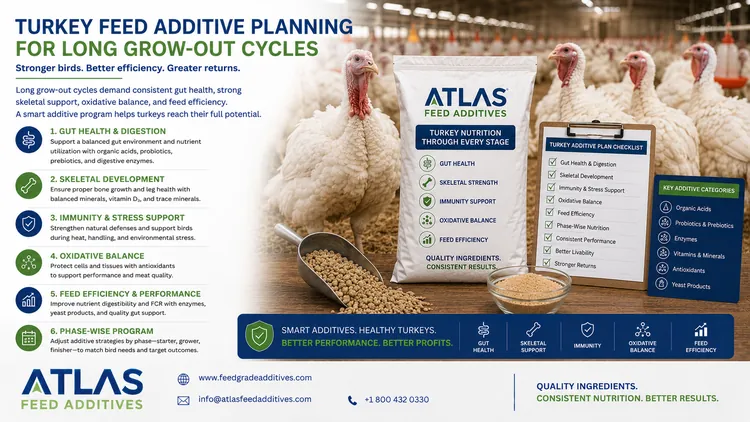
Feed additive decisions are strongest when they begin with a clear production objective. Turkey Feed Additive Planning for Long Grow-Out Cycles is not a single-product decision; it is a practical process of matching animal needs, raw material risk, feed manufacturing conditions, health program, and the commercial target.
Why this topic matters
Managing gut, skeletal, and oxidative challenges in turkey production requires a longer planning view than many shorter poultry cycles. Turkeys remain on feed for an extended period, reach heavier bodyweights, and pass through several nutritional phases before processing. Small problems in digestion, mineral support, litter condition, or oxidative balance can become more costly when they continue over many weeks.
In real operations, the result depends on feed quality, farm management, genetics, health status, water quality, storage, and how consistently the additive is applied. A feed additive program should therefore support the full production plan rather than only respond to visible problems late in the cycle.
Key pressure points in long grow-out cycles
Turkey programs should be reviewed by phase because the bird's priorities change from early growth to finishing. Starter feeds often focus on early gut development, feed intake, and uniformity. Grower and finisher feeds may place more emphasis on feed efficiency, skeletal support, litter management, and maintaining performance under environmental pressure.
- Gut development: early digestive support can help birds use nutrients more consistently during the first weeks.
- Skeletal strength: mineral nutrition and vitamin support are important as bodyweight increases.
- Oxidative pressure: heat, fast growth, health challenges, and diet composition can increase the need to review antioxidant support.
- Litter quality: wet litter can affect footpad condition, air quality, bird comfort, and final performance.
- Feed efficiency: enzyme, acidifier, probiotic, and other additive choices should be connected to raw material quality and diet design.
Practical approach
A practical turkey additive program starts with the production objective: better early uniformity, stronger skeletal support, improved feed conversion, reduced litter moisture, stronger gut resilience, or support during heat stress. Once the objective is clear, product selection becomes more focused and easier to evaluate.
- Check feed form, pellet quality, feeder management, and water quality before blaming additive performance.
- Align additives with age, genetics, health program, raw material variability, and farm challenge level.
- Review whether the additive is intended for starter, grower, finisher, or all-phase use.
- Match product choice with measurable outcomes such as feed conversion, mortality, litter condition, uniformity, bodyweight, and processing results.
- Use documentation, trial design, and supplier guidance to avoid comparing products without a clear baseline.
Feed form and raw material considerations
Feed form is especially important in turkey production because intake and feed efficiency can be affected by pellet durability, fines level, and particle size. If birds receive inconsistent feed form, the value of an additive program may be harder to measure. Pellet quality, mixing accuracy, and storage conditions should be reviewed alongside additive selection.
Raw material variability also matters. Changes in cereal quality, protein meals, fat sources, fiber level, or mycotoxin pressure can influence gut function and nutrient availability. When raw materials vary between batches or seasons, enzymes, acidifiers, binders, probiotics, antioxidants, and mineral-support products may need to be reviewed as part of a broader feed quality plan.
Product groups to review
Depending on the challenge, the following product groups may be worth reviewing with your nutrition, technical, or procurement team:
Buyer checklist
Before ordering, request the product specification, certificate of analysis, shelf-life, storage conditions, recommended inclusion range, packaging details, and destination-market documents. For commercial trials, define the baseline, control group, feed batches, performance indicators, and review period before the additive is introduced.
For turkey programs, it is also useful to share the production phase, expected slaughter age, target bodyweight, feed form, farm challenge, current diet type, and any recurring concerns such as wet litter, poor uniformity, leg issues, heat stress, or inconsistent feed conversion. This helps suppliers and technical teams narrow the options more efficiently.
How Atlas Feed Additives can support
Atlas Feed Additives can help buyers compare feed-grade additive options, coordinate supplier documentation, and structure inquiries for international shipments. Send the target application, current challenge, production phase, product group, estimated quantity, and destination country so we can review the request efficiently.