
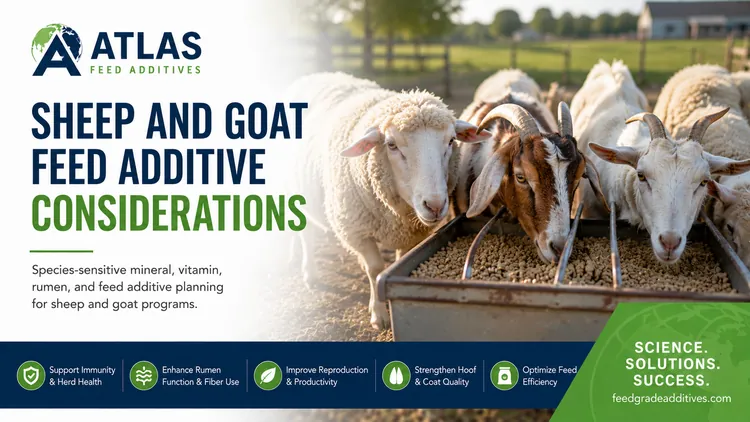
Feed additive decisions are strongest when they begin with a clear production objective. Sheep and Goat Feed Additive Considerations is not a single-product decision; it is a practical process of matching species needs, forage quality, mineral sensitivity, feed manufacturing conditions, farm management, and the commercial target.
Why this topic matters
Species-sensitive mineral and rumen-additive planning is important because sheep and goats are often managed together in the small ruminant category, but they are not identical. Their mineral tolerance, grazing behavior, production purpose, intake pattern, and response to feed programs can differ. A product that is suitable for one group may still need review before it is used in another.
In real operations, the result depends on feed quality, forage base, farm management, genetics, age, production phase, health status, water access, storage, and how consistently the additive is applied. A practical program should support the full feeding system rather than rely on one additive to solve management or forage problems.
Key areas to review
Small ruminant programs should be reviewed by species and production goal. Meat lambs, dairy goats, breeding ewes, replacement females, growing kids, and grazing flocks may all need different priorities. Mineral balance, rumen function, body condition, reproduction, growth, and milk production should be considered before product selection.
- Species sensitivity: sheep and goats should be reviewed separately, especially when trace minerals and premix specifications are involved.
- Forage base: pasture, hay, silage, straw, and concentrate level influence rumen conditions and additive needs.
- Mineral balance: macro minerals, trace minerals, salt intake, water quality, and antagonists should be reviewed together.
- Production phase: growing, breeding, late gestation, lactation, finishing, and maintenance animals may require different support.
- Feed access: uneven intake, sorting, competition, and inconsistent mineral consumption can reduce program reliability.
Practical approach
A practical sheep or goat additive program starts by defining the main objective: better growth, stronger reproduction, improved milk performance, more stable rumen function, better body condition, reduced feed sorting, or support during forage changes. Once the objective is clear, the product group and evaluation method become easier to select.
- Review mineral tolerance and species sensitivity before transferring assumptions from cattle or other livestock programs.
- Avoid using cattle premixes directly for sheep and goats unless the formulation has been checked for suitability.
- Match additives with forage quality, concentrate level, water quality, grazing conditions, and production phase.
- Track intake, body condition, growth, milk yield, reproduction, hoof condition, coat quality, and health events.
- Use farm records and controlled comparisons before scaling a new additive program across the full flock or herd.
Mineral and rumen considerations
Trace mineral programs should be handled carefully in small ruminants. Copper, selenium, zinc, manganese, iodine, cobalt, and other minerals should be reviewed in relation to local forage, water, soil conditions, species tolerance, and local regulations. Professional review is especially important where mineral excess or deficiency is suspected.
Rumen-focused additives should also be matched to the diet. Forage quality, sudden grain changes, fiber level, feed sorting, and water availability can affect rumen stability. Buffers, yeasts, enzymes, probiotics, binders, or other functional additives may be useful in some programs, but they should be selected according to the actual challenge and not used as a substitute for balanced feeding.
Feed manufacturing and storage considerations
Small ruminant feeds and mineral products are often used in modest volumes, so premix uniformity, correct labeling, packaging size, and stock rotation matter. Low-inclusion additives should be mixed carefully, and mineral supplements should remain clearly identified to avoid accidental use in the wrong species group.
Finished feeds and premixes should be stored in dry, clean, well-ventilated areas away from moisture, pests, sunlight, and strong odors. If products contain sensitive vitamins, probiotics, enzymes, or specialty minerals, shelf-life and storage conditions should be reviewed before purchase and during use.
Product groups to review
Depending on the challenge, the following product groups may be worth reviewing with your nutrition, technical, or procurement team:
Buyer checklist
Before ordering, request the product specification, certificate of analysis, shelf-life, storage conditions, recommended inclusion range, packaging details, handling guidance, and destination-market documents. For commercial trials, define the baseline, control group, feed batches, performance indicators, and review period before the additive is introduced.
For sheep and goat programs, also share the species, breed type, production phase, forage base, concentrate level, water quality concerns, current mineral program, target performance issue, expected quantity, packaging preference, and whether the product will be used in feed, mineral blocks, loose minerals, or another delivery format. This helps suppliers and technical teams recommend options that fit the actual farm setting.
How Atlas Feed Additives can support
Atlas Feed Additives can help buyers compare feed-grade mineral, vitamin, and functional additive options, coordinate supplier documentation, and structure inquiries for international shipments. Send the target application, current challenge, species, production phase, product group, expected quantity, destination country, and required documents so we can review the request efficiently.