
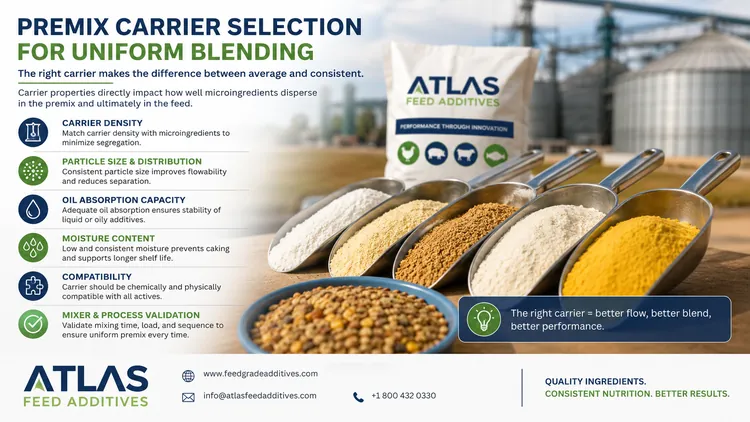
Feed additive decisions are strongest when they begin with a clear production objective. Premix carrier selection for uniform blending is not a single-product decision; it is a practical process of matching animal needs, raw material risk, feed manufacturing conditions, handling requirements, and the commercial target.
Why this topic matters
A carrier helps distribute low-inclusion active ingredients more evenly through a premix or complete feed. When the carrier is poorly matched to the additive, the final blend may show segregation, dusting, poor flow, uneven dosing, or reduced stability during storage and transport.
Carrier density, particle size, surface texture, and oil absorption all influence how well vitamins, trace minerals, enzymes, probiotics, antioxidants, pigments, flavors, and other feed additives remain distributed. In real operations, the result also depends on feed quality, farm management, species, genetics, health status, storage time, packaging, and how consistently the additive is applied.
What makes a suitable carrier?
A good carrier should support accurate dosing, stable flow through equipment, and uniform dispersion without damaging sensitive ingredients. It should also be practical for the buyer’s handling system, local climate, packaging format, and destination-market requirements.
- Particle size: The carrier should be close enough to the active ingredient size to reduce separation during mixing, bagging, transport, and discharge.
- Bulk density: Similar density between carrier and active materials helps reduce layering and improves consistency between samples.
- Oil absorption: Higher absorption may help hold liquid or oily ingredients, but excessive absorption can affect flowability and dosing behavior.
- Moisture level: Moisture should be controlled to reduce caking risk, microbial concerns, and unwanted reactions with sensitive additives.
- Surface behavior: Texture, porosity, dust level, and electrostatic behavior can influence how the active ingredient attaches to the carrier.
Practical approach
Carrier selection should be reviewed together with the formula, target inclusion rate, mixing sequence, packaging type, and shelf-life expectations. A technically suitable carrier may still create problems if it flows poorly through the customer’s equipment or reacts with the active ingredient during storage.
- Review particle size distribution, density, electrostatic behavior, moisture, and dusting tendency before confirming a carrier.
- Check compatibility for sensitive vitamins, enzymes, probiotics, organic acids, antioxidants, and highly reactive mineral sources.
- Use validated mixer performance, mixing time records, flush procedures, and retention samples to support consistency.
- Confirm whether the premix will be packed in bags, big bags, drums, or lined packaging, especially for export shipments.
- Define sampling points from the beginning, middle, and end of the batch to detect segregation or poor dispersion.
Common carrier selection risks
Many blending issues are not caused by the active ingredient alone. A premix can fail to perform consistently because the carrier does not match the application, the mixer is overloaded, the mixing time is not validated, or the finished product is exposed to moisture and vibration during storage.
Buyers should pay particular attention to caking, bridge formation in hoppers, dust loss during transfer, separation in partially filled bags, and reduced activity of sensitive ingredients. These risks become more important when the inclusion rate is very low or when the premix contains several active components with different physical properties.
Product groups to review
Depending on the challenge, the following product groups may be worth reviewing with your nutrition, technical, or procurement team. Each group may require a different carrier strategy depending on dosage level, stability, handling, and target species.
Buyer checklist
Before ordering, request the product specification, certificate of analysis, shelf-life, storage conditions, recommended inclusion range, packaging details, and destination-market documents. Ask whether the supplier can provide information on particle size, bulk density, moisture, flowability, heavy metals where relevant, and recommended handling precautions.
For commercial trials, define the baseline, control group, feed batches, performance indicators, sampling method, and review period before the additive is introduced. When possible, retain samples from the carrier, active ingredient, finished premix, and complete feed so that any quality question can be investigated more quickly.
How Atlas Feed Additives can support
Atlas Feed Additives can help buyers compare feed-grade additive options, coordinate supplier documentation, and structure inquiries for international shipments. We can support discussions around target application, physical form, packaging preference, specification requirements, and the product group that best matches the buyer’s program.
Send the target species, production phase, current challenge, active ingredient group, estimated monthly quantity, destination country, and required documents so we can review the request efficiently.