
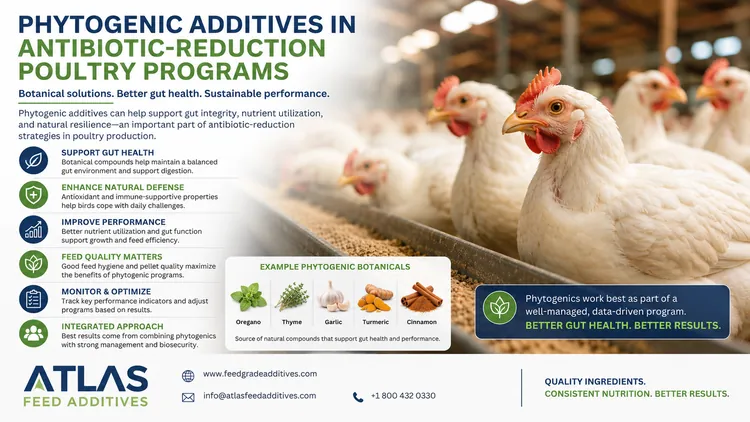
Feed additive decisions are strongest when they begin with a clear production objective. Phytogenic Additives in Antibiotic-Reduction Poultry Programs is not a single-product decision; it is a practical process of matching bird needs, raw material risk, feed manufacturing conditions, health program, and the commercial target.
Why this topic matters
Antibiotic-reduction programs require more than one additive change. They depend on feed quality, flock health, farm hygiene, water management, litter condition, stocking density, vaccination planning, and the way daily production challenges are monitored. Phytogenic additives can be reviewed as one tool within this wider system.
Botanical blends may include essential oil components, plant extracts, herbs, spices, or other natural-origin compounds. Their practical value depends on product consistency, active composition, stability during feed processing, application rate, and how well they fit the farm’s broader gut health and performance strategy.
Practical approach
- Check feed form, pellet quality, water quality, litter condition, and house management before blaming additive performance.
- Align additives with bird age, genetics, health program, raw material variability, stocking density, and seasonal pressure.
- Review phytogenic products together with enzymes, organic acids, probiotics, antioxidants, minerals, and vitamin support.
- Track feed conversion, mortality, daily gain, litter quality, uniformity, veterinary records, processing results, and cost per kilogram of live weight.
Where phytogenic additives may fit
Phytogenic additives are often considered when producers want to support feed intake, digestive balance, gut comfort, and overall flock resilience. In broilers, they are commonly reviewed around starter feed quality, growth performance, litter pressure, and processing outcomes. In layers and breeders, the discussion may also include persistency, egg quality, body condition, and long-term flock stability.
The best product choice depends on the target challenge. Some botanical blends are positioned mainly for palatability and feed intake support, while others are selected for digestive or gut environment objectives. Buyers should request clear information on active ingredients, carrier system, stability, recommended inclusion range, and compatibility with pelleting or premix manufacturing.
Program design considerations
A phytogenic program should be introduced with a defined baseline. Before evaluating results, the team should know the current feed conversion, mortality, medication records, litter score, body weight, uniformity, and major farm challenges. Without this baseline, it becomes difficult to separate additive impact from seasonal changes, ingredient shifts, disease pressure, or management variation.
It is also important to avoid overcomplication. Phytogenic additives should fit into a clear feed and farm plan rather than being layered into a formula without a specific reason. When multiple gut health tools are used together, each product should have a defined role, such as feed hygiene, nutrient release, microbial support, palatability, or antioxidant protection.
Product groups to review
Depending on the challenge, the following product groups may be worth reviewing with your nutrition, technical, or procurement team:
Buyer checklist
Before ordering, request the product specification, certificate of analysis, shelf-life, storage conditions, recommended inclusion range, packaging details, and destination-market documents. For phytogenic products, also review botanical source, active markers where available, carrier type, odor profile, heat stability, flowability, and compatibility with premix or finished feed production.
For commercial trials, define the baseline, control group, feed batches, performance indicators, and review period before the additive is introduced. Useful indicators may include feed intake, feed conversion, average daily gain, mortality, culls, litter score, footpad condition, processing yield, egg production, egg quality, and medication or veterinary intervention records depending on the poultry category.
How Atlas Feed Additives can support
Atlas Feed Additives can help buyers compare feed-grade additive options, coordinate supplier documentation, and structure inquiries for international shipments. We can support discussions around target application, phytogenic format, complementary additive groups, packaging preference, and destination-market requirements.
Send the target species, production phase, current challenge, product group, expected quantity, destination country, and required documents so we can review the request efficiently.