
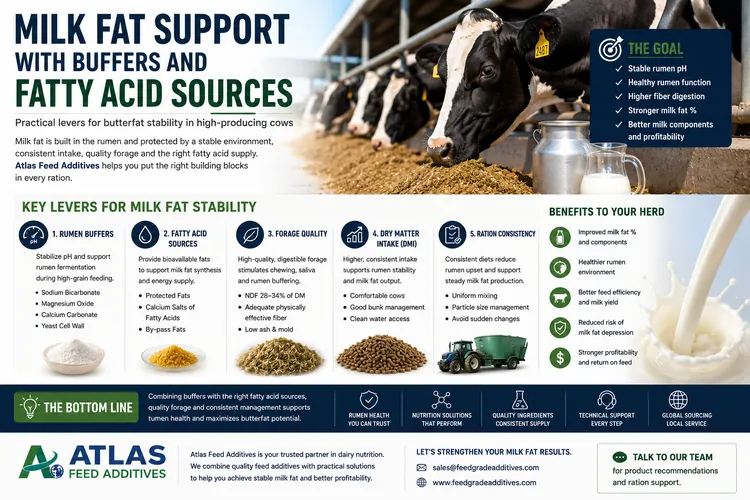
Feed additive decisions are strongest when they begin with a clear production objective. Milk Fat Support with Buffers and Fatty Acid Sources is not a single-product decision; it is a practical process of matching cow needs, forage quality, ration consistency, rumen stability, fat source selection, and the commercial target.
Why this topic matters
Milk fat stability is important in high-producing dairy herds because butterfat contributes directly to milk value in many markets. When milk fat declines or becomes inconsistent, the cause may be linked to ration fermentability, effective fiber, feed sorting, heat stress, dry matter intake, transition-cow pressure, fat source, or rumen stability rather than one additive alone.
Practical levers for butterfat stability in high-producing cows include buffers, fatty acid sources, forage management, feed delivery, and consistent monitoring of milk components. In real operations, the result depends on feed quality, farm management, genetics, lactation stage, health status, storage, and how consistently the additive is applied.
Practical approach
- Start with forage quality, ration consistency, effective fiber, sorting behavior, feed availability, and dry matter intake.
- Review transition-cow risk, rumen stability, milk fat percentage, milk protein percentage, body condition, manure consistency, and heat-stress pressure.
- Work with a nutritionist when using protected nutrients, fatty acid sources, specialty rumen additives, or significant ration fat adjustments.
- Compare additive cost against milk component response, ration stability, feed intake, and herd-level repeatability rather than unit price alone.
Buffers and rumen stability
Buffers are typically reviewed when the ration is highly fermentable, cows are under intake pressure, or milk fat patterns suggest rumen stability should be checked. They may support rumen conditions when used as part of a balanced program that includes adequate forage particle size, consistent mixing, controlled sorting, and suitable feed delivery routines.
Buyers should review the buffer type, neutralizing capacity where relevant, sodium contribution, inclusion range, carrier, flowability, and compatibility with the total mixed ration or premix. Buffer decisions should also consider water access, cow comfort, bunk management, and heat stress because these factors can influence intake and rumination behavior.
Fatty acid source considerations
Fatty acid sources may be used to support energy supply, milk components, body condition, or targeted production goals. However, not all fat sources behave the same in the rumen or support the same objective. Product format, fatty acid profile, digestibility target, rumen protection, palatability, and handling properties should all be reviewed.
For milk fat support, the technical team should distinguish between general fat supplementation and a specific fatty acid strategy. The product should fit the herd objective, whether the target is butterfat stability, energy density, early lactation support, body condition management, or component yield.
Program design for dairy herds
A milk fat support program should begin with baseline data. Useful information includes milk fat and protein trends, fat-to-protein ratio, milk yield, days in milk, parity group, feed intake, forage analysis, ration starch level, particle size, manure observations, and recent changes in ingredients or management.
Because milk fat response can be influenced by several factors at once, trial periods should be long enough to show a stable pattern. Feed batches, additive lots, ration changes, weather conditions, and herd events should be recorded so the result can be interpreted with confidence.
Product groups to review
Depending on the challenge, the following product group may be worth reviewing with your nutrition, technical, or procurement team:
Buyer checklist
Before ordering, request the product specification, certificate of analysis, shelf-life, storage conditions, recommended inclusion range, packaging details, and destination-market documents. For milk fat support programs, also review active composition, fatty acid profile where relevant, buffer type, carrier, handling properties, heat stability, palatability, and compatibility with the complete dairy ration.
For commercial trials, define the baseline, control group if possible, feed batches, performance indicators, and review period before the additive is introduced. Useful indicators may include milk yield, milk fat percentage, milk fat yield, milk protein, dry matter intake, body condition, manure consistency, rumination observations, sorting behavior, and feed cost per unit of component output.
How Atlas Feed Additives can support
Atlas Feed Additives can help buyers compare feed-grade additive options, coordinate supplier documentation, and structure inquiries for international shipments. We can support discussions around buffer products, fatty acid source options, protected nutrient formats, packaging preference, supplier documentation, and destination-market requirements.
Send the target species, lactation stage, current challenge, milk component data if available, product group, expected quantity, destination country, and required documents so we can review the request efficiently.