
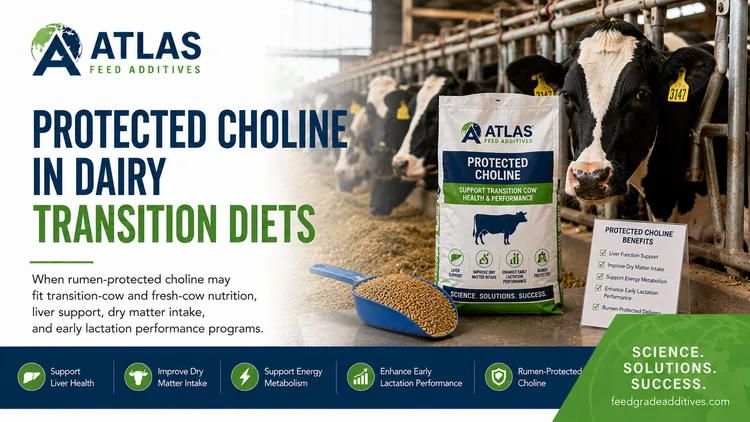
Feed additive decisions are strongest when they begin with a clear production objective. Protected Choline in Dairy Transition Diets is not a single-product decision; it is a practical process of matching cow needs, transition risk, ration quality, rumen protection technology, feed manufacturing conditions, and the commercial target.
Why this topic matters
Rumen-protected choline may be reviewed in transition and fresh-cow programs because the weeks around calving place heavy pressure on intake, energy balance, liver function, body condition, and early lactation performance. Choline support is most useful when it is considered as part of a complete transition-cow plan rather than a stand-alone solution.
In real operations, the result depends on forage quality, dry matter intake, body condition at calving, cow comfort, ration consistency, grouping strategy, metabolic risk, storage conditions, and how consistently the additive is applied. A protected choline program should therefore be evaluated alongside energy nutrition, transition management, and fresh-cow monitoring.
Key areas to review
Protected choline decisions should begin with the cow group and the transition objective. Close-up dry cows, fresh cows, high-risk cows, and early lactation groups may each require a different review. The goal is to support the transition period without ignoring the basic drivers of performance: intake, comfort, forage quality, and ration delivery.
- Transition risk: review body condition, previous health events, calving ease, ketosis risk, fatty liver pressure, and fresh-cow performance records.
- Dry matter intake: bunk space, feed access, heat stress, water access, feed refusals, and ration freshness can influence additive response.
- Ration balance: energy density, metabolizable protein, amino acid supply, fiber level, starch level, and mineral balance should be reviewed together.
- Product protection: rumen bypass, intestinal availability, coating quality, storage stability, and mixing tolerance should be checked with the supplier.
- Fresh-cow monitoring: milk yield, milk components, body condition, health events, and early lactation intake should guide program evaluation.
Practical approach
A practical protected choline program starts by defining the reason for use: transition-cow support, fresh-cow performance, energy metabolism support, liver-focused nutrition, or performance consistency in high-risk groups. Once the objective is clear, the nutritionist can decide where the product fits in the dry cow, close-up, fresh cow, or early lactation feeding program.
- Start with forage quality, ration consistency, dry matter intake, cow comfort, and transition-cow grouping before adding protected nutrients.
- Review transition-cow risk, rumen stability, milk components, body condition, fresh-cow health events, and early lactation performance.
- Work with a nutritionist when using protected nutrients, specialty rumen additives, or transition-cow support strategies.
- Check product handling, storage conditions, mixing sequence, palatability, and compatibility with premix, complete feed, or TMR use.
- Measure milk yield, milk fat, milk protein, dry matter intake, body condition, ketosis-related records where used, and ration cost per cow.
Transition-cow and fresh-cow considerations
The transition period is sensitive because intake often changes while nutrient demand increases. Protected choline should be reviewed together with the overall close-up and fresh-cow ration, not simply added after problems appear. Energy supply, effective fiber, feed sorting, mineral balance, and cow comfort can all influence the final outcome.
Fresh-cow groups should be monitored closely after calving. Reduced intake, excessive body condition loss, abnormal manure, low rumination, or health events can limit the visible response to any additive. When protected choline is used, the farm should define which records will be reviewed and how long the evaluation period will last.
Feed manufacturing and handling considerations
Rumen-protected choline products can differ in coating technology, active content, particle size, density, flowability, and handling sensitivity. Feed mills and farms should confirm whether the product is suitable for the intended use, including mineral premixes, compound feed, TMR inclusion, or farm-level top-dressing where applicable.
Storage discipline is important because moisture, heat, physical abrasion, and long storage periods may affect some protected products. Bags should remain sealed until use, and products should be clearly labeled and protected from contamination. If the product is blended with minerals, buffers, yeasts, vitamins, or other additives, compatibility and mixing uniformity should be reviewed before scaling up.
Evaluation and performance monitoring
Protected choline should be evaluated with a clear baseline and a realistic review period. Short-term changes in forage dry matter, calving pattern, weather, grouping, cow comfort, or health events can affect transition performance, so results should not be judged from a single day or a very small group.
Useful records include dry matter intake, milk yield, milk fat, milk protein, body condition score, fresh-cow health events, displaced abomasum records, ketosis-related records where monitored, reproduction indicators, feed refusals, and ration cost. These records help separate product response from normal herd variation.
Product groups to review
Depending on the challenge, the following product groups may be worth reviewing with your nutrition, technical, or procurement team:
Buyer checklist
Before ordering, request the product specification, certificate of analysis, active content, rumen-protection information where available, shelf-life, storage conditions, recommended inclusion range, packaging details, handling guidance, and destination-market documents. For commercial trials, define the baseline, cow group, feed batches, performance indicators, and review period before the additive is introduced.
For protected choline projects, also share the cow group, transition program, ration type, forage base, current fresh-cow challenges, expected feeding duration, milk production level, mixing system, processing conditions, expected quantity, and whether the product will be used in premix, complete feed, TMR, or another delivery format. This helps suppliers and technical teams recommend options that fit the actual dairy program.
How Atlas Feed Additives can support
Atlas Feed Additives can help buyers compare feed-grade protected nutrient and ruminant performance additive options, coordinate supplier documentation, and structure inquiries for international shipments. Send the target application, current challenge, species, production phase, product group, expected quantity, destination country, and required documents so we can review the request efficiently.