
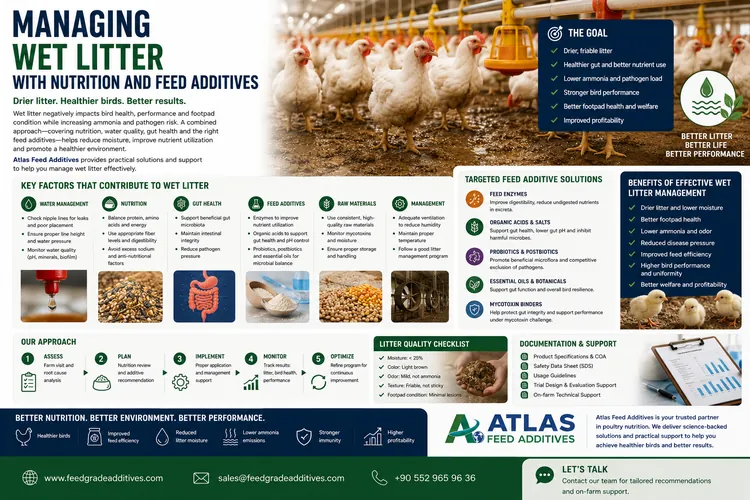
Feed additive decisions are strongest when they begin with a clear production objective. Managing Wet Litter with Nutrition and Feed Additives is not a single-product decision; it is a practical process of matching bird age, raw material risk, gut health status, water quality, feed manufacturing conditions, and the commercial target.
Why this topic matters
Wet litter affects poultry performance, house environment, bird comfort, footpad quality, ammonia pressure, and processing results. It can also make daily management more difficult because moisture problems often increase gradually before they become visible across the house.
Nutrition and feed additives can support litter quality by improving digestibility, helping maintain gut balance, and reducing unnecessary nutrient flow into the lower gut. However, the result in real operations also depends on ventilation, drinker management, water quality, stocking density, disease pressure, feed form, raw material quality, and how consistently the feeding program is applied.
Practical approach
- Check feed form, water quality, drinker height, drinker pressure, and ventilation before blaming additive performance.
- Align additives with bird age, genetics, health program, raw material variability, and the main litter challenge observed on farm.
- Review sodium, potassium, chloride, protein quality, fiber level, fat quality, cereal choice, and ingredient consistency in the formula.
- Track feed conversion, mortality, litter score, footpad condition, uniformity, manure consistency, and processing results.
- Use commercial trials with a clear baseline, defined treatment group, and practical review period.
Common nutrition points to review
Wet litter can be linked to several nutritional factors. Excessive minerals, poorly balanced electrolytes, high or poorly digested protein, ingredient changes, rancid fat, mycotoxin pressure, and low digestibility raw materials can all increase the risk of loose droppings or higher litter moisture. The first step is usually to check the formula and ingredient quality before adding complexity to the program.
Feed form is also important. Poor pellet quality, excessive fines, or inconsistent crumble structure can reduce intake uniformity and affect gut function. A well-managed feed program should support steady intake, good digestion, and stable manure quality across the flock.
Product groups to review
Depending on the challenge, the following product groups may be worth reviewing with your nutrition, technical, or procurement team. Feed enzymes may support digestibility when cereals, fiber, or anti-nutritional factors are part of the issue. Organic acids and acidifiers may support feed hygiene and gut environment. Probiotics and fermentation products may help maintain microbial balance, especially during stress periods or feed transitions.
The best choice depends on the production phase, raw materials, farm challenge, and existing health program. A product should be selected for a defined reason, not simply added as a general solution. Buyers should also review heat stability, application method, compatibility with premixes, shelf-life, and whether the supplier provides clear technical guidance for the target species.
Trial and farm monitoring
For commercial trials, define the baseline litter condition, house or flock group, feed batches, additive inclusion rate, performance indicators, and review period before the additive is introduced. It is useful to record litter score, droppings appearance, water consumption, feed intake, body weight, feed conversion, mortality, and footpad observations.
Results should be interpreted carefully because wet litter is rarely caused by one factor alone. A sudden change may point to water leakage, disease pressure, raw material change, or ventilation problems, while a gradual increase may be more closely linked to diet balance, stocking density, or seasonal conditions. Good records help separate feed-related issues from management-related issues.
Buyer checklist
Before ordering, request the product specification, certificate of analysis, shelf-life, storage conditions, recommended inclusion range, packaging details, safety data sheet, and destination-market documents. For commercial use, also request technical notes covering the target species, production phase, application method, heat stability, and compatibility with other additives.
For international shipments, confirm label requirements, customs documentation, batch traceability, product classification, and whether the product is accepted in the destination market. Clear documentation helps procurement, quality control, and technical teams evaluate the product before it enters the feed program.
How Atlas Feed Additives can support
Atlas Feed Additives can help buyers compare feed-grade additive options, coordinate supplier documentation, and structure inquiries for international shipments. Our team can support the early review stage by clarifying the target species, production phase, current litter challenge, product group, packaging format, and document expectations.
Send the target application, current challenge, product group, estimated quantity, and destination country so we can review the request efficiently and help identify suitable feed additive options for your poultry program.