
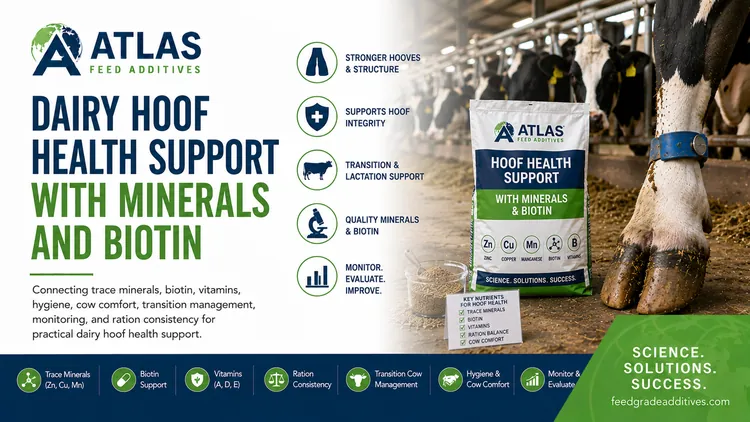
Feed additive decisions are strongest when they begin with a clear production objective. Dairy hoof health support with minerals and biotin is not a single-product decision; it is a practical process of matching ration consistency, trace mineral supply, hoof-care routines, hygiene, cow comfort, walking surfaces, transition management, and the commercial target of the dairy herd.
Why this topic matters
Hoof health influences mobility, feed intake, milk performance, reproduction, culling pressure, labor demand, and overall herd welfare. Nutrition is only one part of the program, but it can support hoof horn quality, tissue integrity, immune resilience, and recovery when it is combined with strong management and regular hoof care.
Trace minerals, vitamins, and biotin are commonly reviewed because hoof-related challenges are often long-term and multi-factorial. In real operations, the result depends on ration consistency, dry matter intake, transition-cow management, floor condition, bedding hygiene, footbath routines, trimming schedules, heat stress, and how consistently the additive program is applied.
A stronger hoof-health strategy also helps procurement teams avoid narrow product comparisons. Instead of asking only which additive is cheapest, buyers and technical teams can compare specification, source, documentation, handling, inclusion practicality, supplier reliability, and how well the product fits the farm’s existing feeding system.
Practical approach
- Start with forage quality, ration consistency, stable dry matter intake, cow comfort, and clean walking areas.
- Review hoof lesion records, mobility scoring, trimming reports, lameness events, milk performance, and body condition.
- Separate nutrition-related support from hygiene, flooring, infectious pressure, and mechanical hoof-care issues.
- Check transition-cow pressure, heat stress, overcrowding, time standing, and walking distance before judging additive response.
- Work with a nutritionist and veterinarian when using specialty trace minerals, biotin, or long-term hoof-support programs.
- Measure results over enough time because hoof horn quality and mobility improvements are usually not immediate.
Minerals, biotin, and hoof tissue support
Trace minerals such as zinc, copper, and manganese are often reviewed in dairy hoof-health programs because they are connected with tissue strength, skin integrity, immune function, and normal hoof structure. The source, bioavailability, antagonists in the ration, and total mineral balance should be considered before changing the program.
Zinc is frequently discussed in relation to skin and hoof horn quality, while copper and manganese may be reviewed when the objective includes connective tissue support, normal structural development, and wider mineral balance. In practice, these nutrients should not be evaluated in isolation because excesses, deficiencies, antagonists, and inconsistent intake can all affect the final response.
Biotin is also commonly reviewed in hoof-health programs. It should be evaluated as part of a longer-term feeding strategy rather than a quick correction. Consistent daily intake, correct inclusion, and adequate review time are important because hoof horn growth and visible field response take time to develop.
When comparing mineral and biotin options, buyers should review active ingredient level, carrier type, premix compatibility, stability, packaging, documentation, and whether the product is intended for direct farm use, feed mill inclusion, or premix manufacturing.
Ration consistency and transition risk
Hoof health can be affected by ration instability, feed sorting, inconsistent forage dry matter, poor rumen adaptation, and sudden diet changes. Transition cows and high-producing cows may be especially sensitive because intake, rumen stability, body condition, and metabolic pressure are changing quickly.
A practical hoof-support program should therefore review the wider feeding system. Forage quality, effective fiber, starch level, mineral balance, water access, bunk space, and mixing consistency all influence whether the additive program can perform as expected.
Transition periods deserve special attention because hoof issues observed later may be connected to earlier stress around calving, reduced intake, metabolic pressure, or changes in housing. For this reason, hoof-health monitoring should include both current cow observations and recent herd events.
Product groups to review
Depending on the challenge, the following product groups may be worth reviewing with your nutrition, technical, veterinary, or procurement team:
Vitamins and vitamin-like nutrients include biotin and other nutrients that may be reviewed in hoof-support programs. Trace minerals and specialty minerals may be reviewed when the objective includes hoof horn quality, tissue integrity, or long-term mineral consistency. Antioxidants and fermentation products may also be considered when resilience, rumen stability, or stress support is part of the broader dairy program.
The best product group depends on the starting point. A herd with inconsistent intake may need ration and management review first, while a herd with long-term mineral supply questions may require a closer look at trace mineral source, inclusion, and premix quality. Additive selection should follow the diagnosis, not replace it.
Management factors that influence results
Feed additives cannot overcome poor flooring, wet bedding, overcrowding, weak footbath routines, delayed hoof trimming, or chronic cow comfort issues. Hoof-support programs are strongest when nutrition is combined with clean alleys, suitable lying time, careful animal movement, routine hoof checks, and early treatment of problem cows.
Because hoof problems often have more than one cause, technical teams should review nutrition and management records together. A mineral or biotin program may support the herd, but interpretation should also consider infection pressure, walking distance, time standing, heat stress, calving pressure, and the quality of hoof-care routines.
Commercial farms should also keep staff routines simple and repeatable. A technically strong product may underperform if it is difficult to dose, poorly mixed, exposed to moisture, stored incorrectly, or used inconsistently between feed batches.
Program design and monitoring
A dairy hoof-health additive program should be reviewed over a realistic period. Before introducing a product, define the cow group, ration, product name, inclusion level, baseline hoof status, mobility indicators, and review schedule. This makes it easier to understand whether the response is linked to the additive or to another change in management.
- Record ration formulas, mineral sources, biotin inclusion, feed batch details, and mixing procedures.
- Track hoof trimming records, lesion types, mobility scores, lameness treatments, culling reasons, and milk performance.
- Review transition cows, high-producing cows, and older cows separately because risk may differ by group.
- Keep bedding, footbath, trimming, flooring, and cow-flow routines as consistent as possible during trials.
- Note major weather, heat stress, forage, housing, or staffing changes that may affect hoof-health interpretation.
- Evaluate biological response, product compatibility, practical handling, and economic value before expanding the program.
Commercial trial planning
For commercial trials, define the baseline before the additive is introduced. Record current mineral sources, biotin use, hoof lesion frequency, mobility scoring method, trimming schedule, ration changes, and recent herd events. This helps the team understand whether later changes reflect the additive program, hoof-care routines, or another farm factor.
Trial results should be interpreted carefully because hoof health responds slowly. A short review may miss the full response, while a long review without good records may include too many uncontrolled variables. The strongest evaluations combine nutrition records, hoof-care data, and practical farm observations.
Where possible, keep comparison groups clear. Review similar cow groups, similar housing conditions, and similar ration periods. If the whole herd is changed at once, record the decision clearly and avoid over-interpreting short-term movement in lameness, trimming, or production data.
Buyer checklist
Before ordering, request the product specification, certificate of analysis, safety data sheet where applicable, shelf-life, storage conditions, recommended inclusion range, packaging details, mineral source information, biotin level where relevant, batch traceability, and destination-market documents. Buyers should also confirm whether the product is suitable for dairy cattle and whether it has special handling requirements related to moisture, mixing, carrier type, or premix use.
For repeat purchases, keep records of supplier, batch number, delivery date, inclusion level, feed batch, cow group, formulation target, and field observations. These records help technical and procurement teams compare products more clearly and reduce variation between feeding periods.
For international purchasing, confirm documentation early. Depending on the product and market, customers may need commercial invoice details, packing list, certificate of analysis, origin documentation, product specification, label information, shelf-life declaration, or other import-related documents.
How Atlas Feed Additives can support
Atlas Feed Additives can help buyers compare feed-grade additive options, coordinate supplier documentation, and structure inquiries for international shipments. Send the target species, production phase, current challenge, product group, expected quantity, destination country, packaging preference, and required documents so we can review the request efficiently.
For dairy hoof-health programs, we can help organize requests around biotin products, trace mineral sources, vitamin premixes, specialty minerals, and related feed additive categories. We can also help clarify whether the inquiry is for direct farm use, premix production, compound feed manufacturing, or distributor supply.