Binders, carriers, and flow agents

Zeolite Anticaking Agent

Zeolite Anticaking Agent helps improve powder handling, flowability, moisture control, pellet integrity, carrier performance, and uniform distribution of active ingredients in feed and premix systems.

  • Flowability support
  • Anticaking function
  • Carrier compatibility
  • Particle size review
  • Export documentation
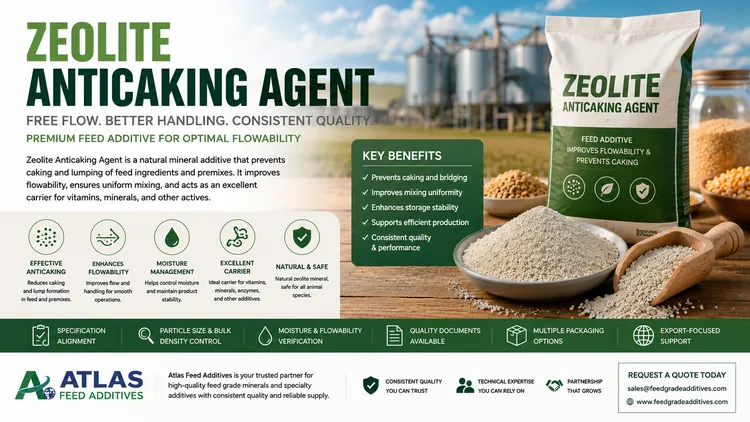
Zeolite Anticaking Agent feed additive visual

Product role

Where Zeolite Anticaking Agent fits

Zeolite Anticaking Agent is part of the binders, carriers, and flow agents group. It is used in feed manufacturing and premix systems where formulators need support for powder flow, caking reduction, moisture management, carrier performance, and uniform distribution of micro-ingredients.

Zeolite-based technological additives are valued for their porous mineral structure, moisture-handling behavior, and ability to support free-flowing powder systems. In practical feed production, buyers often review this product for mineral premixes, vitamin-mineral premixes, trace mineral blends, enzyme or probiotic carriers, pellet mill formulas, and feed additives that require reliable handling.

Buyers typically evaluate Zeolite Anticaking Agent by matching particle size distribution, bulk density, moisture, flowability, caking resistance, dust level, mineral profile, adsorption behavior, contaminant limits, compatibility with target actives, packaging, origin, storage requirements, and documentation package.

Atlas Feed Additives can coordinate international supplier options for feed mills, premix producers, pellet mills, additive blenders, mineral suppliers, distributors, and integrators that need consistent feed-grade material and export-focused supplier communication.

Procurement overview

Zeolite Anticaking Agent should be compared by handling performance, not only by price per kilogram

Zeolite Anticaking Agent products can differ significantly by mineral source, processing method, particle size, dust level, bulk density, moisture, flowability, anticaking effect, adsorption behavior, contaminant profile, packaging, and documentation. A meaningful commercial comparison should consider process performance and consistency in the final feed or premix, not only invoice price.

Particle size Confirm particle distribution, fine fraction, dust profile, and whether the material fits the target premix or feed process.
Flowability Review free-flow behavior, bulk density, discharge performance, bridging risk, and mixing compatibility.
Moisture control Check moisture content, caking tendency, storage requirements, and compatibility with hygroscopic ingredients.
Total value Compare handling benefit, inclusion rate, contaminant profile, packaging, freight cost, and document support together.

Application areas

Typical applications

  • Pellet mills, premix plants, mineral blending plants, and feed additive production facilities.
  • Vitamin-mineral premixes where caking, dust, moisture, and uniform distribution must be controlled.
  • Micro-ingredient carrier systems for enzymes, probiotics, vitamins, minerals, flavors, acids, phytogenics, or specialty additives where compatible.
  • Powder handling programs designed to improve bag discharge, silo flow, dosing accuracy, and plant cleanliness.
  • Feed formulations where moisture variation or hygroscopic ingredients create caking or clumping risk.
  • Pellet or granule systems where the product is reviewed as part of a binder, carrier, flow-aid, or processing-support strategy.
  • Export-oriented feed additive blends requiring stable packaging, batch traceability, and predictable handling after shipment.

Quality focus

Buyer quality checklist

  • Particle size distribution and fine fraction control.
  • Bulk density, flowability, angle of repose, or practical discharge behavior where available.
  • Moisture content, water activity where relevant, caking tendency, and storage guidance.
  • Mineralogical profile or zeolite source declaration where available.
  • Dust level, powder handling behavior, and worker exposure considerations.
  • Compatibility with target actives such as vitamins, enzymes, probiotics, organic acids, minerals, or flavors.
  • Heavy metals and undesirable substance limits, including lead, cadmium, arsenic, mercury, and dioxins where required.
  • Microbiological quality, insoluble matter, mineral impurities, and market-specific parameters where required.
  • Feed-grade declaration, origin statement, batch number, packaging, and traceability details.

Commercial focus

Buying criteria

  • Required particle size: fine powder, granular, premix grade, or customer-specific cut.
  • Target function: anticaking, carrier, flow aid, moisture management, pellet support, or dust control.
  • Required bulk density, flowability, and caking performance expectations.
  • Target active ingredients and compatibility requirements.
  • Required test results for heavy metals, dioxins, microbiology, and undesirable substances.
  • Target species, production phase, and feed application.
  • Packaging size, palletization, moisture barrier, and storage expectations.
  • Minimum order quantity, lead time, quotation validity, Incoterm, destination country, and shipment route.

Technical profile

Key points to confirm before ordering

Zeolite Anticaking Agent should be evaluated by process performance, feed-grade suitability, safety profile, and compatibility with the final formula. A lower-priced product may not be the best choice if particle size, dust level, flowability, moisture behavior, contaminant profile, or documentation package does not match the buyer’s specification.

Review area What to confirm
Product identity Full product name, mineral type, feed-grade status, supplier reference, origin, and intended technological use.
Mineral profile Zeolite source, clinoptilolite or associated mineral content where available, processing method, and mineralogical test support.
Particle size Particle distribution, fine fraction, coarse fraction, dust level, surface behavior, mixing uniformity, and compatibility with the intended process.
Bulk density Loose and tapped density where available, dosing behavior, packaging weight-volume fit, and impact on blend uniformity.
Flowability Free-flow behavior, bridging risk, angle of repose where available, discharge behavior, and suitability for hoppers, bags, dosing systems, and silos.
Anticaking performance Caking resistance under humidity, storage, pressure, and transport conditions relevant to the buyer’s supply chain.
Carrier compatibility Compatibility with vitamins, trace minerals, enzymes, probiotics, organic acids, amino acids, flavors, toxin binders, medication, or other actives.
Purity and contaminants Heavy metals, dioxins, undesirable substances, microbiological quality, mineral impurities, and market-specific limits.
Storage conditions Humidity control, moisture protection, shelf life, caking risk, sealed packaging, and remaining shelf life at shipment.
Packaging Bag size, liner, moisture barrier, palletization, label format, batch code, big-bag option, and container loading requirements.
Compliance Destination-country rules, feed additive status, label requirements, import documents, undesirable substance limits, and customer-specific approvals.
Commercial terms MOQ, lead time, Incoterms, payment terms, quotation validity, document availability, and shipment frequency.

Procurement note

Ask for the right specification before comparing prices.

Price comparisons are meaningful only when particle size, bulk density, moisture, flowability, dust profile, anticaking performance, contaminant limits, packaging, origin, storage guidance, and documentation are aligned. For carriers and flow agents, buyers should also review compatibility with target actives, inclusion rate, final blend uniformity, and performance during storage and transport.

Atlas Feed Additives helps buyers clarify these details before supplier comparison, reducing the risk of mismatched particle size, poor bag discharge, excessive dust, caking during storage, incomplete documents, incompatible carrier behavior, or delays during customer approval and import review.

Handling and feed mill control

Operational topics buyers often review

Particle size and dust

Fine zeolite powders may improve surface interaction but can increase dust. Coarser material may improve handling but reduce distribution uniformity. Buyers should request particle size distribution and dust information.

Flowability and discharge

Flow behavior affects bag discharge, hopper flow, dosing accuracy, and production speed. Review bridging risk, angle of repose where available, and practical discharge performance.

Moisture and caking control

Zeolite can help manage moisture but still requires correct storage. Confirm moisture content, packaging liner, humidity protection, caking risk, and warehouse storage requirements.

Carrier compatibility

Carrier selection should consider the active ingredient. Vitamins, enzymes, probiotics, organic acids, trace minerals, and flavors may have different sensitivity to moisture, pH, surface adsorption, and storage time.

Blend uniformity

Bulk density, particle size, and surface characteristics affect uniform distribution. Buyers should review whether the zeolite grade fits the target blend ratio and mixer type.

Pelleting and processing

Buyers should confirm whether the product is suitable for premix, mash, crumble, pellet, granule, or TMR applications and whether heat, friction, or compression affects performance.

Batch traceability

Each shipment should be traceable through product name, batch number, production date, expiry date, COA reference, supplier information, packaging labels, and shipment documents.

Label and claim control

Functional claims should match local feed additive rules, product registration status, and supplier documentation. Marketing, labels, and technical documents should not exceed the permitted claim framework.

Document retention

Keep specification sheets, COAs, SDS documents, import papers, batch records, supplier approvals, and customer confirmations for audits, traceability, and feed safety system compliance.

Sourcing process

How Atlas Feed Additives supports Zeolite Anticaking Agent buyers

  1. Requirement review

    Atlas reviews your target particle size, intended function, active compatibility needs, quantity, destination country, packaging preference, and required documents.

  2. Specification matching

    Potential supplier options are compared against particle size, bulk density, flowability, moisture, dust level, contaminant limits, shelf life, and documentation readiness.

  3. Technical document check

    Available technical data, COA, SDS, specification, origin information, heavy metal results, dioxin results where required, storage guidance, and product handling documents are reviewed for fit with your request.

  4. Supplier option check

    Available sources are evaluated based on commercial availability, consistency, lead time, export suitability, minimum order quantity, quality records, and ability to provide required certificates.

  5. Quotation alignment

    The quote is checked for particle profile, packaging, Incoterms, validity, dispatch timeline, payment terms, and whether the offer matches your technical requirement.

  6. Shipment follow-up

    Atlas supports communication from order confirmation through dispatch planning, document preparation, shipment tracking, and post-shipment follow-up.

Common buying risks

What can go wrong without enough detail?

Important: Zeolite Anticaking Agent should be selected and used according to applicable market rules, target species, product label, feed manufacturing process, formulation objectives, and professional nutrition or production recommendations. Atlas Feed Additives provides sourcing and quotation support; the buyer is responsible for confirming final regulatory acceptance and suitability in the destination market.

Risk How to reduce it
Misleading price comparison Compare particle size, flowability, anticaking effect, contaminant profile, document package, freight cost, and total landed value, not only price per kilogram.
Unsuitable particle size Request particle size distribution, dust profile, bulk density, and flowability information before ordering.
Poor flowability Confirm practical discharge behavior, angle of repose where available, bridging risk, and suitability for the intended production system.
Incompatible carrier behavior Check compatibility with target actives, especially vitamins, enzymes, probiotics, organic acids, and sensitive micro-ingredients.
Undesirable substance risk Request heavy metal, dioxin, microbiological, and impurity results where required by the buyer, customer, or destination market.
Caking during storage Confirm moisture, packaging liner, humidity protection, pallet wrapping, warehouse conditions, and remaining shelf life.
Incomplete documentation List all mandatory documents before order confirmation, especially for regulated import markets or customer audits.
Unclear landed cost Compare Incoterms, freight assumptions, packaging format, palletization, MOQ, and customs document requirements.
Unsupported product claims Confirm that marketing statements, technical claims, and label use match the supplier documentation and local rules.

Commercial details

Information that improves quotation accuracy

Specification details

  • Exact product name or current supplier reference.
  • Required particle size, dust level, flowability, and physical form.
  • Target function: anticaking, carrier, flow aid, moisture control, pellet support, or dust reduction.
  • Required bulk density, moisture, or caking performance information.
  • Target active ingredients and compatibility requirements.
  • Powder, granular, micronized, free-flowing, or premix-compatible format.
  • Target species, production phase, and feed application.

Quality document details

  • Product specification sheet.
  • Certificate of analysis.
  • Safety data sheet.
  • Technical data sheet.
  • Particle size distribution.
  • Moisture and bulk density results.
  • Heavy metal and dioxin results where required.
  • Origin statement and batch traceability.
  • Shelf-life and storage condition statement.

Destination details

  • Country of import and final use market.
  • Preferred port, airport, warehouse, or delivery city.
  • Required language for labels or documents.
  • Import permit, registration, or consignee requirement.
  • Customer-specific approval documents.
  • Target delivery date and shipment mode.

Order details

  • Trial quantity, first order volume, or annual demand.
  • Preferred Incoterm and shipment route.
  • Payment preference and quotation validity needs.
  • Packaging size and palletization requirement.
  • Private label or neutral label expectations, if any.
  • Required dispatch period or delivery deadline.

Packaging details

  • Bag size, carton size, drum, or big-bag requirement.
  • Moisture barrier and inner liner requirements.
  • Anticaking and humidity-control expectations.
  • Label format and batch coding needs.
  • Pallet wrapping and container loading preference.
  • Storage and warehouse handling requirements.

Supplier comparison details

  • Comparable particle size distribution.
  • Comparable bulk density and moisture.
  • Comparable flowability and anticaking performance.
  • Comparable contaminant and undesirable substance limits.
  • Comparable packaging and shelf-life condition.
  • Comparable document package.
  • Comparable Incoterm, lead time, and freight assumptions.

Application planning

Process review by feed manufacturing segment

Segment Common review points
Vitamin-mineral premixes Blend uniformity, moisture control, vitamin stability, trace mineral interaction, carrier compatibility, particle size, and dust control.
Micro-ingredient blends Low inclusion accuracy, carrier loading capacity, segregation risk, flowability, active compatibility, and packaging stability.
Pellet mills Pellet durability, moisture behavior, binder compatibility, die performance, fines management, and processing temperature.
Mineral blends Bulk density alignment, segregation risk, caking behavior, flowability, storage stability, and final label values.
Powder additive production Carrier function, active distribution, dust control, product appearance, flow behavior, and bag discharge.
Export shipments Humidity exposure, container conditions, pallet wrapping, liner quality, remaining shelf life, and document readiness.
Farm-level blends Practical handling, storage after opening, caking risk, mixing uniformity, and safe inclusion according to label and formulation guidance.

Specification language

Terms buyers should clarify

Term Why it matters
Anticaking performance Shows how the product helps reduce clumping under moisture, pressure, storage, and transport conditions.
Flowability Important for bag discharge, hopper movement, dosing, mixing, and production efficiency.
Particle size Affects mixing uniformity, surface behavior, dust, segregation risk, and compatibility with premix production.
Bulk density Influences dosing accuracy, blend uniformity, bag volume, pallet loading, and storage planning.
Carrier capacity Indicates whether the material can help distribute small-volume actives uniformly in the final blend.
Moisture content Affects caking, stability, handling, microbial risk, and compatibility with moisture-sensitive additives.
Dust profile Relevant for worker handling, product loss, plant cleanliness, and customer acceptance.
Compatibility Important because carriers and flow agents may interact with sensitive actives or influence shelf life.
Shelf life Remaining shelf life at shipment and arrival is important for maintaining expected product quality and usability.

Buyer documentation

Recommended document package

A complete document package improves internal approval, customer review, import handling, and feed safety records. Availability can vary by supplier, product grade, market, and order size.

Core documents

  • Product specification sheet.
  • Certificate of analysis.
  • Safety data sheet.
  • Technical data sheet.
  • Batch number and production date.
  • Expiry date or retest date.

Technical documents

  • Particle size distribution.
  • Bulk density statement where available.
  • Moisture result.
  • Flowability or anticaking performance data where available.
  • Mineralogical or composition statement where available.
  • Heavy metal and dioxin results where required.
  • Handling, mixing, and storage guidance.

Market documents

  • Country-of-origin statement.
  • Feed-grade declaration.
  • GMO status statement where required.
  • Allergen statement where required.
  • Dioxin, undesirable substance, or contaminant statements where required.
  • Registration or authorization support documents where available.
  • Customer-specific certificates for audits or tenders.

Questions

Useful answers

What is Zeolite Anticaking Agent used for in animal nutrition?

Zeolite Anticaking Agent helps improve pellet integrity, powder handling, flowability, moisture control, caking resistance, and uniform distribution of active ingredients. It should be used according to the target species, formulation objective, product label, and applicable market rules.

Can Atlas Feed Additives quote Zeolite Anticaking Agent?

Yes. Send your required specification, particle size, target function, quantity, destination, packaging preference, delivery terms, and documents so Atlas Feed Additives can review suitable supplier options for Zeolite Anticaking Agent.

What quality documents should buyers request for Zeolite Anticaking Agent?

Common documents include specification, certificate of analysis, safety data sheet, technical data sheet, particle size data, moisture value, bulk density where available, origin information, batch details, shelf-life statement, storage guidance, and any market-specific certificates required by the buyer.

Why is particle size important?

Particle size affects flowability, dust level, surface area, mixing uniformity, carrier behavior, segregation risk, and suitability for premix or feed production.

How should two Zeolite Anticaking Agent offers be compared?

Compare particle size, bulk density, moisture, flowability, anticaking effect, dust level, contaminant limits, packaging, shelf life, documents, lead time, Incoterms, and total landed cost.

Can Zeolite Anticaking Agent be used as a carrier?

It may be used as a carrier when the particle size, surface behavior, bulk density, flowability, and compatibility match the target active ingredients. Buyers should confirm compatibility with sensitive additives before use.

Why does flowability matter?

Flowability affects discharge from bags, hoppers, silos, and dosing systems. Poor flow can reduce production efficiency, increase waste, and affect ingredient dosing accuracy.

Can Zeolite Anticaking Agent replace formulation testing?

No. It should be reviewed through practical blend testing, storage checks, and production trials where needed. It is part of a handling strategy, not a replacement for quality control.

Why are heavy metal and dioxin results important?

Natural mineral products can contain undesirable substances depending on source and processing. Buyers should request contaminant results where required by their customer, quality system, or destination market.

Can Zeolite Anticaking Agent be used in all feed products?

No single specification should be assumed suitable for every product, species, process, or market. Suitability depends on product grade, local regulation, feed process, target active ingredients, inclusion rate, and customer requirements.

What storage conditions should be checked?

Buyers should confirm recommended temperature range, humidity protection, sealed packaging requirements, caking risk, shelf life, and handling after opening.

What information helps Atlas respond faster?

The fastest quotation requests usually include required particle size, target function, target formula type, quantity, destination country, Incoterm, packaging preference, required documents, and order timeline.

Does Atlas Feed Additives provide regulatory approval?

Atlas Feed Additives provides sourcing, quotation, and documentation coordination support. Buyers should confirm regulatory acceptance, product registration, label claims, maximum limits, and final use permissions with local authorities or qualified regulatory advisors.

Request a quotation

Tell us what you need

Send your product list, target specification, particle size, intended function, destination country, packaging preference, and required documents. Our team will review your request and respond from orders@feedgradeadditives.com.