Binders, carriers, and flow agents

Vegetable Oil Carrier

Vegetable Oil Carrier is a plant-derived liquid carrier used in feed and premix manufacturing to support active ingredient dispersion, liquid additive handling, dust control, pellet surface application, powder coating, lubrication, palatability support and uniform distribution of oil-soluble or oil-dispersible ingredients.

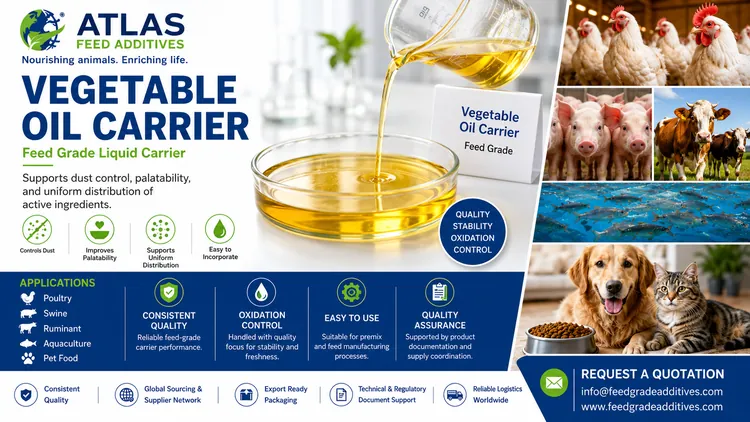
Vegetable Oil Carrier feed additive visual

Product role

Where Vegetable Oil Carrier fits

Vegetable Oil Carrier is part of the binders, carriers, and flow agents group. Buyers typically evaluate this product by matching the vegetable source, refining level, physical form, oxidation status, fatty-acid profile, intended species, feed-processing conditions and documentation requirements.

In feed manufacturing, vegetable oil carriers may be used to dissolve, disperse, dilute, coat or apply oil-compatible ingredients. They can be relevant for liquid feed additives, oil-based premixes, pellet surface treatment, dust-control systems, flavor or aroma carriers, liquid application systems, fat-soluble vitamin preparations and selected specialty additive blends.

Atlas Feed Additives can coordinate international supplier options for feed mills, premix producers, distributors, liquid additive manufacturers and integrators that need consistent feed-grade vegetable oil material, export documentation, packaging clarity and quotation support.

Typical applications

  • Feed mills using liquid application systems for pellet surface coating or mixer addition.
  • Premix plants preparing oil-based additive blends, liquid concentrates or coated powder systems.
  • Micro-ingredient carriers for fat-soluble vitamins, flavors, essential oils, pigments or oil-dispersible actives.
  • Dust-control programs in mash feed, mineral premixes, dry blends and fine-powder handling systems.
  • Pellet mills evaluating lubrication, coating, surface quality or selected palatability objectives.
  • Liquid feed and specialty additive manufacturers requiring a plant-derived carrier base.
  • Aquaculture, pet food and specialty feed systems where oil compatibility and application uniformity matter.

Buyer quality checklist

  • Botanical source and whether the product is single-source or blended vegetable oil.
  • Refining level: crude, degummed, neutralized, bleached, deodorized or fully refined where specified.
  • Peroxide value, acid value, free fatty acids, moisture and impurities.
  • Fatty-acid profile, iodine value, saponification value and unsaponifiable matter where required.
  • Color, odor, clarity, viscosity and low-temperature flow behavior.
  • Contaminant profile, including heavy metals, pesticide residues, dioxins, PAHs or mycotoxin-related concerns where relevant.
  • Oxidation stability, antioxidant system and shelf-life guidance.
  • Compatibility with target actives, pumps, spray nozzles, tanks, premix carriers and finished-feed processes.

Procurement note

Ask for the right specification before comparing prices.

Price comparisons are meaningful only when vegetable source, refining level, oxidation parameters, fatty-acid profile, packaging, origin, shelf life and documentation are aligned. A low-price oil may not be a better carrier if it has poor oxidation status, off-odor, inconsistent viscosity, unsuitable contaminant profile or weak documentation.

For Vegetable Oil Carrier, buyers should also confirm whether the oil will be used as an active energy ingredient, a technological carrier, a coating medium, a dust-control ingredient or a solvent/dispersion base for another additive. Each use has different quality priorities and different handling requirements.

Technical overview

What buyers should understand about Vegetable Oil Carrier

Plant-derived triglyceride carrier

Vegetable oil carriers are plant-derived oils composed mainly of triglycerides. They may be produced from seeds or other plant parts and can vary widely by botanical source, refining process, fatty-acid profile, oxidation status, viscosity, odor and color. These differences influence how the oil performs in feed manufacturing and liquid additive systems.

Carrier function in feed applications

Vegetable Oil Carrier may be selected to disperse oil-compatible active ingredients, help apply additives uniformly, reduce dust, support pellet surface coating, improve handling of fine powders or provide a liquid base for specialty feed products. It is a technological ingredient in many formulations, but it can also contribute energy depending on inclusion level and feed design.

Oxidation quality is critical

Oils can oxidize during production, storage and transport. Oxidation may affect odor, color, palatability, nutritional value and compatibility with sensitive active ingredients. Buyers should review peroxide value, acid value, free fatty acids, freshness, storage history, antioxidant use and shelf-life guidance before purchase.

Refining level changes performance

Crude, degummed, neutralized, bleached, deodorized and fully refined oils can differ in color, odor, impurities, phospholipid content, free fatty acids and suitability for liquid application. The correct refining level depends on the buyer’s feed application, animal species, quality policy and destination-market requirements.

Feed and premix applications

Where Vegetable Oil Carrier may be evaluated

Liquid additive carriers

Vegetable Oil Carrier can be used as a liquid base for oil-compatible additives where uniform dispersion and practical application are important. It may be considered for liquid premixes, fat-soluble vitamin preparations, essential oil blends, flavors, pigments, specialty additives and oil-dispersible actives.

  • Liquid concentrates requiring a plant-derived carrier base.
  • Oil-soluble or oil-dispersible active ingredients.
  • Liquid additive systems applied by pump, spray nozzle or mixer addition.
  • Specialty blends where odor, color and oxidation status influence product quality.

Pellet mills and surface application

Vegetable Oil Carrier may be used in pellet mills for surface coating, fat application, selected dust control and specialty additive application. The suitability depends on oil viscosity, temperature, pumpability, nozzle performance, feed formula and compatibility with target additives.

  • Post-pellet oil application systems.
  • Pellet surface coating and liquid additive application.
  • Dust reduction and fines-control strategies where oil addition is appropriate.
  • Programs comparing oil carriers with dry binders or hydrocolloid systems.

Premix and micro-ingredient handling

Premix producers may evaluate Vegetable Oil Carrier where a small amount of oil improves dust control, active distribution, coating or handling behavior. The oil should be compatible with the carrier matrix and should not create caking, segregation, rancidity or poor flow during storage.

  • Vitamin-mineral premixes where dust control is a priority.
  • Micro-ingredient distribution systems requiring oil-based coating.
  • Dry additive blends that need a compatible liquid carrier or anti-dust aid.
  • Products where flowability, caking and shelf-life behavior are measured during storage.

Aquaculture, pet food and specialty feeds

In aquaculture and pet food applications, Vegetable Oil Carrier may be used for coating, palatability support, oil-based additive delivery or liquid application. Buyers should confirm species suitability, oxidation status, label requirements, contaminant profile and destination-market authorization before purchase.

  • Fish and shrimp feed coating systems.
  • Pet food surface application and flavor carrier systems.
  • Specialty diets where oil-soluble actives require a compatible carrier.
  • Export applications requiring clear product identity and market-specific documents.

Functional formulation guide

How Vegetable Oil Carrier is used in practical feed systems

Active ingredient distribution

Vegetable Oil Carrier can help distribute oil-soluble or oil-dispersible ingredients more uniformly in feed or premix systems. The oil’s viscosity, polarity, compatibility and mixing sequence can affect how well the active ingredient remains dispersed and how consistently it is applied.

Dust control and powder coating

Small oil additions may reduce dust and help coat fine particles in selected dry blends. However, too much oil can reduce flowability, increase caking, cause equipment buildup or create inconsistent dosing. Buyers should test the oil in the actual carrier matrix and production equipment.

Liquid application and pumpability

For liquid application systems, pumpability, viscosity and low-temperature behavior are important. Some vegetable oils may become more viscous at lower temperatures, affecting pumping, spraying and nozzle performance. Temperature management may be needed in cold climates or unheated storage areas.

Compatibility testing

Vegetable Oil Carrier should be tested with the intended active ingredients. Some vitamins, flavors, pigments, antioxidants, acidifiers, essential oils and botanical extracts have specific solubility, dispersion or stability requirements. The buyer should evaluate the exact formulation before scale-up.

Commercial buying guide

Information to confirm before placing an order

Technical information

  • Exact product name and vegetable source: soybean, sunflower, canola, rapeseed, corn, palm fraction or specified blend.
  • Refining level and production description: crude, degummed, neutralized, refined, bleached, deodorized or supplier-defined grade.
  • Target application: liquid carrier, dust control, pellet surface application, oil-based premix, flavor carrier or specialty additive base.
  • Peroxide value, acid value, free fatty acids, moisture, impurities and insoluble matter.
  • Fatty-acid profile, iodine value, saponification value and unsaponifiable matter where required.
  • Color, odor, clarity, viscosity and low-temperature flow behavior.
  • Antioxidant system and oxidation-stability information where available.
  • Contaminant profile and market-specific feed-safety requirements.
  • Compatibility with pumps, nozzles, storage tanks, premix carriers and target active ingredients.
  • Shelf life and storage conditions under the supplier specification.

Commercial information

  • Required order quantity and expected annual demand.
  • Destination country, destination port or delivery address.
  • Preferred Incoterms, shipment method and target delivery date.
  • Packaging preference: drum, IBC, flexitank, bulk tanker or customer-specific packaging.
  • Required certificates, legalization needs and import documents.
  • Minimum shelf life required at loading and at arrival.
  • Sample requirement, pre-shipment inspection or third-party testing request.
  • Payment terms, lead time and regular supply expectations.

Quality and documentation

Documents commonly requested by professional buyers

Documentation requirements vary by destination country, buyer policy, species application, oil source and regulatory classification. Atlas Feed Additives can help clarify which documents are available from supplier options before quotation confirmation.

Core documents

  • Product specification sheet with botanical source, refining level and physical-chemical parameters.
  • Certificate of Analysis for the offered batch or representative lot.
  • Safety Data Sheet for handling, transport and storage review.
  • Country of origin statement and supplier or manufacturer details where available.
  • Batch number, production date, expiry date and shelf-life statement.
  • Packaging specification, net weight, gross weight, pallet or tank details and container loading information.

Additional documents when required

  • Fatty-acid profile, peroxide value, acid value and free fatty acid analysis.
  • GMO status declaration or crop-origin statement where required.
  • Allergen statement, BSE/TSE statement or animal-origin declaration where relevant.
  • Heavy metals, pesticide residues, dioxins, PAHs or undesirable-substance analysis where required.
  • Halal, free-sale, health, sanitary or market-specific certificates where available.
  • Regulatory compliance statement for the destination country when requested.

Handling and storage

Storage, transport and shelf-life considerations

Storage recommendations

Vegetable Oil Carrier should generally be stored in clean, sealed containers away from excessive heat, direct sunlight, moisture, oxygen exposure, strong odors and contamination. Oil quality can decline through oxidation, hydrolysis or contamination if storage conditions are poor. Always follow the supplier’s official storage statement because shelf life can vary by oil source, refining level, antioxidant system and packaging.

  • Keep drums, IBCs, tanks or bulk containers sealed when not in use.
  • Avoid water ingress, condensation, dirty transfer hoses and contaminated pumps.
  • Store away from oxidizing chemicals, disinfectants and strong-smelling materials.
  • Use first-expired, first-out stock rotation.
  • Inspect damaged, leaking or contaminated packaging before acceptance.
  • Record batch numbers and tank numbers for traceability and quality follow-up.

Transport considerations

For export shipments, buyers should confirm whether the oil is shipped in drums, IBCs, flexitanks, ISO tanks or bulk tankers. Cleanliness of containers, previous cargo history, temperature exposure and sealing are important for oil quality and feed-safety assurance.

  • Confirm packaging or tank cleanliness before loading.
  • Request label, seal, drum, IBC or flexitank photos when needed.
  • Check shelf life remaining at dispatch and expected shelf life at arrival.
  • Confirm whether certificates must be issued before shipment.
  • Align product description, HS code guidance and import documents with destination requirements.
  • Avoid long exposure to high heat, direct sunlight, air, water and contaminated transfer equipment.

Formulation compatibility

How to evaluate Vegetable Oil Carrier in a feed program

Questions for formulators

  • Is the main objective liquid carrying, coating, dust control, palatability, energy contribution or active dispersion?
  • Which active ingredients must be dissolved, suspended or dispersed in the oil?
  • Will the product be applied in a mixer, on pellets, in a liquid feed system or in a premix plant?
  • What viscosity and flow behavior are needed at the actual storage and processing temperature?
  • Will the oil be exposed to heat, steam, extrusion, acids, minerals, enzymes or long storage?
  • Are antioxidant protection and oxidation stability sufficient for the expected shelf life?
  • Will the oil affect pellet durability, flowability, caking, palatability or label declarations?
  • Are the botanical source and regulatory status suitable for the destination market?

Questions for procurement teams

  • Is the offered oil technically equivalent to the requested vegetable source and refining level?
  • Does the supplier declare peroxide value, acid value and free fatty acids clearly?
  • Is the product suitable for feed use and destination-market requirements?
  • Are batch documents available before shipment?
  • Does packaging protect the oil during export transport?
  • Is the price based on the same oil source, refining level and document package?
  • Is regular supply available or only spot stock?
  • Can the supplier support drums, IBCs, flexitanks, bulk shipments or buyer-specific packaging?

Comparison guide

Vegetable Oil Carrier compared with related binders and carriers

Vegetable Oil Carrier

Vegetable Oil Carrier is selected when the buyer needs a liquid, plant-derived carrier for oil-compatible actives, pellet surface application, dust control, coating, palatability support or liquid feed manufacturing. Buyers should compare vegetable source, refining level, oxidation quality, viscosity and documentation.

Lignosulfonate Pellet Binder

Lignosulfonate products are commonly used as dry or liquid pellet binders and may support pellet durability and fines reduction. They differ from vegetable oil carriers because they are usually evaluated mainly for pellet binding and process performance rather than oil-soluble active delivery.

Bentonite Pellet Binder

Bentonite is a clay-based binder and carrier used in feed applications. It may support pellet quality, flow control or binding, depending on grade and inclusion. It is a mineral material and does not provide the same liquid carrier function as vegetable oil.

Guar Gum

Guar Gum is a hydrocolloid thickener and binder. It may support viscosity, binding and water-related texture, but it is not a liquid oil carrier and is used for different functional objectives.

Xanthan Gum

Xanthan Gum is a hydrocolloid used for thickening, suspension control and stabilization. It can be useful in liquid systems but behaves differently from vegetable oil because it is water-dispersible rather than a lipid carrier.

Why Atlas Feed Additives

Export-focused sourcing support

Atlas Feed Additives supports international buyers that need practical sourcing help for feed-grade additives. Instead of only providing a product name and price, our team can review the intended use, confirm the quotation basis, collect available supplier documents and help buyers compare technically similar options.

Support areas

  • Supplier option review for Vegetable Oil Carrier and related binders, carriers and flow agents.
  • Specification matching according to buyer target and destination requirements.
  • Document coordination for COA, SDS, origin, packaging and shelf-life information.
  • Quality-parameter review for peroxide value, acid value, free fatty acids and feed-safety documents where available.
  • Quotation support for trial orders, drum shipments, IBC shipments, flexitanks, bulk shipments and regular supply programs.
  • Communication support for English and Turkish-speaking buyers.
  • Export-focused coordination from Ankara, Turkey.

Questions

Useful answers

What is Vegetable Oil Carrier used for in animal nutrition?

Vegetable Oil Carrier is used as a liquid carrier, coating aid, dust-control ingredient and dispersion medium for selected feed additives. It can help distribute oil-soluble or oil-dispersible active ingredients, support pellet surface application, improve powder handling and provide a plant-derived liquid base for specialty feed products.

Which vegetable oils can be used as feed carriers?

Vegetable oil carriers may be based on soybean oil, sunflower oil, canola or rapeseed oil, corn oil, palm oil fractions or other plant-derived oils depending on supplier availability, local feed regulations and buyer specification.

Is Vegetable Oil Carrier the same as an energy feed ingredient?

It can contribute energy when included in feed, but on this page it is positioned primarily as a technological carrier and flow-support ingredient. The final function depends on inclusion rate, feed formula and labeling rules.

Can Vegetable Oil Carrier be used for dust control?

Yes, vegetable oil can be evaluated for dust control in selected mash feeds, dry blends and premixes. The right inclusion level should be tested because too much oil can affect flowability, caking, dosing accuracy or equipment cleanliness.

Can Vegetable Oil Carrier be used with vitamins or essential oils?

It may be used with oil-compatible ingredients such as fat-soluble vitamins, essential oils, flavors, pigments or botanical extracts. Compatibility, solubility, dispersion, oxidation stability and shelf life should be tested before scale-up.

What quality documents should buyers request for Vegetable Oil Carrier?

Common documents include specification, Certificate of Analysis, Safety Data Sheet, origin information, batch details, production date, expiry date, packaging specification, storage instructions, peroxide value, acid value, fatty-acid profile where available and any market-specific certificates required by the buyer.

What should be checked on the Certificate of Analysis?

Check product name, vegetable source, batch number, production date, peroxide value, acid value, free fatty acids, moisture, impurities, color, odor, contaminants where tested, expiry date and whether the values match the agreed specification.

Why do Vegetable Oil Carrier prices vary?

Prices vary because products may differ in vegetable source, refining level, oxidation status, fatty-acid profile, packaging, origin, shelf life, documentation, order quantity, logistics and market availability.

Can Atlas Feed Additives quote Vegetable Oil Carrier?

Yes. Send your required vegetable source, refining level, target application, quality specification, quantity, destination, packaging preference and document requirements so Atlas Feed Additives can review suitable supplier options for Vegetable Oil Carrier.

What information should I send for the fastest quotation?

Please send the product name, preferred vegetable source, target application, required quality parameters, quantity, destination country, preferred Incoterms, packaging preference, required documents and target delivery timing.

Can Vegetable Oil Carrier become rancid?

Vegetable oils can oxidize or degrade if storage, handling or packaging conditions are poor. Buyers should review peroxide value, acid value, odor, antioxidant status, shelf life and storage conditions before purchase and during use.

Can Vegetable Oil Carrier make disease-treatment claims?

No. Vegetable Oil Carrier should be positioned as a feed ingredient or technological carrier according to applicable rules. It should not be marketed as a disease treatment or veterinary product.

Request a quotation

Tell us what you need

Send your product list, target specification, destination country, packaging preference, required documents and expected order quantity. Our team will review your request and respond from orders@feedgradeadditives.com.

Recommended message format

For a faster response, include: “We need Vegetable Oil Carrier for [liquid carrier/pellet coating/dust control/oil-based premix], preferred source [soybean/sunflower/canola/etc.], quality requirements [peroxide value/acid value/free fatty acids/etc.], quantity [kg or MT], destination [country/port], packaging [drum/IBC/flexitank/bulk], documents [COA/SDS/origin/fatty-acid profile/etc.], target delivery date [date].”