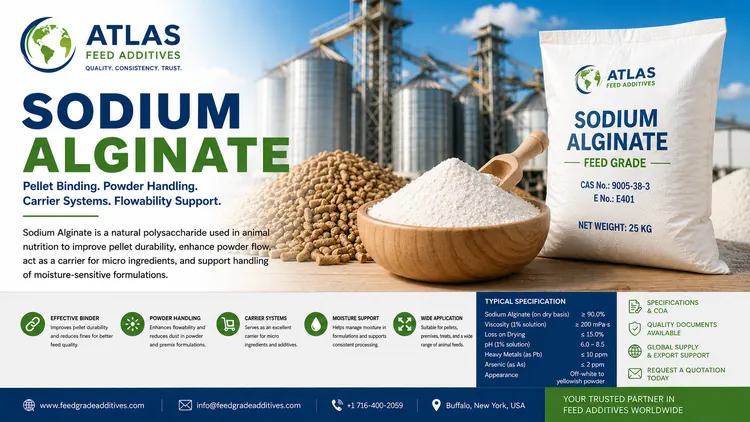
What is Sodium Alginate used for in animal nutrition?
Sodium Alginate is used in animal nutrition and feed manufacturing programs where formulators need support
for pellet integrity, powder handling, flowability, carrier systems, moisture interaction, granule
formation, or active ingredient distribution. It may be considered in compound feed, premix, aquafeed,
pet food, and specialty feed applications depending on formulation objective and applicable market rules.
Can Atlas Feed Additives quote Sodium Alginate?
Yes. Send your required specification, viscosity grade, particle size preference, quantity, destination,
packaging preference, preferred Incoterms, and required documents. Atlas Feed Additives can review suitable
supplier options and provide quotation support for Sodium Alginate.
What quality documents should buyers request for Sodium Alginate?
Common documents include product specification, certificate of analysis, safety data sheet, country of
origin information, batch details, shelf-life statement, packaging information, viscosity information,
particle size details, and any certificates required by the destination market or buyer’s internal approval
process.
Is Sodium Alginate suitable for every pellet or powder application?
No single binder or carrier is suitable for every formula. Suitability depends on feed type, moisture
conditions, processing temperature, target texture, viscosity grade, particle size, water interaction,
active ingredient compatibility, local regulations, and the buyer’s technical objective.
Why is viscosity grade important for Sodium Alginate?
Viscosity grade affects hydration behavior, solution thickness, binding performance, processing behavior,
and application suitability. Buyers should confirm the viscosity value, test method, and target application
before comparing supplier offers.
Is Sodium Alginate used alone or with other binders?
Sodium Alginate may be used alone or as part of a broader binder, carrier, or texture system with gums,
clays, starches, lignosulfonates, cellulose derivatives, or other functional ingredients. The best approach
depends on the target application, cost-in-use, processing method, and regulatory framework.
What makes Sodium Alginate offers difficult to compare?
Offers may differ by viscosity grade, gel strength, particle size, solubility, hydration speed, purity,
moisture, ash, bulk density, packaging, origin, lead time, document quality, shipment terms, and payment
terms. Buyers should compare the complete technical and commercial offer, not only the price per kilogram.
What details should be included in a Sodium Alginate quotation request?
A complete request should include product name, target viscosity grade, intended application, particle size
preference, quantity, destination, preferred Incoterms, packaging preference, required documents, target
shipment date, and any registration, labeling, import, or customer-specific requirements.
How should Sodium Alginate be stored?
Sodium Alginate should be stored according to the supplier’s safety data sheet and label instructions.
In general, buyers should keep the product in clean, dry, well-ventilated storage, protect it from
moisture and contamination, keep packaging closed, and rotate stock according to shelf life.