Binders, carriers, and flow agents

Rice Hull Carrier

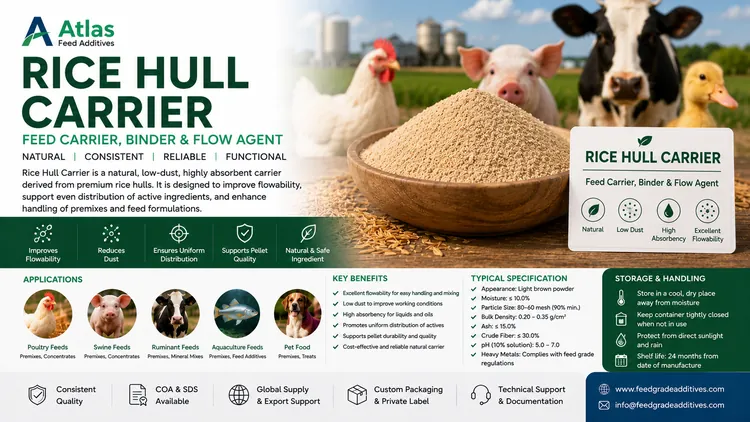
Rice Hull Carrier is a plant-based feed carrier and handling aid used in premixes, additive blends, and powder systems to support active ingredient distribution, flowability, dust control, dilution, and processing consistency.

Rice Hull Carrier feed additive visual

Product role

Where Rice Hull Carrier fits

Rice Hull Carrier is part of the binders, carriers, and flow agents group. It is commonly evaluated by feed mills, premix producers, additive manufacturers, distributors, and integrators that need a consistent plant-based carrier for dry blends, micro-ingredients, functional additives, and processing aids.

In premix and additive systems, a carrier is not just a filler. It affects how active ingredients are absorbed, diluted, distributed, weighed, dosed, transported, mixed, stored, and discharged from bags, silos, hoppers, and dosing equipment. The right Rice Hull Carrier specification can help reduce segregation risk, improve handling, and support more uniform distribution of sensitive or low-inclusion ingredients.

Atlas Feed Additives can coordinate international supplier options for feed-grade Rice Hull Carrier based on particle size, bulk density, moisture, ash, cleanliness, contaminant profile, packaging, destination market, required documentation, and shipment requirements.

Typical applications

  • Premix plants that require a plant-based carrier for vitamins, minerals, enzymes, acids, flavors, pigments, botanicals, or specialty feed additives.
  • Feed additive manufacturers that need dilution support for low-inclusion active ingredients.
  • Powder blends where flowability, discharge behavior, and handling consistency are important.
  • Micro-ingredient systems where uniform distribution and dosing reliability are key quality targets.
  • Pellet mills and compound feed plants requiring support for powder handling, pellet integrity, or process consistency.
  • Dust-control strategies where carrier structure, particle size, and absorption capacity can influence airborne dust.
  • Export-oriented additive blends where stable packaging, moisture control, and batch traceability are required.

Buyer quality checklist

  • Particle size distribution and target mesh size.
  • Bulk density, tapped density, and dosing behavior.
  • Moisture level and water activity where required.
  • Ash, fiber profile, and insoluble material characteristics.
  • Flowability, caking tendency, dusting behavior, and angle of repose where available.
  • Absorption capacity for liquid or oily active ingredients.
  • Compatibility with the target active ingredient and final premix system.
  • Contaminant profile, origin information, packaging, and shelf-life statement.

Technical overview

Why carrier selection matters in premix quality

A feed carrier influences the physical performance of a premix. Even when the active ingredient is chemically correct, poor carrier selection can create practical problems such as segregation, caking, dusting, poor discharge, uneven distribution, low flowability, inaccurate dosing, and inconsistent batch performance.

Rice Hull Carrier is often considered where buyers want a plant-based, fibrous, dry, and relatively inert carrier material for additive systems. However, performance depends on the exact grade. Fine powders may support more uniform distribution but can increase dusting risk. Coarser grades may improve flow but may not be suitable for every low-inclusion active ingredient. Bulk density affects bag filling, dosing equipment, transport cost, and premix formulation volume.

Atlas Feed Additives helps buyers clarify the technical and commercial variables before comparing quotations, reducing the risk of mismatched products, incomplete documents, or unsuitable material for the buyer's equipment and application.

Specification guidance

Common Rice Hull Carrier specification items

Final parameters depend on the supplier, origin, milling process, particle size target, cleanliness controls, and buyer application. Buyers should request a current specification sheet and certificate of analysis for the exact grade being offered.

Identity and source

  • Product name and commercial grade name.
  • Raw material source, such as rice hull or rice husk-derived material.
  • Country of origin and production site information where available.
  • Processing method, milling level, or granulation information where declared.
  • Feed-grade suitability statement where applicable.
  • Batch number and traceability information.

Physical parameters

  • Appearance, color, odor, and physical form.
  • Particle size distribution or mesh size.
  • Bulk density and tapped density.
  • Flowability, caking tendency, and dusting behavior where available.
  • Oil absorption or liquid absorption capacity where relevant.
  • Bag discharge behavior and compatibility with dosing equipment.

Chemical and quality parameters

  • Moisture or loss on drying.
  • Ash content and insoluble ash where requested.
  • Crude fiber or fiber profile where relevant to the buyer.
  • pH or other analytical values where specified.
  • Heavy metal information according to buyer or market requirements.
  • Microbiological and contaminant profile where required for the application.

Commercial and logistics data

  • Packaging type and net weight per bag, big bag, or pallet unit.
  • Pallet configuration and container loading estimate.
  • Minimum order quantity and lead time.
  • Shelf life and recommended storage conditions.
  • Incoterms, destination port, and shipment documentation.
  • Batch traceability and document availability before dispatch.

Application guidance

How buyers use Rice Hull Carrier

Premix carrier

Rice Hull Carrier can be used to dilute and distribute low-inclusion ingredients in vitamin premixes, mineral premixes, enzyme preparations, acidifier blends, flavor systems, pigment blends, botanical products, and other specialty additive systems. The selected grade should match the active ingredient's particle size, density, moisture sensitivity, and mixing behavior.

Flow and handling support

In dry powder systems, carrier selection can influence flow through hoppers, bag filling lines, mixers, screw conveyors, and dosing systems. A well-matched Rice Hull Carrier can support handling consistency and reduce production interruptions caused by bridging, caking, poor discharge, or excessive dust.

Liquid-active absorption

Some feed additives are supplied as liquids, oils, extracts, or viscous materials that must be converted into dry blends. Depending on grade and absorption capacity, Rice Hull Carrier may help carry these actives into a dry, easier-to-handle form. Buyers should check loading capacity, clumping risk, odor retention, and stability before scale-up.

Pellet and finished feed support

Rice Hull Carrier may be evaluated in compound feed and pellet systems as part of a broader handling or physical-quality strategy. Its value depends on formulation, inclusion level, particle size, moisture, conditioning conditions, pellet mill settings, and the target finished feed quality.

Premix performance

Uniform distribution starts with physical compatibility

For premix producers, physical compatibility between the carrier and active ingredient is critical. Differences in particle size, density, shape, moisture, electrostatic behavior, and surface characteristics can cause segregation during mixing, bagging, transport, or storage. A carrier that looks acceptable in a simple visual check may still perform poorly in a homogeneity test.

Buyers should confirm the carrier's behavior in their own mixing equipment and packaging format. Homogeneity checks, tracer tests, flow tests, and storage stability evaluations may be useful when launching a new formulation or changing suppliers.

Practical control points

What to review during trials

  • Mixing time required to achieve uniform distribution.
  • Segregation after bagging, palletizing, transport, and storage.
  • Dust level during weighing, loading, mixing, and discharge.
  • Flow through dosing equipment and screw conveyors.
  • Compatibility with oils, liquids, acids, enzymes, minerals, and botanicals.
  • Effect on final premix bulk density and packaging volume.
  • Clumping tendency under humidity or long storage.
  • Odor, color, and appearance impact on the finished blend.

Processing note

Match the carrier to the equipment, not only to the formula

Rice Hull Carrier performance depends on the full production system. A grade that works well in a ribbon mixer may not perform the same way in a paddle mixer, vertical mixer, micro-dosing unit, pneumatic transfer line, or high-speed packing system. Equipment geometry, batch size, filling order, mixing time, discharge method, and humidity conditions can all influence results.

For buyers using automated dosing or micro-ingredient systems, bulk density and flow behavior should be checked carefully. For buyers using manual weighing and bagging, dusting, worker handling comfort, packaging strength, and moisture resistance may be equally important.

Equipment-related questions

  • Will the material discharge freely from bags or big bags?
  • Does it bridge or compact in the hopper?
  • Does it create excess dust during loading?
  • Can it carry the required liquid or active ingredient level?
  • Does it remain uniform after transport?
  • Does the final blend meet the target bulk density?

Quality documents

Documents to request before purchase

Documentation requirements vary by country, customer, species, certification program, and final use. Atlas Feed Additives can help buyers organize supplier documentation for review before shipment.

Core documents

  • Product specification sheet.
  • Certificate of analysis for the offered batch or representative batch.
  • Safety data sheet.
  • Technical data sheet.
  • Batch number, production date, expiry date, and shelf-life statement.
  • Origin information and manufacturing or processing details where available.

Analytical and quality documents

  • Particle size or mesh analysis.
  • Moisture, ash, and fiber information where requested.
  • Heavy metal results according to buyer or market requirements.
  • Microbiological information where relevant.
  • Mycotoxin, pesticide, or contaminant declarations where required.
  • GMO, allergen, BSE/TSE, irradiation, and residual solvent statements when requested.

Import and commercial documents

  • Commercial invoice and packing list.
  • Certificate of origin when required.
  • Bill of lading, airway bill, or transport document.
  • Phytosanitary, feed, or market-specific certificates where applicable.
  • Pallet details, container loading data, and HS code support where available.
  • Quality system certificates such as ISO, HACCP, GMP+, or similar documents when available.

Customer approval documents

  • Supplier questionnaire or vendor approval form.
  • Traceability and recall statement where required.
  • Food-chain or feed-chain suitability declaration where applicable.
  • Storage and handling recommendation.
  • Packaging specification and label copy where required.
  • Change-control or notification policy for long-term supply agreements.

Storage and handling

Protect flowability, cleanliness, and moisture control

Rice Hull Carrier should be stored according to supplier documents and internal quality procedures. In general, dry carriers should be protected from moisture, rain, high humidity, direct floor contact, pest exposure, odor contamination, and torn packaging. Packaging should remain sealed until use.

Because carriers can influence the quality of sensitive feed additives, warehouse teams should maintain batch traceability and use first-expiry, first-out or first-in, first-out stock rotation as required. Before use, operators should inspect packaging condition, odor, visible contamination, caking, and moisture exposure.

Warehouse checklist

  • Store in a clean, dry, ventilated area.
  • Keep bags closed and protected from humidity.
  • Avoid contact with floor moisture or damaged pallets.
  • Separate from strong odors and incompatible materials.
  • Monitor pest-control status in storage areas.
  • Record batch number and receiving date.
  • Inspect packaging before acceptance and before use.
  • Use stock rotation according to internal quality rules.

Procurement note

Ask for the right specification before comparing prices

Price comparisons are meaningful only when particle size, bulk density, moisture, ash, cleanliness, packaging, origin, shelf life, logistics cost, and documentation are aligned. A lower price may not be economical if the product creates dust, segregation, poor flow, high packaging volume, or quality complaints in the finished premix.

For carrier products, cost-in-use should consider not only the price per metric ton but also active loading capacity, handling efficiency, waste, bagging performance, transport volume, rejected batches, and customer acceptance.

Quotation preparation

Information to send for a faster quote

  • Required product name and target grade.
  • Particle size, mesh range, or physical form preference.
  • Bulk density target or packaging-volume limitation.
  • Application area such as premix carrier, liquid absorption, powder flow support, or pellet support.
  • Target active ingredients to be carried, when relevant.
  • Estimated order quantity and annual demand.
  • Destination country, port, or delivery location.
  • Required packaging, pallet type, and documents.

Comparison guide

Rice Hull Carrier compared with other carrier and binder options

Carrier and binder selection depends on the intended technical function. Rice Hull Carrier may be suitable for plant-based carrier and handling applications, while other products may be selected for stronger pellet binding, gelling, thickening, anticaking, or moisture-control objectives.

Rice Hull Carrier

Often selected as a plant-based carrier or diluent for dry additive systems. Key evaluation points include particle size, bulk density, cleanliness, flowability, dusting, and compatibility with the active ingredient.

Lignosulfonate Pellet Binder

Typically evaluated where pellet durability and binding performance are primary objectives. Buyers should compare binding strength, inclusion level, solubility, color impact, and process compatibility.

Bentonite Pellet Binder

Often considered for binding, moisture management, or physical support in feed systems. Key checks include swelling behavior, mineral profile, contaminant control, and compatibility with formulation goals.

Guar Gum and Xanthan Gum

Hydrocolloid products may be selected for thickening, gelling, suspension, or texture-related functions. Buyers should compare viscosity, hydration behavior, purity, microbiology, and price-in-use.

Related products

Other binders, carriers, and flow agents

Atlas Feed Additives can support sourcing requests for Rice Hull Carrier and other products used to improve powder handling, pellet quality, flowability, binding, dilution, and uniform distribution in feed and premix systems.

Questions

Useful answers

What is Rice Hull Carrier used for in animal nutrition?

Rice Hull Carrier is used as a carrier, diluent, flow-support ingredient, and handling aid in feed additive and premix systems. It can help support powder handling, active ingredient distribution, dust control, flowability, and processing consistency when matched to the correct grade and application.

Can Atlas Feed Additives quote Rice Hull Carrier?

Yes. Send your required specification, particle size, bulk density target, quantity, destination, packaging preference, application area, and required documents so Atlas Feed Additives can review suitable supplier options for Rice Hull Carrier.

What quality documents should buyers request for Rice Hull Carrier?

Common documents include product specification, certificate of analysis, safety data sheet, technical data sheet, origin information, batch details, particle size information, moisture and ash results, contaminant declarations, and market-specific certificates required by the buyer.

Why are particle size and bulk density important?

Particle size and bulk density influence flowability, mixing uniformity, segregation risk, dusting, dosing accuracy, bag filling, transport cost, and compatibility with active ingredients. Buyers should align these parameters with their premix equipment and finished product targets.

Can Rice Hull Carrier absorb liquid active ingredients?

Some grades may be suitable for carrying liquids, oils, extracts, or other active materials, but loading capacity depends on particle structure, moisture, surface characteristics, liquid viscosity, and target blend performance. Buyers should run small-scale compatibility and stability trials before full production.

Is Rice Hull Carrier the same as a pellet binder?

Not necessarily. Rice Hull Carrier may support handling and physical structure in some systems, but dedicated binders such as lignosulfonate or bentonite may be selected when strong pellet durability is the primary objective. The best choice depends on formulation and process goals.

What should be checked during supplier comparison?

Buyers should compare particle size, bulk density, moisture, ash, cleanliness, flowability, contaminant profile, packaging, shelf life, documentation, origin, logistics cost, and actual performance in their production equipment.

How should Rice Hull Carrier be stored?

Store it in a clean, dry, ventilated area, protected from moisture, pests, strong odors, torn packaging, and contamination. Keep packaging sealed until use and maintain batch traceability according to internal quality procedures.

Request a quotation

Tell us what you need

Send your product list, target specification, particle size or mesh range, bulk density target, destination country, packaging preference, application area, expected quantity, and required documents. Our team will review your request and respond from orders@feedgradeadditives.com.