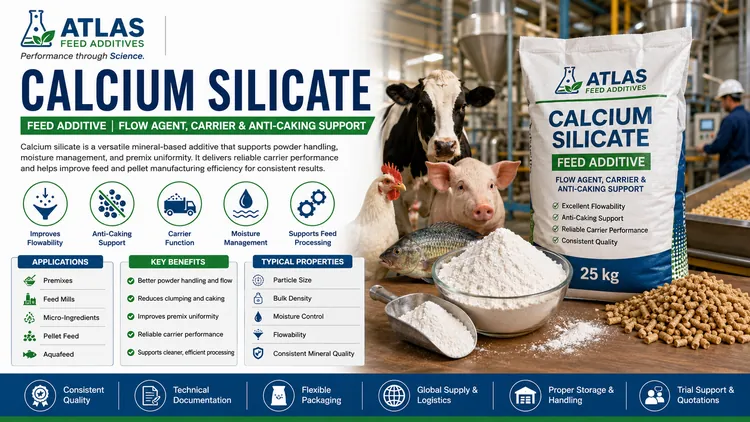
What is Calcium Silicate used for in animal nutrition?
Calcium Silicate helps improve powder handling, flowability, anti-caking behavior, moisture management, carrier performance, and uniform distribution of active ingredients. It should be used according to the target feed system, formulation objective, supplier specification, and applicable market rules.
Is Calcium Silicate a binder, carrier, or flow agent?
It can be selected for several technological functions depending on grade and application. Common roles include anti-caking aid, flow agent, carrier, liquid active adsorbent, moisture-management support, and powder-handling aid.
Can Atlas Feed Additives quote Calcium Silicate?
Yes. Send your required specification, function, particle size, bulk density, quantity, destination, packaging preference, delivery terms, and required documents so Atlas Feed Additives can review suitable supplier options for Calcium Silicate.
What quality documents should buyers request for Calcium Silicate?
Common documents include specification, certificate of analysis, safety data sheet, origin information, batch details, particle-size data, bulk-density data, moisture or loss-on-drying data, contaminant profile, shelf-life statement, packaging details, and any market-specific certificates required by the buyer.
Why is particle size important?
Particle size affects flow, dust, absorption, mixing uniformity, segregation risk, carrier performance, anti-caking behavior, and compatibility with other premix or feed ingredients.
Why is bulk density important?
Bulk density affects packaging volume, dosing accuracy, mixing behavior, segregation risk, hopper flow, and transport cost. It should be matched with the target active and process.
Can Calcium Silicate carry liquid actives?
Some grades can adsorb oils, flavors, acids, botanical extracts, or other liquid actives. Buyers should confirm oil absorption, water absorption, loading capacity, caking behavior after loading, and compatibility with the active ingredient.
Is Calcium Silicate a nutritional calcium source?
Calcium Silicate is normally selected for technological functions, not as the primary dietary calcium source. Nutritional contribution should be evaluated only if supported by the supplier specification and formulation team.
Can Calcium Silicate be used in premixes?
Yes, it may be used in premix systems where flow, anti-caking behavior, carrier function, active distribution, or moisture management is required. Compatibility with vitamins, minerals, enzymes, probiotics, acids, and other actives should be checked.
What contaminants should be checked?
Depending on origin and grade, buyers may request heavy metals, arsenic, lead, cadmium, mercury, soluble salts, microbiology where required, crystalline silica statement where applicable, and other destination-market feed safety parameters.
How should Calcium Silicate be stored?
Store according to the supplier specification and SDS. In general, keep the product dry, sealed, covered, ventilated, protected from contamination and moisture, and rotated using first-expiry-first-out practice.
How should buyers compare different Calcium Silicate offers?
Compare particle size, bulk density, moisture, absorption capacity, flowability, dust, caking behavior, contaminant profile, feed-grade suitability, regulatory fit, packaging, shelf life, document quality, freight, and landed cost.
What information should I send for a fast quotation?
Please send the required function, particle size, bulk density, moisture limit, target application, target active if used as a carrier, order quantity, destination, packaging preference, delivery terms, and required documents.