
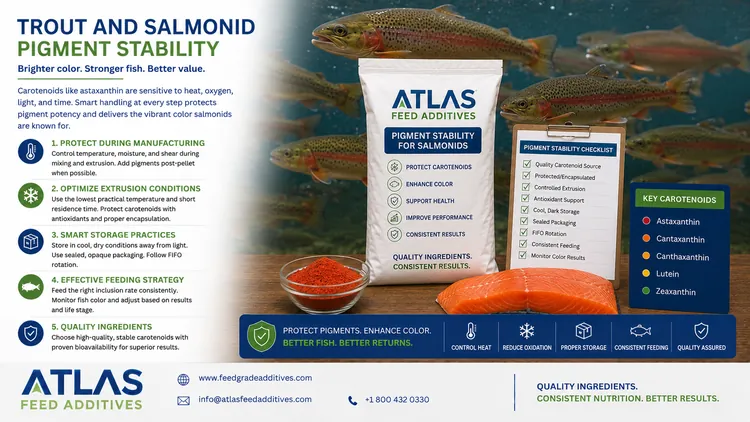
Feed additive decisions are strongest when they begin with a clear production objective. Trout and Salmonid Pigment Stability is not a single-product decision; it is a practical process of matching species, market color target, feed manufacturing conditions, raw material quality, storage time, and the commercial target.
Why this topic matters
Protecting carotenoids through manufacturing and storage is essential in trout and salmonid feeds because pigmentation programs are closely linked to product appearance, buyer expectations, and final market value. Pigments are added at controlled levels, but the amount finally available to the fish can be affected by feed processing, oil quality, oxygen exposure, warehouse conditions, and feeding practices.
In real operations, the result depends on feed quality, farm management, species, genetics, health status, water temperature, storage, and how consistently the additive is applied. A successful pigment program should therefore consider the complete chain from pigment selection to finished feed delivery and on-farm use.
Where pigment losses can occur
Carotenoids can be sensitive to heat, oxygen, light, moisture, and contact with oxidized fats or reactive ingredients. In aquafeed production, extrusion, drying, cooling, oil coating, packaging, and storage can all influence pigment stability. Even when the formulation is correct, poor storage or long exposure to warm and humid conditions may reduce the practical value of the program.
- Manufacturing: extrusion temperature, drying time, and cooling efficiency can affect pigment recovery in finished feed.
- Oil coating: oil quality and antioxidant protection should be reviewed because oxidized oils may increase carotenoid stress.
- Packaging: bags should protect the product from moisture, light exposure, and unnecessary oxygen contact.
- Storage: high temperature, humidity, and long shelf-life can reduce pigment reliability before feeding.
- Feeding period: final color depends on consistent intake, fish size, health status, water temperature, and program duration.
Practical approach
A practical salmonid pigment program starts by defining the market objective: target color intensity, feeding duration, fish size, harvest schedule, and feed type. The next step is to select a pigment source and formulation approach that can remain stable through production and storage while supporting predictable results on farm.
- Match additive selection to species, life stage, water temperature, feed processing, and harvest timing.
- Review pigment form, concentration, carrier system, stability data, and supplier handling recommendations.
- Check feed form, pellet durability, oil coating quality, and storage conditions before judging pigment performance.
- Water stability and palatability are especially important in aquatic feeds because uneaten feed affects both cost and water quality.
- Track survival, FCR, growth rate, pigmentation, feeding behavior, and water-quality indicators during commercial evaluation.
Manufacturing and storage considerations
Feed mills should review pigment addition points, mixing accuracy, extrusion conditions, drying temperature, coating quality, and finished-feed cooling. If the feed is packed before it is properly cooled, condensation risk can increase and storage quality may decline. For long-distance shipments, packaging strength, pallet protection, container conditions, and expected destination climate should also be considered.
Good warehouse practice supports pigment protection. Finished feeds should be stored in a dry, clean, shaded, and well-ventilated area. Bags should remain closed until use, damaged packaging should be checked, and a first-in, first-out stock rotation system should be followed. These basic steps help protect both pigment activity and overall feed quality.
Product groups to review
Depending on the challenge, the following product groups may be worth reviewing with your nutrition, technical, or procurement team:
Buyer checklist
Before ordering, request the product specification, certificate of analysis, shelf-life, storage conditions, recommended inclusion range, packaging details, and destination-market documents. For commercial trials, define the baseline, control group, feed batches, performance indicators, color target, sampling method, and review period before the additive is introduced.
For trout and salmonid pigment programs, it is also useful to share the species, average fish size, harvest target, feed form, extrusion or coating method, expected storage period, water temperature range, and customer color requirements. This helps suppliers and technical teams recommend options that fit the practical production setting.
How Atlas Feed Additives can support
Atlas Feed Additives can help buyers compare feed-grade pigment and additive options, coordinate supplier documentation, and structure inquiries for international shipments. Send the target application, current challenge, species, production phase, product group, expected quantity, destination country, and document requirements so we can review the request efficiently.