
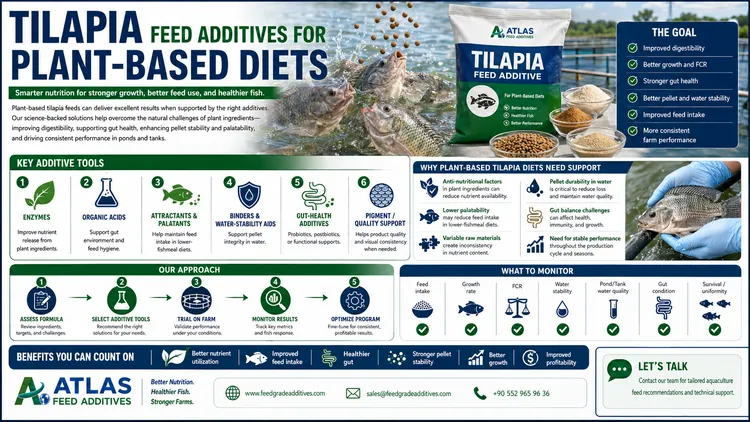
Feed additive decisions are strongest when they begin with a clear production objective. Tilapia Feed Additives for Plant-Based Diets is not a single-product decision; it is a practical process of matching plant-protein sources, tilapia life stage, feed processing, water stability, gut health, nutrient density, and farm performance targets.
Why this topic matters
Tilapia feeds often use soybean meal, corn gluten, wheat products, canola meal, pea protein, rice bran, or other regional plant ingredients to manage cost and fishmeal availability. These ingredients can support efficient production, but they may also change digestibility, palatability, pellet quality, amino acid balance, mineral availability, and gut conditions.
In real farms, the result depends on fish size, water temperature, stocking density, feeding method, extrusion or pelleting conditions, storage, pellet water stability, and how consistently the additive is applied. Feed additives should therefore be reviewed as part of the full formula and production system, not as isolated ingredients.
Practical approach
- Review the plant-protein sources, inclusion levels, anti-nutritional factors, fiber load, oil quality, and expected nutrient availability.
- Match additive selection to tilapia life stage, feed size, culture system, water temperature, salinity, feeding frequency, and processing method.
- Balance palatability, digestibility, pellet durability, and water stability so nutrients reach the fish rather than leaching into the water.
- Track feed intake, feeding response, growth rate, feed conversion ratio, survival, size uniformity, gut observations, feces quality, and water-quality indicators.
- Confirm product specifications, supplier documentation, storage requirements, recommended inclusion range, and destination-market rules before purchase.
Additive groups commonly reviewed
Plant-based tilapia formulas may need a combination of additive tools. Enzymes can be reviewed for fiber and phosphorus availability. Organic acids and acidifier blends may support feed hygiene and gut-environment strategies. Probiotics, prebiotics, yeast fractions, and immunostimulant ingredients may be evaluated when farms are focused on gut resilience and stress periods.
Palatants and attractants can help when formulas have lower fishmeal, unfamiliar plant ingredients, or variable intake. Binders and gums may support pellet integrity and water stability. Antioxidants and emulsifiers may be reviewed when oil quality, fat utilization, or storage stability is important. Amino acids, minerals, vitamins, and pigment sources should be checked against the complete formulation target.
Digestibility and nutrient availability
Plant proteins can introduce fiber, phytate, non-starch polysaccharides, and other factors that influence nutrient release. Enzyme programs may be reviewed to improve access to selected nutrients, but the value depends on substrate level, processing conditions, enzyme stability, and feed manufacturing control.
For tilapia, formulation teams should also review amino acid balance, available phosphorus, mineral interactions, lipid source, and protein quality. An additive cannot correct a poorly balanced formula by itself, so digestibility support should be combined with proper raw-material evaluation and formulation review.
Palatability and feeding behavior
Tilapia are adaptable feeders, but formula changes can still influence feeding response. Lower fishmeal diets may have different aroma, taste, texture, and nutrient release in water. Palatants, attractants, and liquid coating strategies may help improve feed recognition and acceptance when they are matched to pellet quality and farm feeding practice.
Palatability should be evaluated with practical observations, not human smell alone. Useful measures include response time, uneaten feed, feeding uniformity, growth, feed conversion ratio, and behavior after formula changes. Water temperature, stress, stocking density, and feeding schedule should be recorded during trials.
Pellet quality and water stability
Plant-based diets can change pellet expansion, hardness, fines, dust, and water stability. Weak pellets increase waste, nutrient loss, and water-quality pressure. Binder selection, starch gelatinization, drying, cooling, oil coating, and storage all influence final feed performance.
When evaluating binders or gums, buyers should ask about application point, inclusion range, compatibility with extrusion or pelleting, water stability data, viscosity, mixing guidance, and finished-feed texture. The best choice depends on whether the feed is floating, sinking, crumble, or a specialty form.
Farm trial checklist
- Define the control diet, test diet, trial duration, fish size, stocking density, feeding rate, and water-quality monitoring plan.
- Use comparable feed batches and store them under the same conditions before testing.
- Measure feed intake, FCR, growth, survival, size uniformity, gut or feces observations, and uneaten feed.
- Record water temperature, dissolved oxygen, pH, ammonia, weather changes, disease events, and management changes.
- Review cost in use, not only additive price per kilogram.
Buyer checklist
Before ordering, request the specification, certificate of analysis, shelf-life, storage conditions, packaging, recommended inclusion range, safety information, and required export or import documents. For aquafeed products, also ask about heat stability, water solubility, carrier type, odor profile, point of application, pellet compatibility, and species guidance.
For international shipments, confirm whether the product classification, label, claim language, and documentation match the destination market. Additive claims, allowed ingredients, and feed-use conditions can differ by country.
How Atlas Feed Additives can support
Atlas Feed Additives can help buyers compare feed-grade additive options, coordinate supplier documentation, and structure sourcing requests for tilapia and other aquaculture programs. Send the target species, life stage, feed type, plant-protein sources, current challenge, additive group, quantity, destination country, packaging preference, and required documents so we can review the request efficiently.