
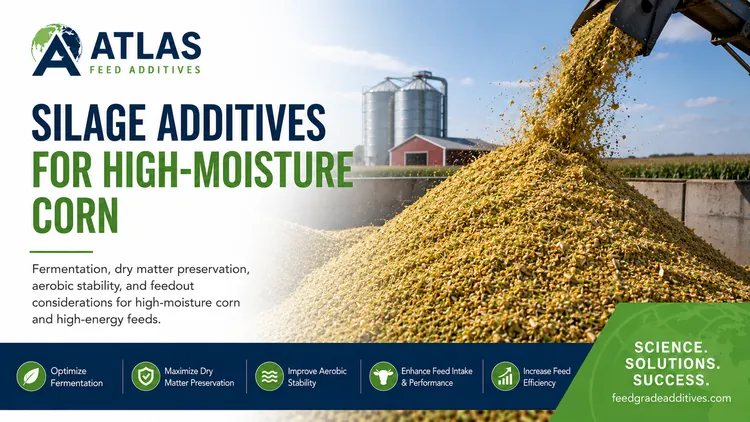
Feed additive decisions are strongest when they begin with a clear production objective. Silage Additives for High-Moisture Corn is not a single-product decision; it is a practical process of matching crop moisture, kernel processing, harvest hygiene, storage conditions, ration use, and the commercial target.
Why this topic matters
Fermentation and aerobic-stability considerations are important because high-moisture corn is a valuable high-energy feed, but it must be harvested, processed, stored, and fed with discipline. Poor fermentation, oxygen exposure, heating, mold growth, or excessive dry matter loss can reduce the practical value of the feed before it reaches the ration.
In real operations, the result depends on crop maturity, moisture level, kernel processing, packing density, storage structure, sealing quality, feedout rate, weather, and how consistently the additive is applied. A good additive program should therefore support the whole preservation system rather than compensate for avoidable harvest or storage problems.
Key areas to review
High-moisture corn programs should be planned before harvest so the additive choice matches the actual crop and storage challenge. The same product may not be suitable for every moisture level, storage system, or feedout speed, so buyers should review practical conditions before ordering.
- Harvest moisture: moisture level affects fermentation pattern, packing ability, seepage risk, and storage stability.
- Kernel processing: grinding, rolling, or cracking should support both fermentation and later feed utilization.
- Storage system: bunker, bag, pile, silo, or covered storage systems each need suitable packing, sealing, and feedout control.
- Oxygen exclusion: rapid filling, tight packing, and effective sealing reduce air exposure during storage.
- Feedout management: face removal rate, heating, loose material, and visible spoilage should be monitored during daily use.
Practical approach
A practical high-moisture corn additive program starts by defining the target: improved fermentation, reduced dry matter loss, better aerobic stability, cleaner feedout, or more consistent ration energy. Once the objective is clear, the team can compare inoculants, preservative-style products, or combination approaches with the storage and feeding system in mind.
- Review crop moisture, harvest hygiene, kernel processing, and storage readiness before selecting the additive.
- Match the inoculant or preservative to the crop, moisture range, storage structure, expected opening date, and feedout speed.
- Check product shelf-life, storage requirements, application water quality, and applicator calibration before harvest begins.
- Measure dry matter loss, heating, visible spoilage, face condition, odor, animal intake, and ration consistency.
- Use forage analysis and farm records to compare results across harvests, storage structures, and seasons.
Harvest and application considerations
High-moisture corn should be harvested and processed consistently so the stored mass can pack tightly and ferment evenly. Variable particle size, uneven moisture, slow filling, or delayed covering can make it harder for any additive program to perform. Harvest teams should agree on processing target, filling speed, packing method, and cover management before the first load arrives.
Application accuracy is also important. The additive should be applied at the supplier-recommended rate and mixed or distributed as evenly as possible. Tanks, pumps, nozzles, and application lines should be checked before harvest, especially when field speed or tonnage per hour changes throughout the day.
Storage and feedout considerations
Good storage management protects the value of high-moisture corn. The storage structure should be filled quickly, packed tightly, sealed well, and protected from air, water, birds, rodents, and cover damage. If the crop is exposed to oxygen during storage or feedout, heating and spoilage risk can increase.
At feedout, the face should remain clean and tight, with loose material removed quickly. Heating, mold, unusual odor, clumping, refusal changes, or reduced intake should be recorded and reviewed. These observations help the team decide whether the next harvest needs a different additive strategy, faster feedout, better packing, or improved sealing.
Product groups to review
Depending on the challenge, the following product group may be worth reviewing with your nutrition, technical, forage, or procurement team:
Buyer checklist
Before ordering, request the product specification, strain or active information where available, certificate of analysis, shelf-life, storage conditions, recommended application rate, water application guidance, packaging details, and destination-market documents. For commercial trials, define the baseline, crop moisture, storage structure, treated area, performance indicators, and review period before the additive is introduced.
For high-moisture corn programs, also share the expected tonnage, harvest moisture target, processing method, storage system, planned opening date, feedout rate, current issues with heating or spoilage, and whether the farm wants faster fermentation, improved aerobic stability, or both. This helps suppliers and technical teams recommend options that fit the actual feeding system.
How Atlas Feed Additives can support
Atlas Feed Additives can help buyers compare feed-grade silage and forage additive options, coordinate supplier documentation, and structure inquiries for international shipments. Send the target crop, storage system, current challenge, product group, expected quantity, destination country, and required documents so we can review the request efficiently.